Hypanus spp.
Spot whiptail stingrays year-round in the Yucatán Peninsula, Grand Cayman and the Galápagos. Warm waters from 19-29 °C keep them active across the Caribbean.
If you're stung
Venomous tail barbGeneral first-aid guidance, not a substitute for professional medical care. In an emergency, call your local emergency number.
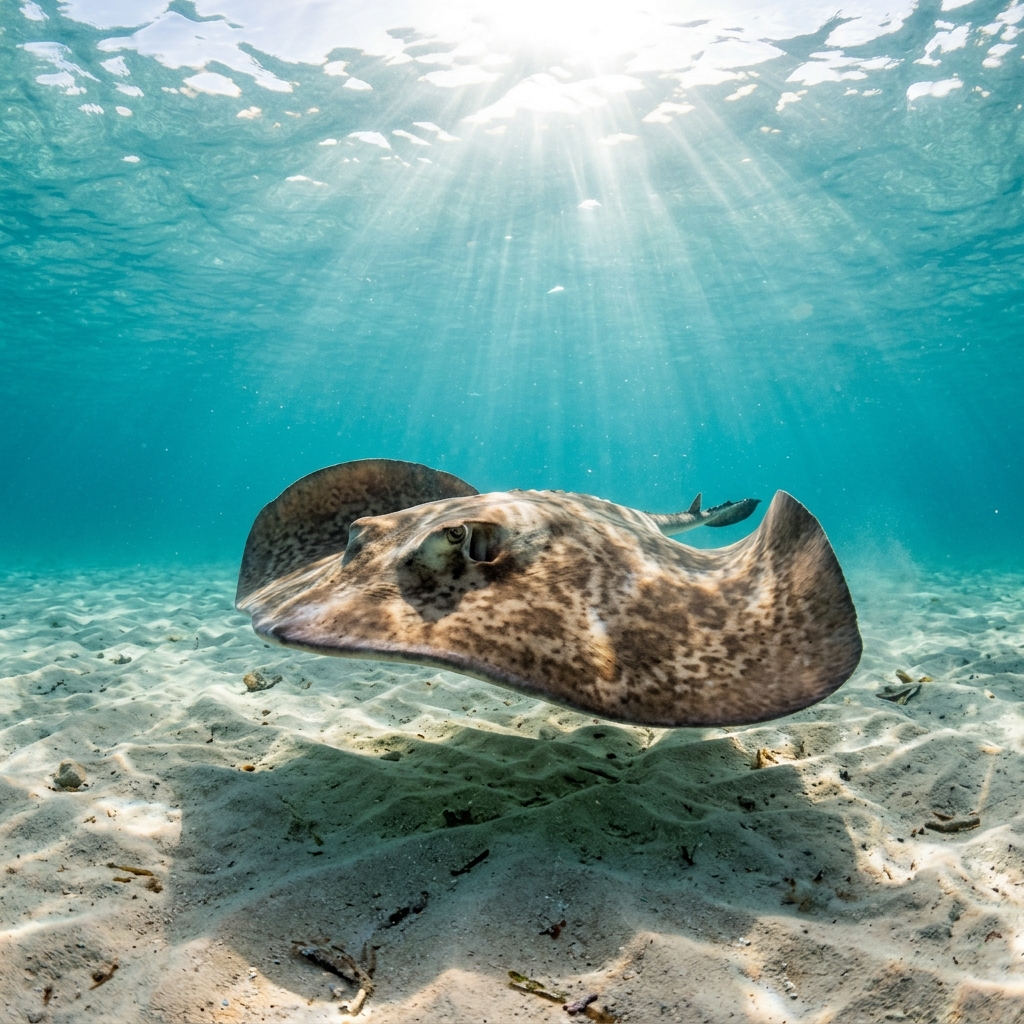
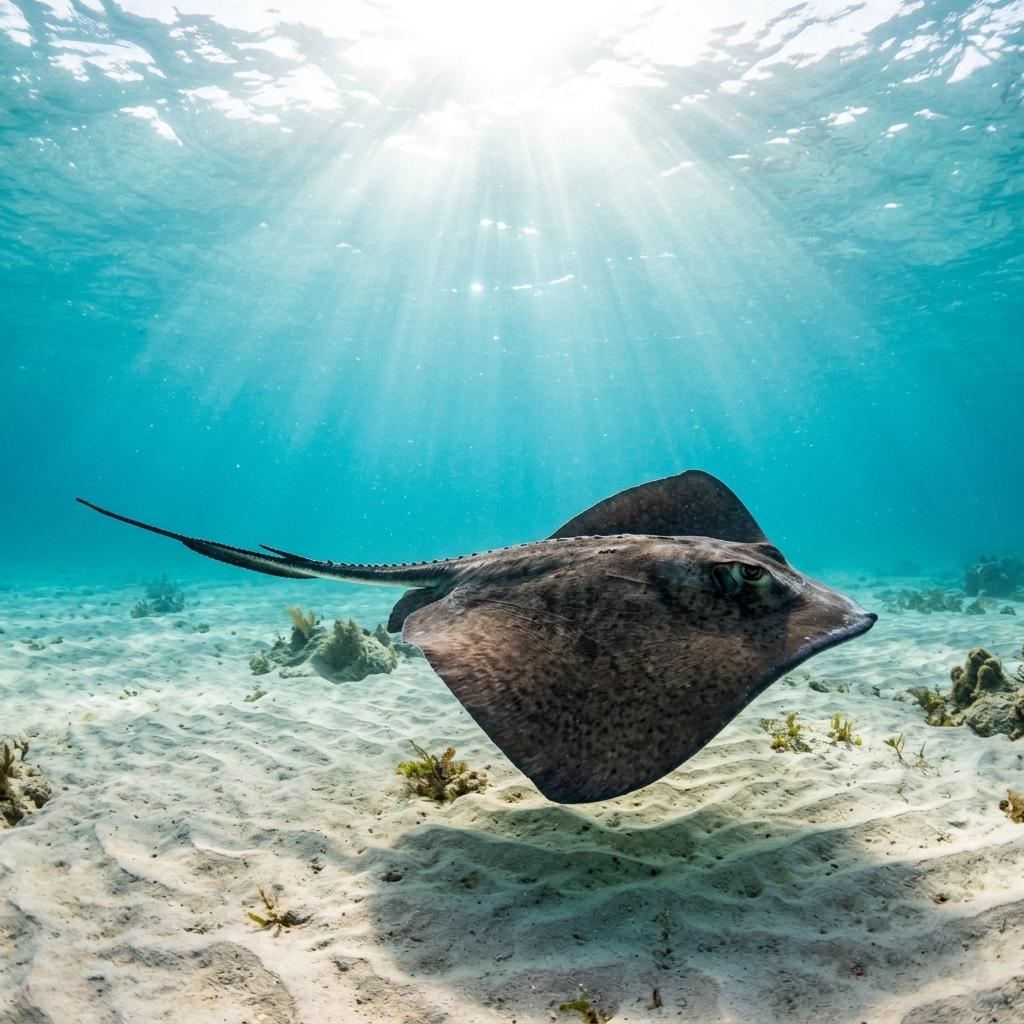
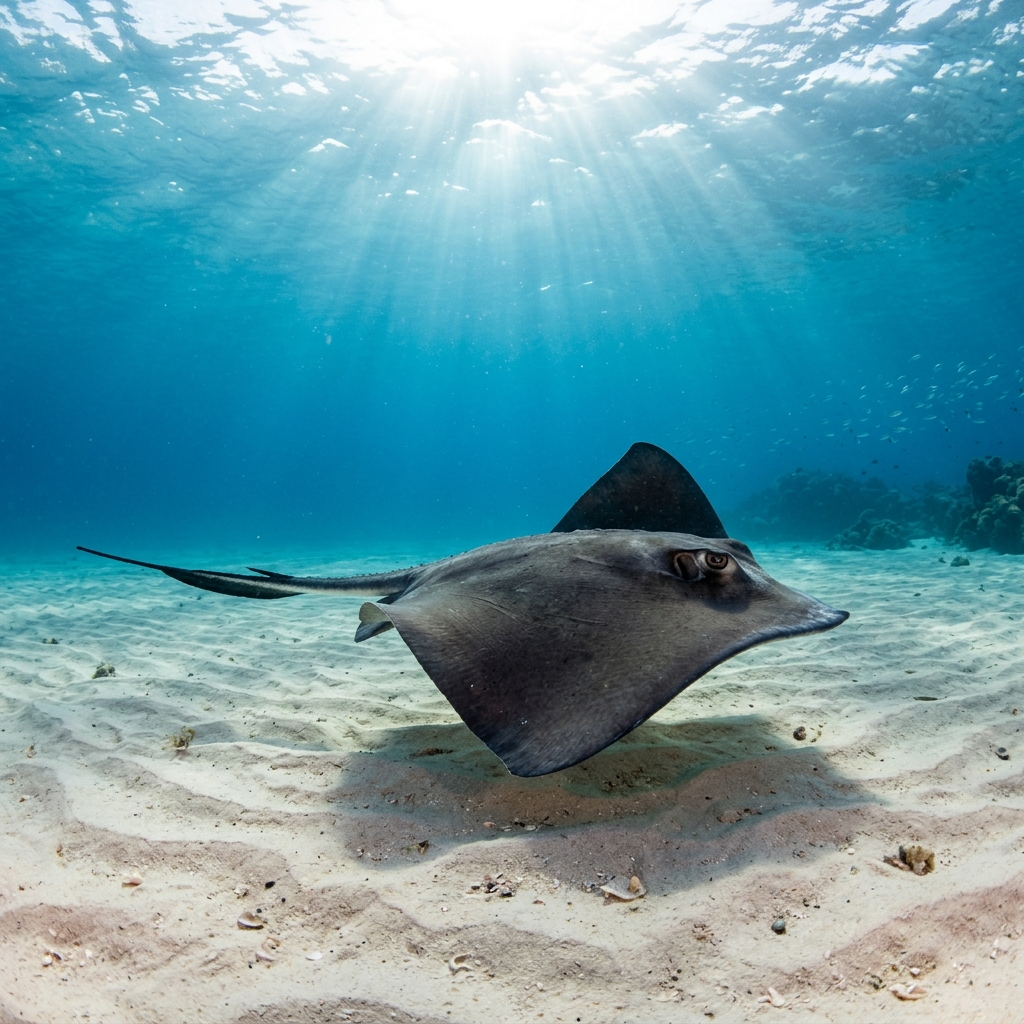
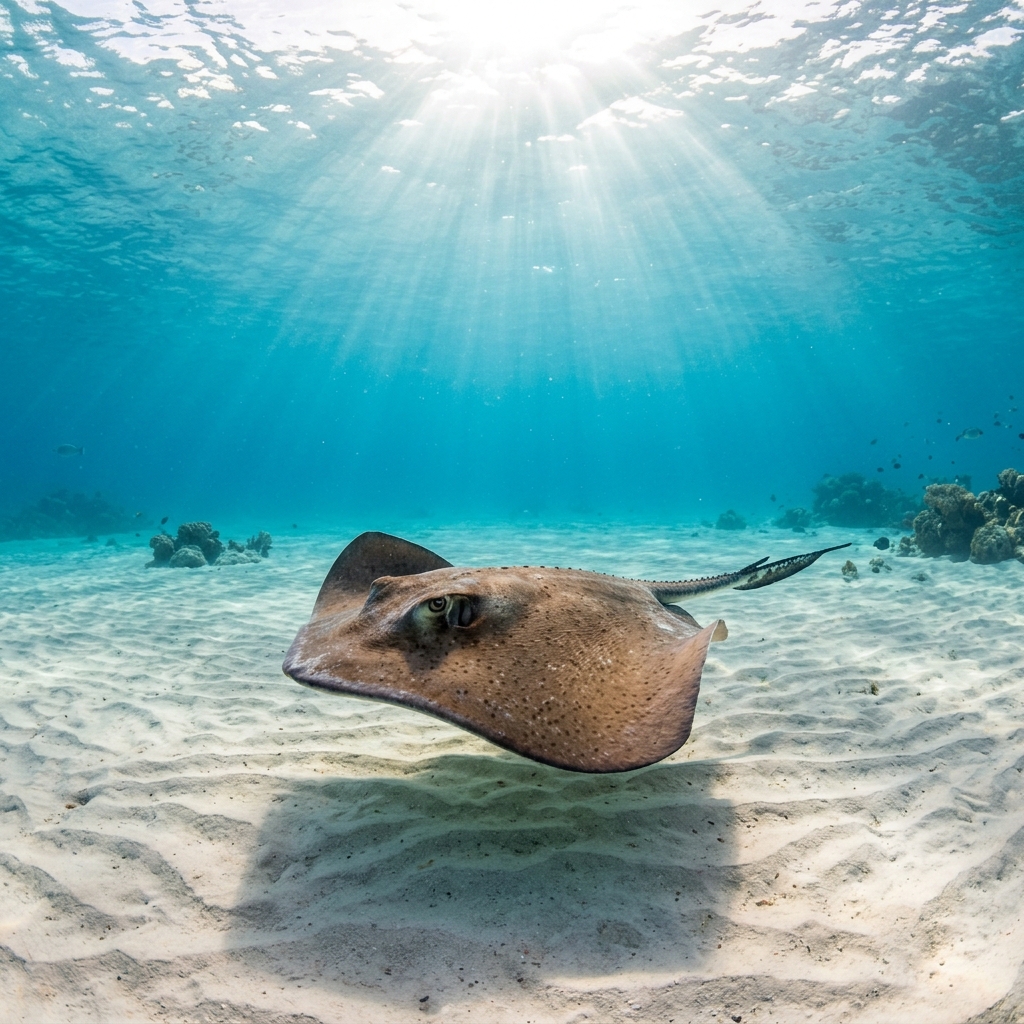
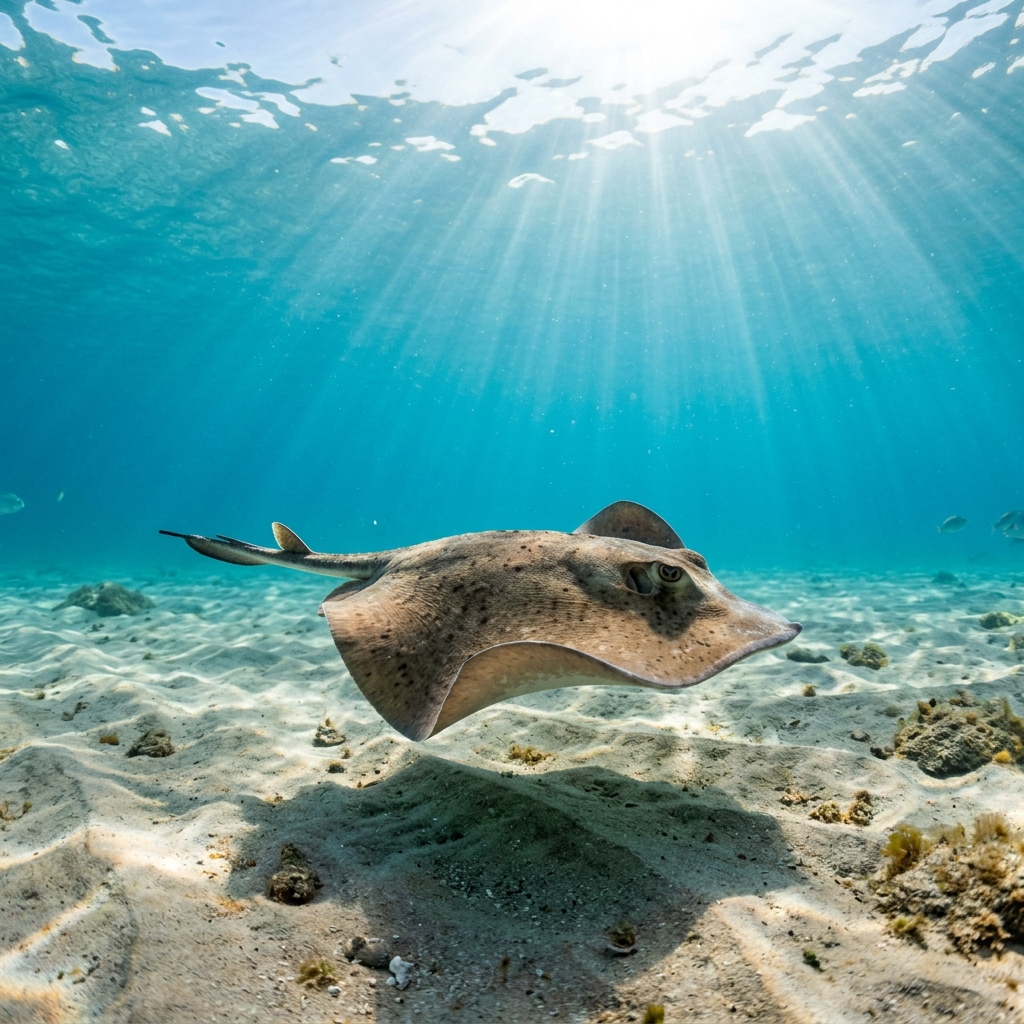
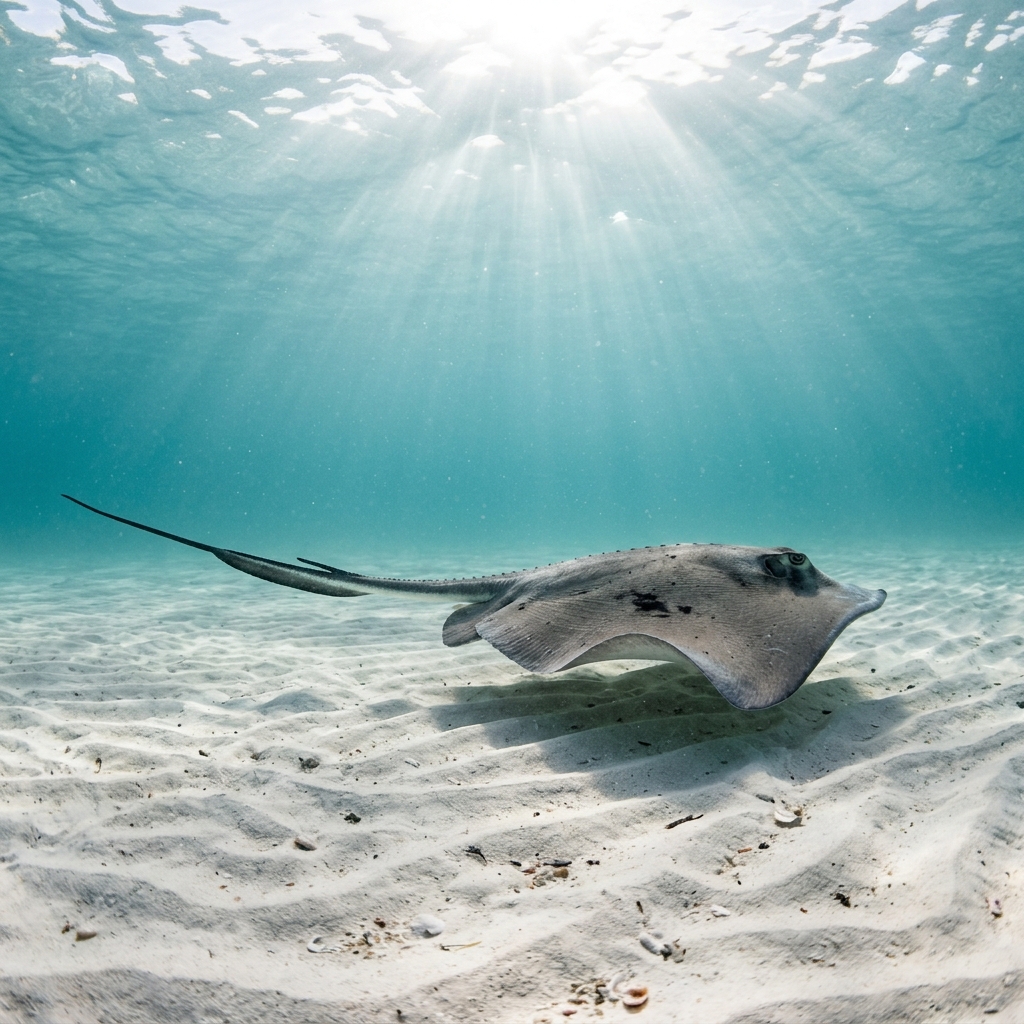
Look for a flattened, diamond-shaped disc with a dramatically long, whip-like tail that can extend well beyond the body length, that tail is the key field mark separating this group from most other rays. Dorsal colouration is typically grey to olive-brown or dark grey depending on species, with a pale underside. They are benthic (bottom-dwelling) rays, usually seen gliding low over sand or lying partially buried, which puts the disc shape and tail squarely in view. Disc width varies across the genus, but all species share the smooth, angular outline that gives the group its diamond silhouette.
Most encounters involve a ray cruising slowly over sand flats or resting half-buried at the bottom, with just the disc and the long trailing tail visible above the substrate. They generally ignore divers who approach calmly, continuing to forage by fanning the sand with their disc to expose buried invertebrates. Give them space to move freely and they will often pass within a few metres without altering course.
Several members of this genus, particularly the Southern Stingray in the Cayman Islands, have become so accustomed to regular diver presence at specific sandy sites that they actively approach divers, a behaviour driven historically by feeding, though many operators now discourage feeding to preserve natural foraging patterns.
Whiptail stingrays are present year-round at their established sites, which aligns with their tolerance for tropical and subtropical temperatures ranging from roughly 19 to 29 °C, conditions that persist on Caribbean and Galápagos reefs in every season.
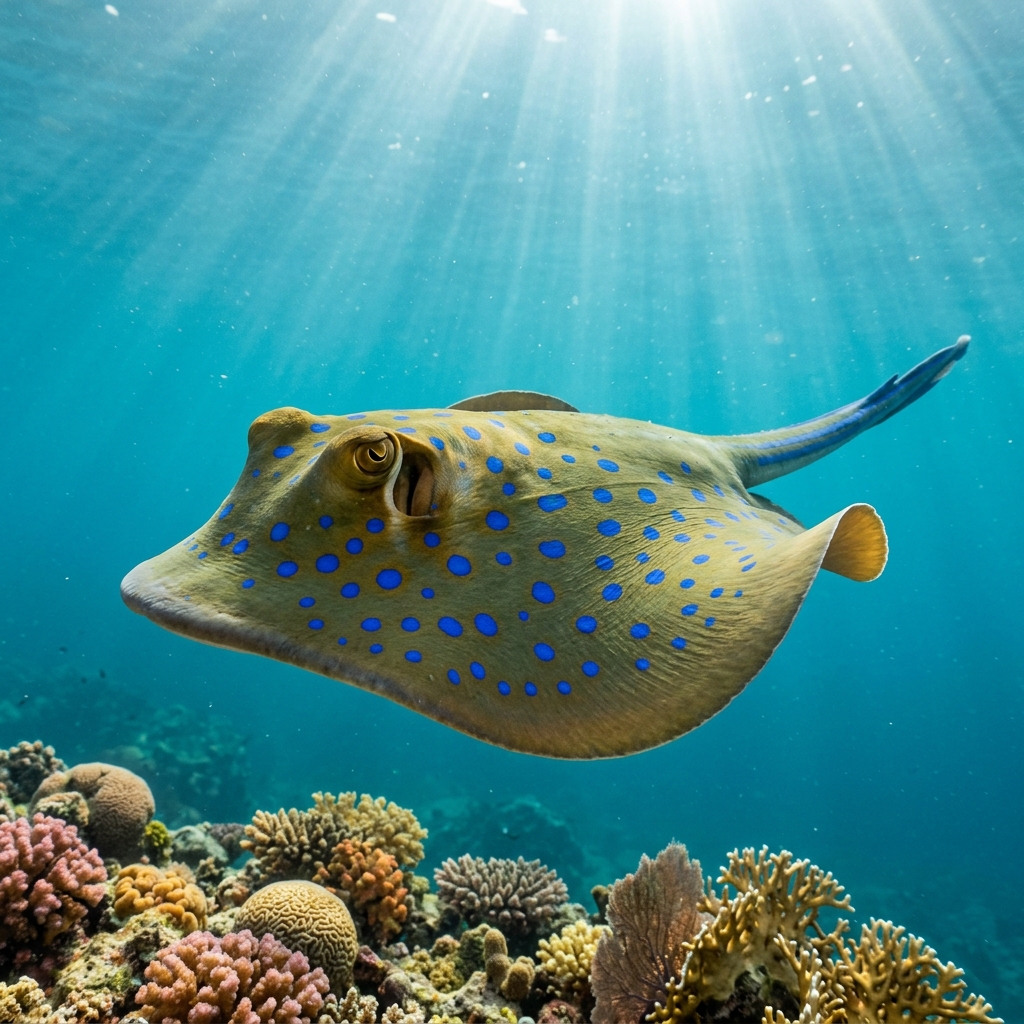
Reef neighbours a diver could mistake it for. Use the identification notes above to tell them apart.
Whiptail stingrays are most consistently logged across the Caribbean and western Atlantic, with the Yucatán Peninsula and Florida leading sighting records, followed closely by Grand Cayman and Roatán, Honduras. Strong populations are also reported at Grenada Island, the British Virgin Islands, and San Andrés and Providencia in Colombia. Outside the Atlantic, the Galápagos Islands in Ecuador stand out as a key Pacific location for the genus.
Mapping where Whiptail Stingray is logged…
The Caribbean is the most reliable region, with the Yucatán Peninsula, Grand Cayman, Roatán, and Grenada Island producing frequent sightings. Florida and the US Virgin Islands are strong Atlantic options. The Galápagos Islands are the standout Pacific location for the genus.
They are present year-round across their range. Because the genus thrives in water between roughly 19 and 29 °C, Caribbean and Galápagos dive sites stay within that window in every season, so there is no single peak month to target.
Whiptail stingrays carry a venomous spine at the base of their tail, but they use it only defensively if handled or stood on. Divers who stay calm, avoid grabbing or cornering them, and never stand on the seafloor where rays may be buried face very little risk. Give them a respectful distance and they will go about their business.
The defining feature is the tail, far longer relative to body size than on most other rays, tapering to a fine whip with a venomous spine near the base. The disc is distinctly diamond-shaped and smooth, usually grey-brown above and pale below. Butterfly rays have a similar disc but a very short tail, making the long tail the quickest split.
Disc width varies by species within the genus. The Southern Stingray, one of the largest and most commonly encountered members, can reach around 150 cm across the disc. Other species in the group are somewhat smaller, though all share the same proportionally elongated tail.
Site and sighting data is aggregated from diver logs, iNaturalist and GBIF. For taxonomy and conservation status:
Porcupine Ray
1,536 sites