Gymnuridae spp.
Broad-winged and fast, butterfly rays appear from Florida to the Philippines. Learn where divers spot them and how to tell them from other rays.
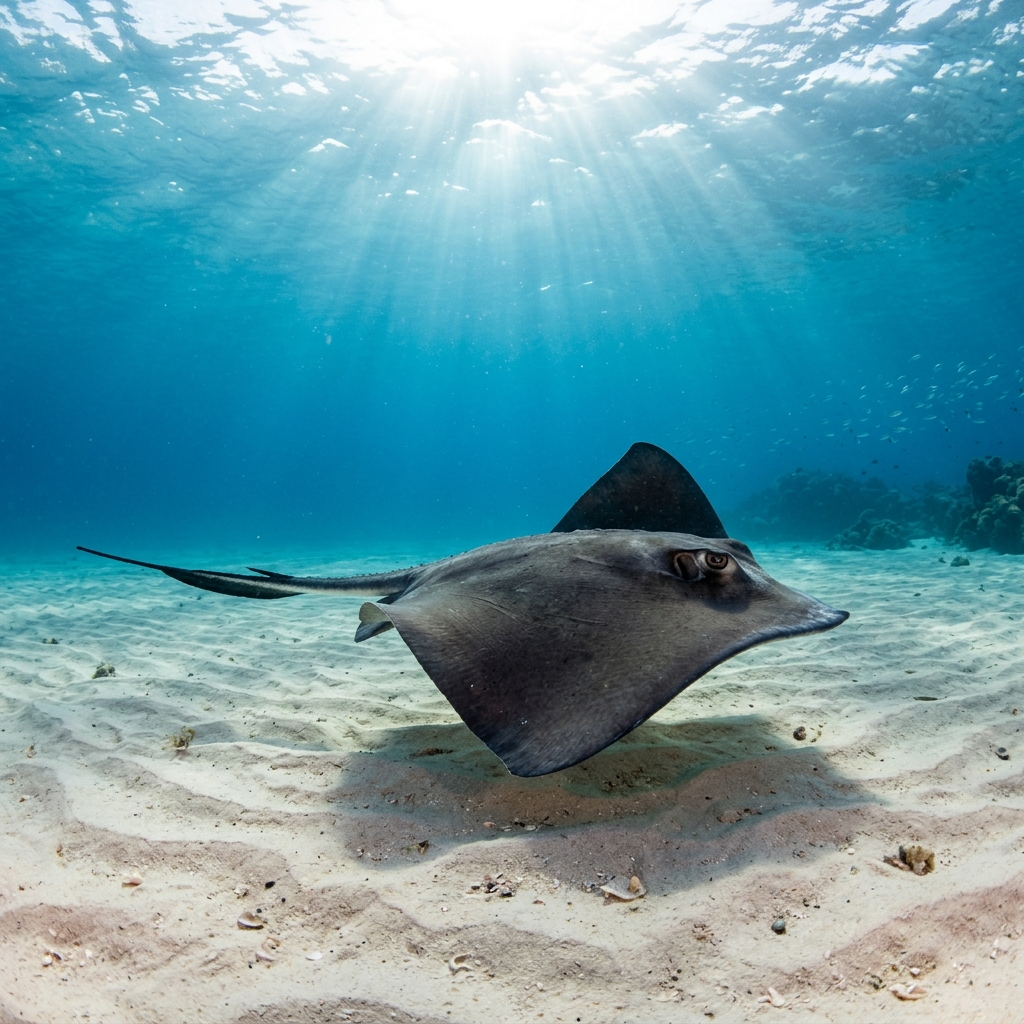
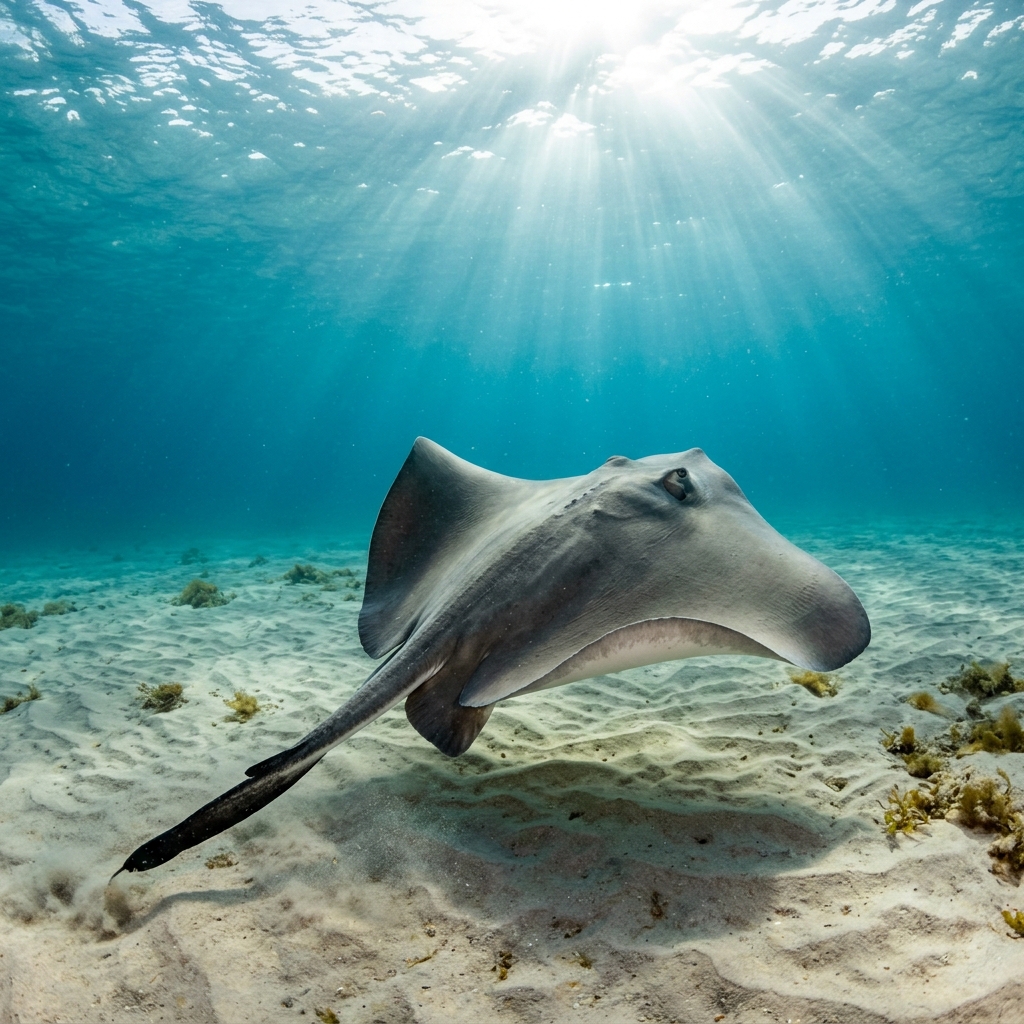
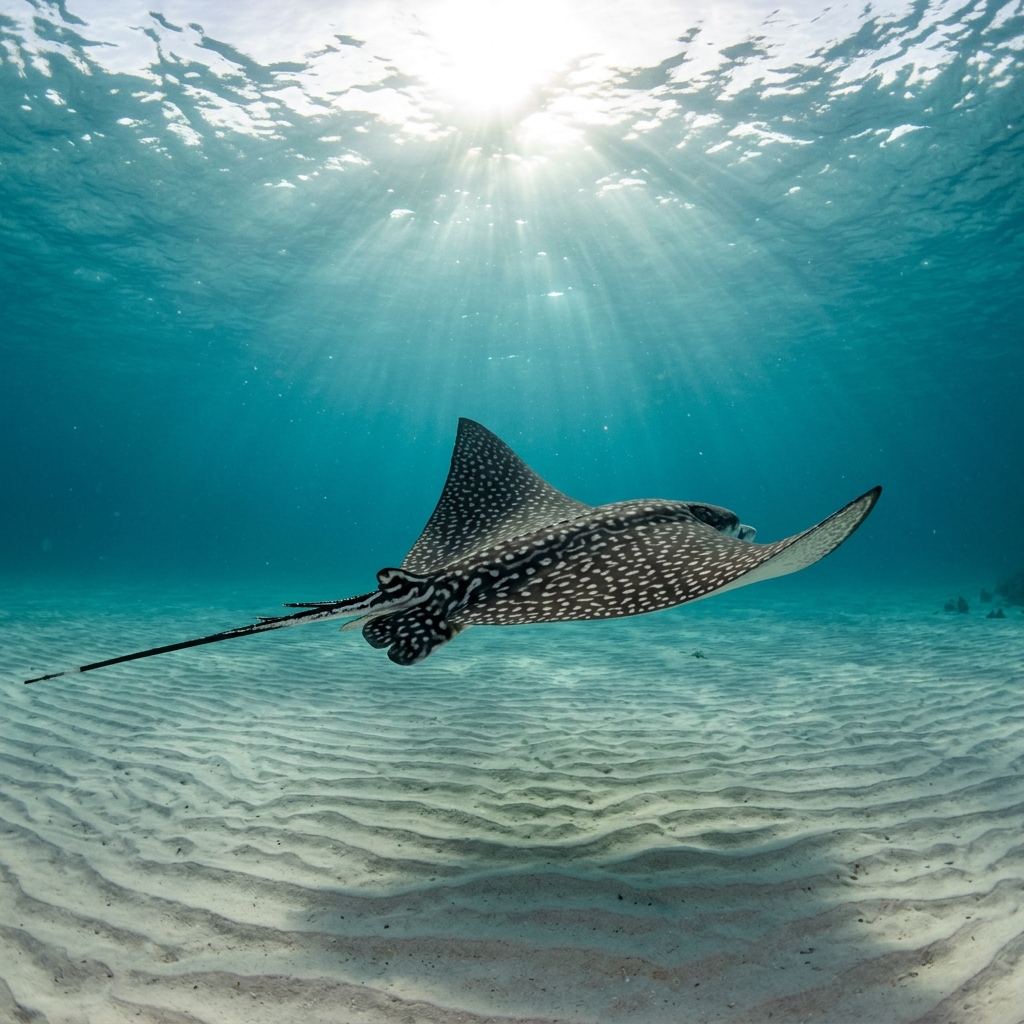
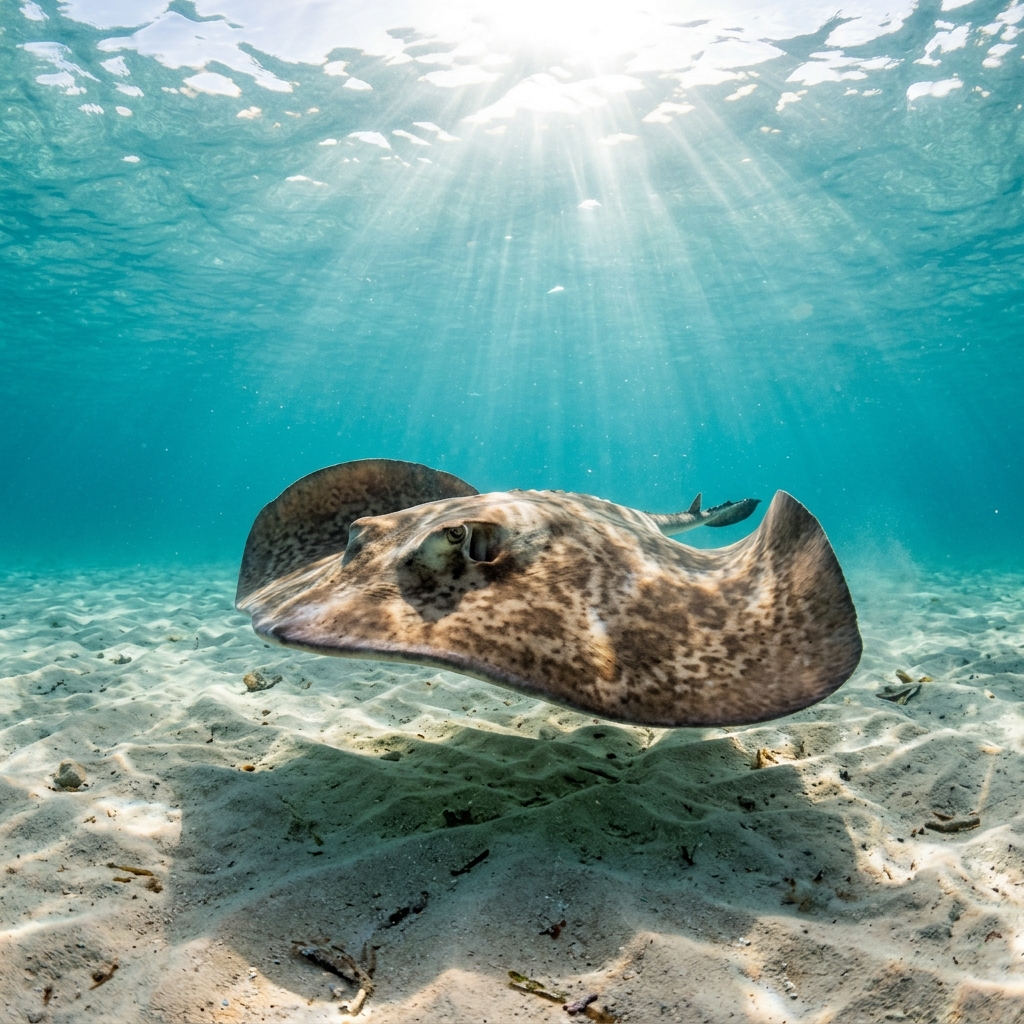
What sets butterfly rays apart from other rays is their extraordinarily wide, rhomboid disc, often much wider than it is long, giving them a shape closer to a kite than a typical stingray. The tail is short and slender compared to most stingrays, with little or no whip. Colouration varies across the family from greyish-brown to olive or spotted, often with a subtly mottled pattern across the dorsal surface that blends well against sand. In the water, that wide, flat silhouette and stubby tail are the cues to key on.
Butterfly rays are most often encountered resting or gliding just above sandy or muddy bottoms in coastal shallows, where they may partially bury themselves to ambush prey or avoid attention. When approached, they tend to flush quickly, making a fast low pass before disappearing, so sightings are often brief. They are not aggressive and present no meaningful threat to divers.
The family's defining adaptation is a disc width that can exceed twice the body length, a proportion unmatched among rays, which lets them plane efficiently across open sandy flats with minimal fin effort.
No clear seasonal peak has emerged from diver records, so butterfly rays are best treated as year-round targets across their range. Observed water temperatures run from roughly 16 to 29 degrees Celsius, suggesting they tolerate both warm tropical shallows and cooler temperate seas, which fits their global spread.
Reef neighbours a diver could mistake it for. Use the identification notes above to tell them apart.
Butterfly rays are logged across a wide band of tropical and warm-temperate seas, with the strongest representation from the United States, particularly Florida and the Southeast, through the Mediterranean, including Greece, Italy, Spain, and Turkey, and across the Indo-Pacific including the Philippines and Indonesia. Brazil's Rio de Janeiro and São Paulo coast and Queensland, Australia also feature regularly. Real observations are still relatively few, so encounters are spread thinly across a very large global range rather than concentrated at a handful of hotspots.
Mapping where Butterfly Ray is logged…
The best-represented areas in diver records are Florida and the broader southeastern United States, the Mediterranean coasts of Greece, Italy, Spain, and Turkey, and the Indo-Pacific including the Philippines and Indonesia. Brazil's southeast coast and Queensland, Australia also come up regularly. Despite this wide range, actual sightings are rare, so treat any encounter as a bonus rather than a given.
No strong seasonal pattern has been detected in diver records, so they are considered year-round targets across their range. Observed water temperatures span roughly 16 to 29 degrees Celsius, showing they are comfortable in both tropical and cool temperate conditions.
Look for the unusually wide, kite-shaped disc that is much broader than it is long, combined with a short, thin tail. That wide-to-long ratio is the key field mark and immediately separates butterfly rays from stingrays, which have a narrower disc and a much longer tail.
No. Butterfly rays are not considered dangerous. Some species carry a small tail spine, but they are not aggressive and will typically flee before a diver gets close. Give them space and avoid cornering them on the bottom, and there is no meaningful risk.
Disc width varies across the family, with larger species reaching over 2 metres across. What is consistent is that the disc is far wider than it is long, so even a modestly sized individual looks impressively broad in the water.
Site and sighting data is aggregated from diver logs, iNaturalist and GBIF. For taxonomy and conservation status:

Fiddler Ray
342 sites