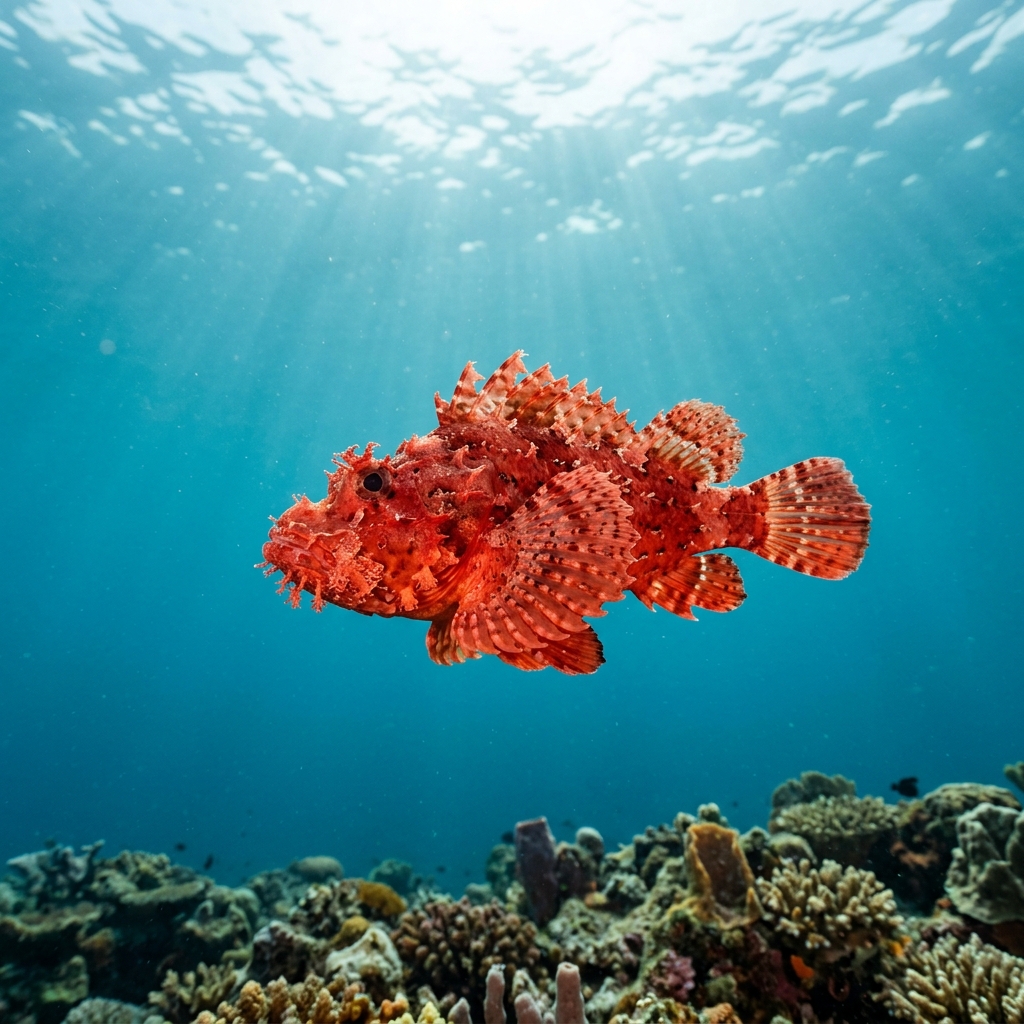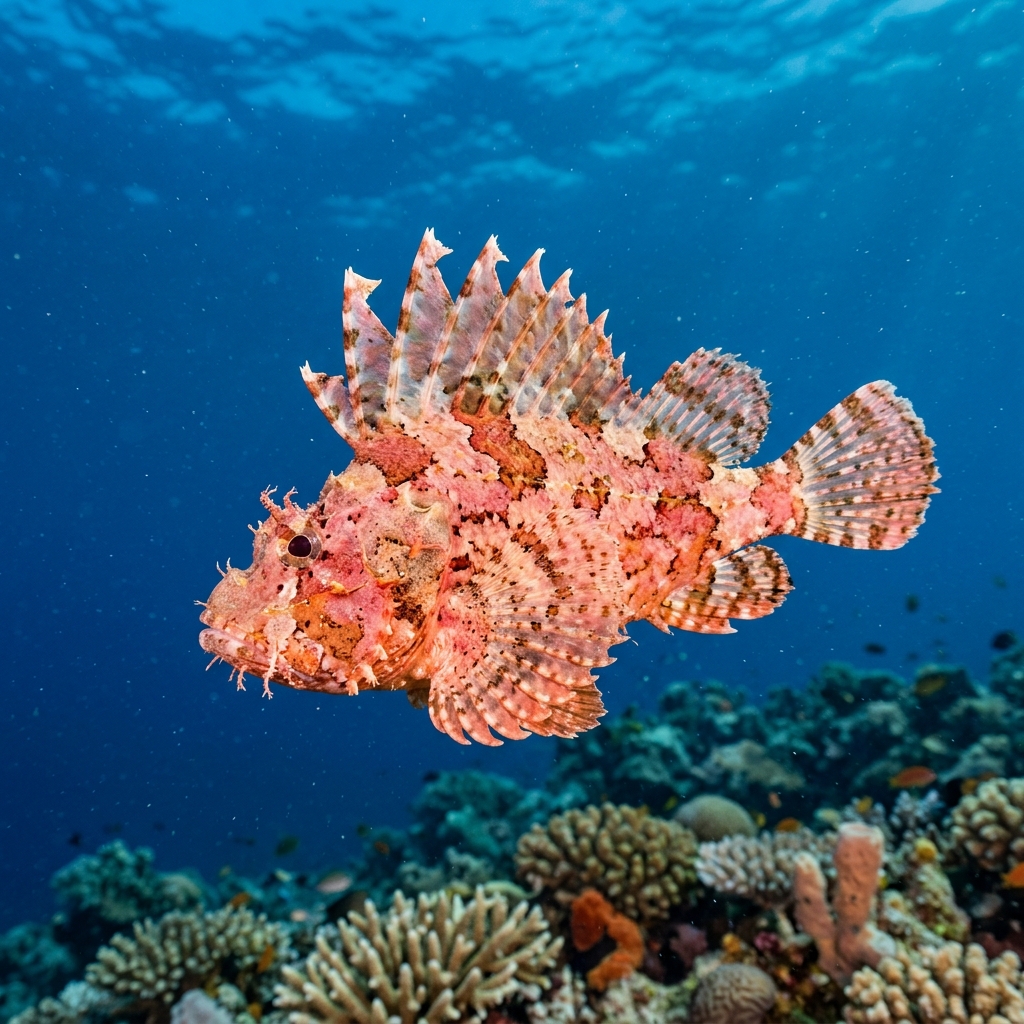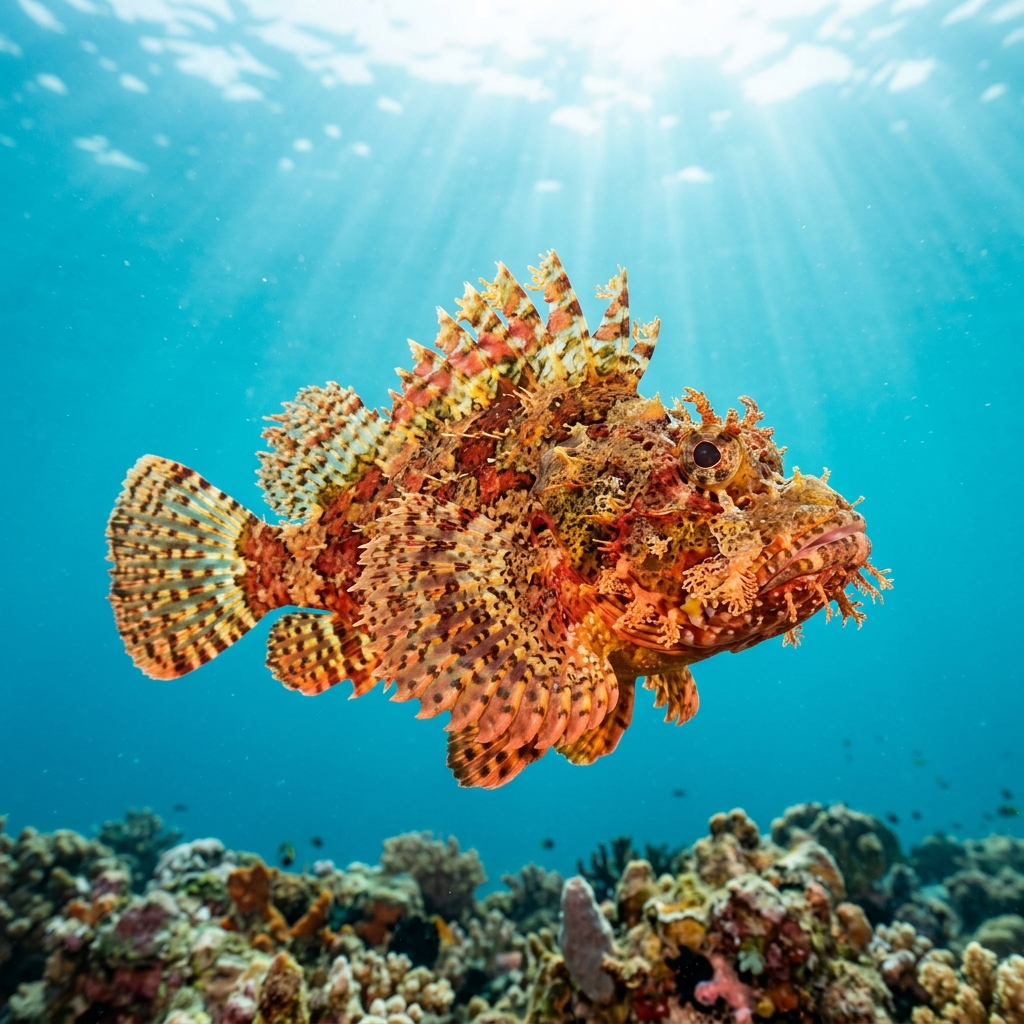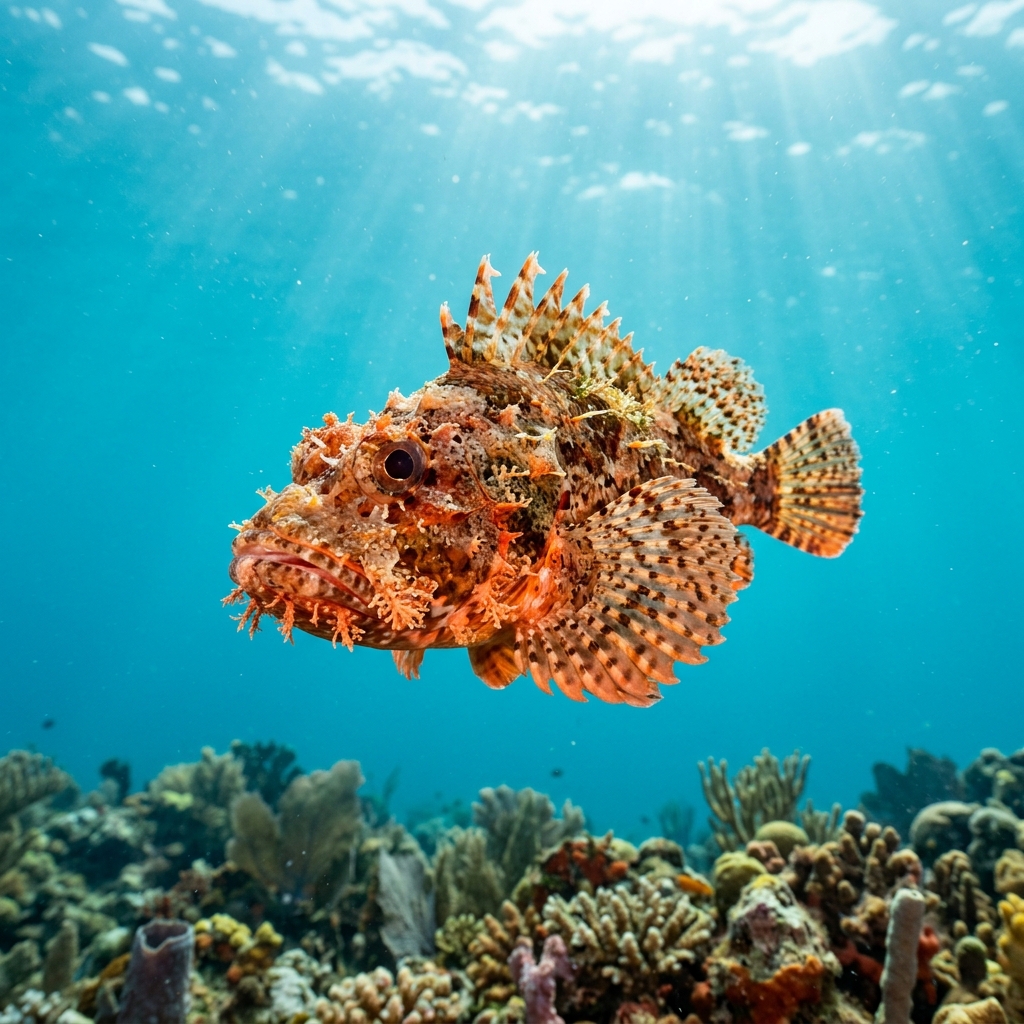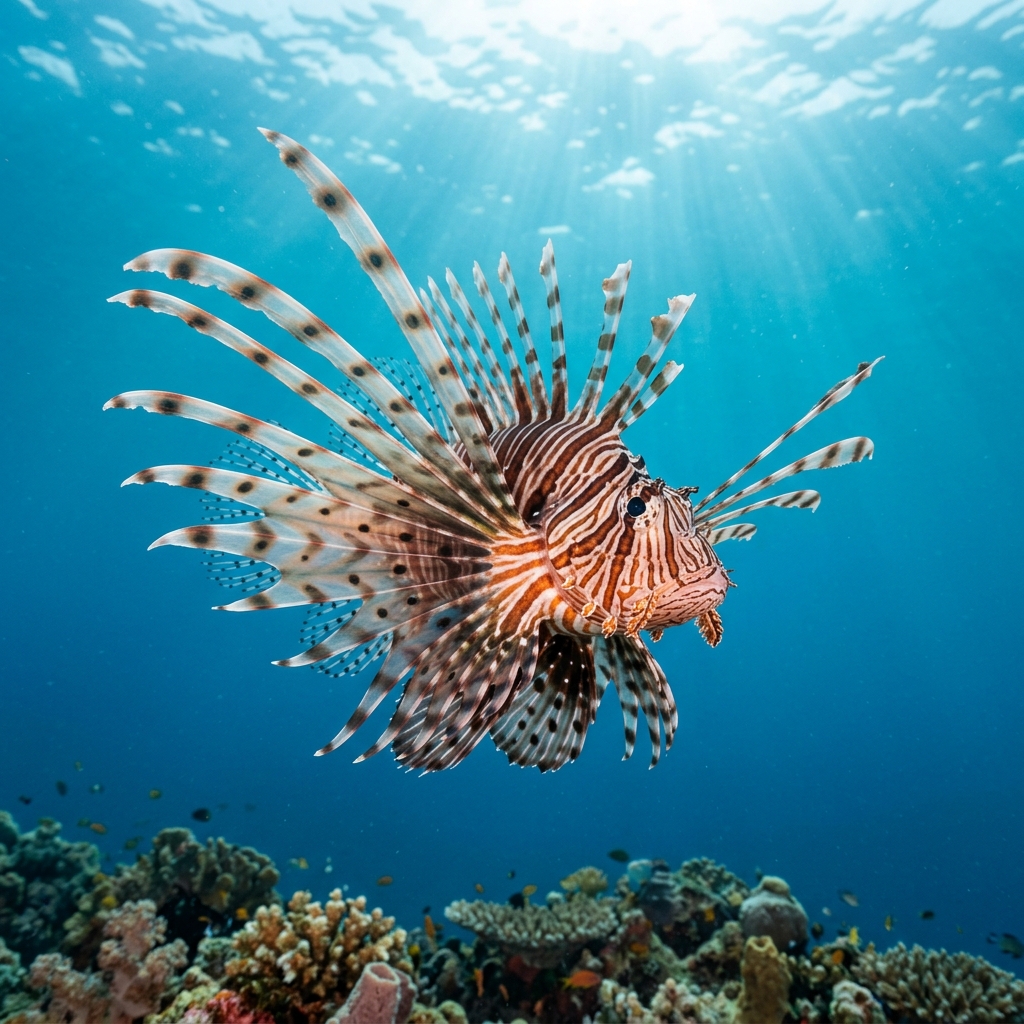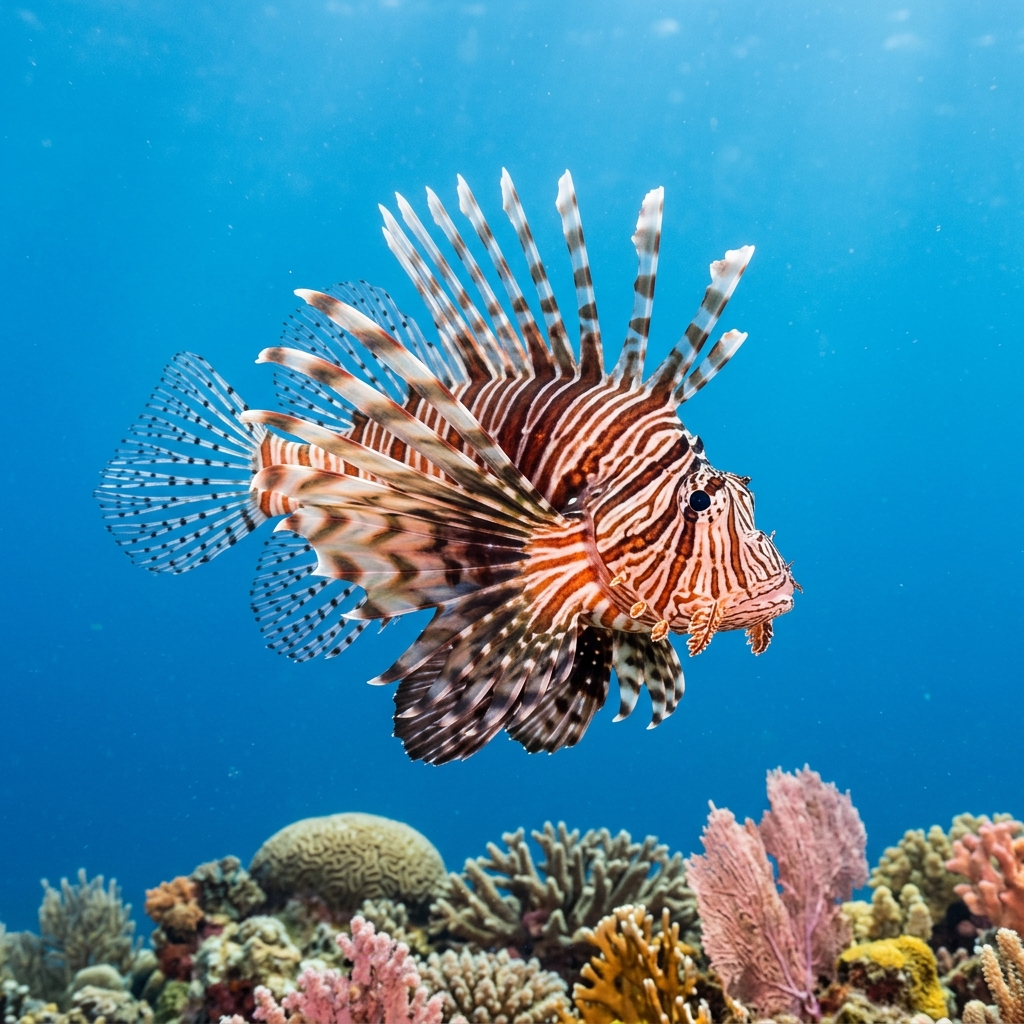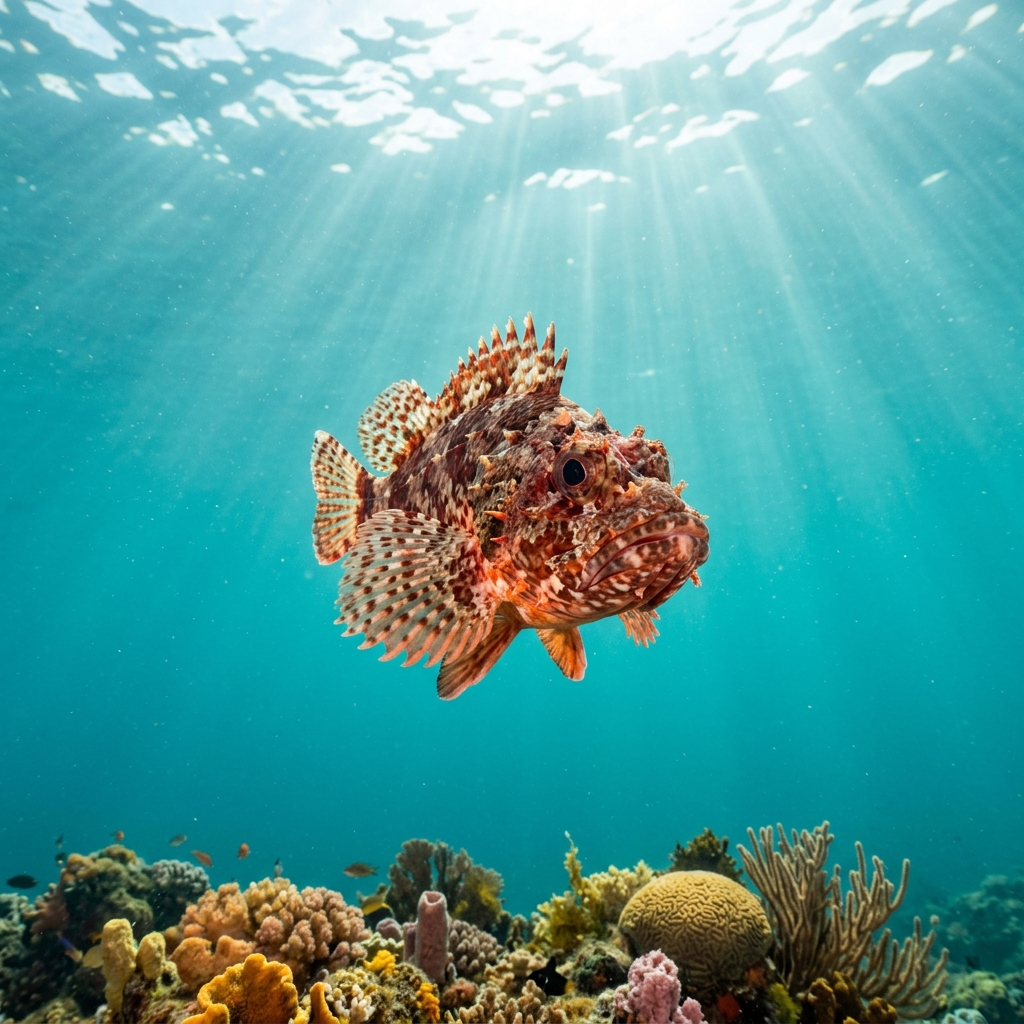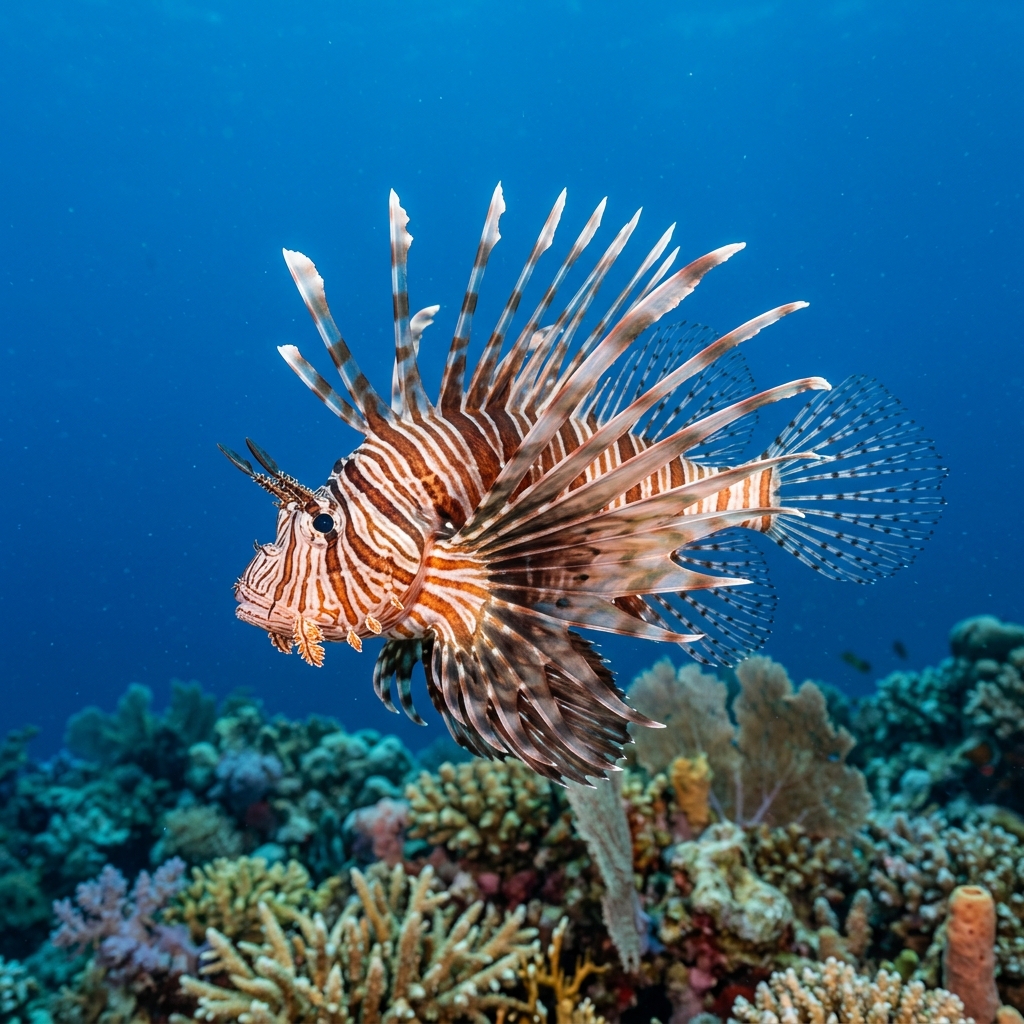
Pteroidichthys amboinensis
Spot the Ambon Scorpionfish in Sulawesi and the Philippine Visayas. Rare to uncommon, warm-water, and a serious ID challenge. Here's how to find it.
Safety warning
The spines carry venom and snap off easily in the skin. Do not touch it, and never rest a hand or knee on the reef near one; the spines drive in on the lightest contact.
If you're stung
Venomous spinesGeneral first-aid guidance, not a substitute for professional medical care. In an emergency, call your local emergency number.
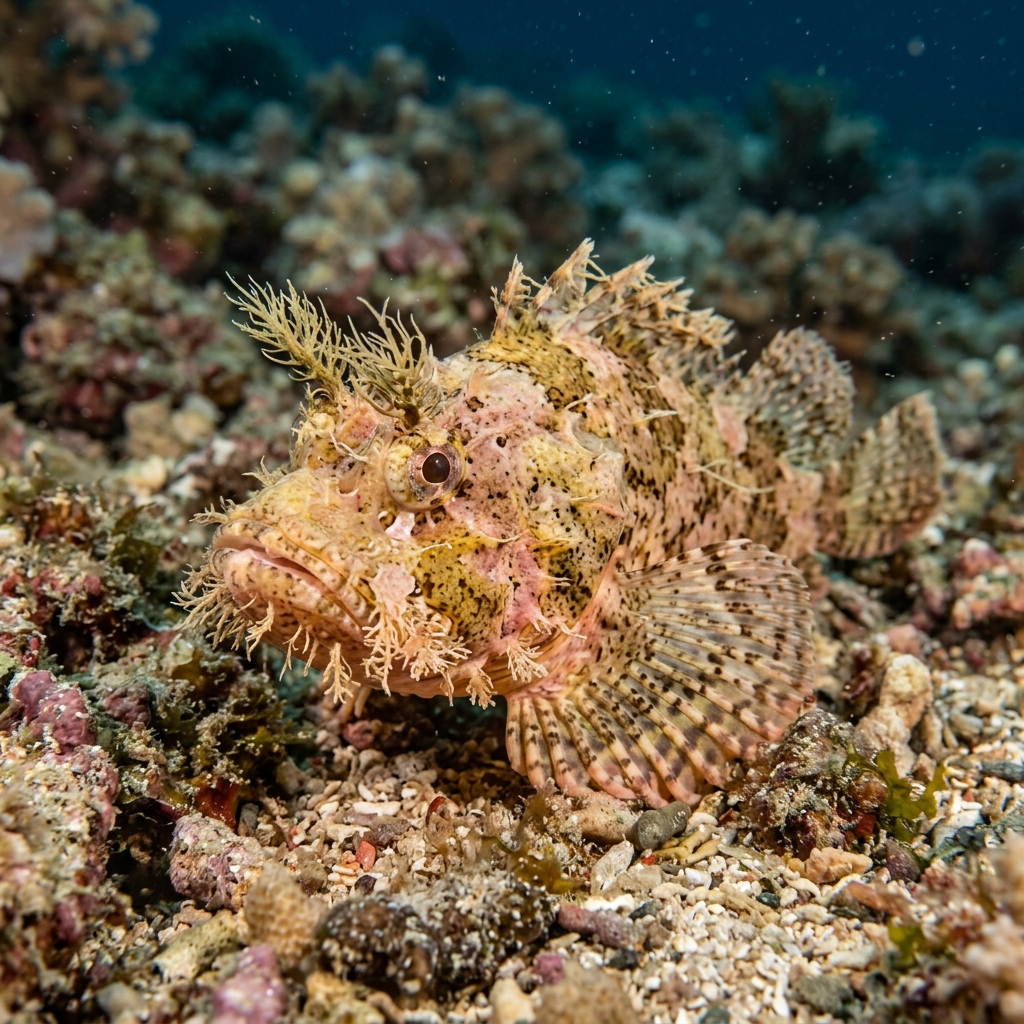
Arguably one of the most heavily fringed scorpionfish in the family, this species is covered in elaborate skin flaps and cirri (fleshy filaments) that break up its outline completely against rubble, algae, or sponge. Colour is highly variable, running through browns, creams, and ochres, often with a mottled pattern that shifts to match the substrate. The eye has a distinctive fringe above it, and the head profile is steep and lumpy rather than streamlined. Slow, careful scanning of sandy rubble patches is the only reliable way to pick it out.
Like most scorpionfish, it rests motionless on the substrate for long periods, relying entirely on camouflage rather than flight when a diver approaches. You are most likely to find it sitting on rubble, coarse sand, or algae-covered rock in relatively shallow water. It may shift position very slowly or give a subtle twitch of the pectoral fin when it decides you are too close, which is often the moment divers first realise something is there.
The elaborate skin fringes are not just camouflage decoration; they can be rippled and repositioned, allowing the fish to fine-tune its outline to blend with whatever it has settled on, from coarse algae to feathery hydroids.
Seasonality data for northern hemisphere sites points to March through June as the period when sightings concentrate. Water temperatures at observed sites run 27 to 29 °C, so the species sits firmly in warm tropical conditions year-round; the March-June signal likely reflects dive-season pressure in the Philippines and Sulawesi as much as any animal behaviour.
Reef neighbours a diver could mistake it for. Use the identification notes above to tell them apart.
Most sightings come from Indonesia, overwhelmingly in Sulawesi, which accounts for the large majority of logged sites. The Philippine Visayas, particularly Central Visayas, is the other reliable region, with additional records from Luzon and Western Visayas. A smaller number of logs come from Bali, Lombok, and Java.
Mapping where Ambon Scorpionfish is logged…
Sulawesi in Indonesia is by far the most productive region, followed by Central Visayas in the Philippines. Smaller numbers of sightings come from Luzon, Western Visayas, and Bali. These are all classic muck-diving destinations where guides actively hunt cryptic species on sand and rubble slopes.
Sightings at northern hemisphere sites concentrate between March and June. Outside those months the species is still present in warm Coral Triangle waters, but your odds improve during the boreal spring when dive activity and reporting are at their peak in Sulawesi and the Visayas.
Look for the extraordinary density of skin fringes and cirri covering the whole body, including a prominent tuft above each eye. Colour varies but is usually mottled brown, cream, or ochre. It sits completely still on rubble or algae. The Weedy Scorpionfish and Eschmeyer's Scorpionfish are the most likely mix-ups, but neither has quite the same fringe density or steep head profile.
Precise size data is limited, but the species is a small scorpionfish, typically encountered at a size a diver could cover with one hand. Its compact body is easily overlooked against background rubble.
They are not considered dangerous to divers. Like other scorpionfish they carry venomous dorsal spines, but because this species relies on camouflage and stays still, the only real risk is accidentally touching one you did not see. Keep hands off the substrate and the risk is negligible.
At most sites where it has been recorded, divers log it as uncommon or rare, and it turns up far less often than common scorpionfish like the Stonefish or Leaf Scorpionfish. A sharp-eyed local guide in Sulawesi or the Visayas greatly improves your chances, as these fish are routinely missed even by experienced divers.
Site and sighting data is aggregated from diver logs, iNaturalist and GBIF. For taxonomy and conservation status:
Madeira Rockfish
2,773 sites