Aetobatus narinari
Spot white-dotted wings gliding over Maldivian reefs or Florida's coast. Where and when divers log spotted eagle rays worldwide.
Safety warning
The long tail carries one or more venomous spines at its base. A ray that feels cornered or is handled can whip its tail defensively, causing a serious puncture wound. Keep a respectful distance, never attempt to touch or ride the animal, and avoid positioning yourself directly behind it. The risk to an observant diver is low, but the injury when it does occur can be severe.
If you're stung
Venomous tail barbGeneral first-aid guidance, not a substitute for professional medical care. In an emergency, call your local emergency number.
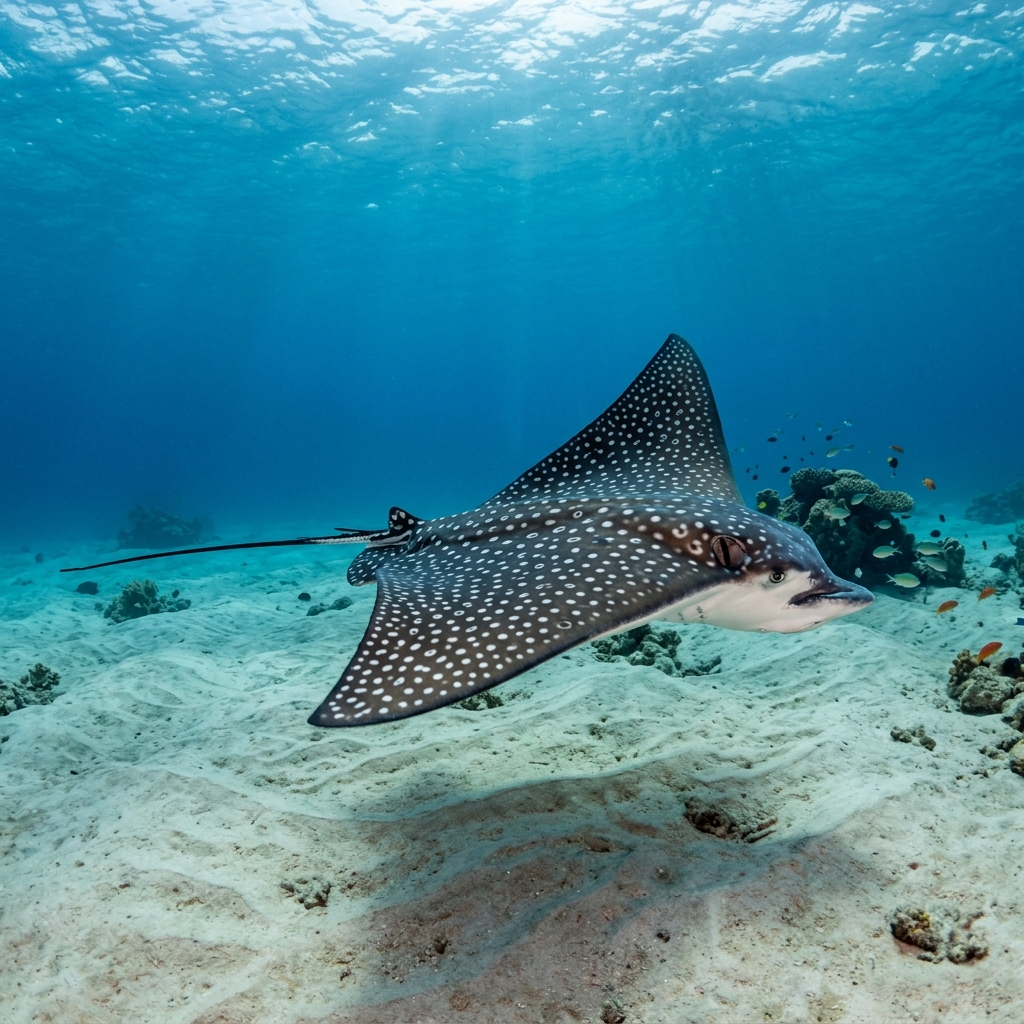
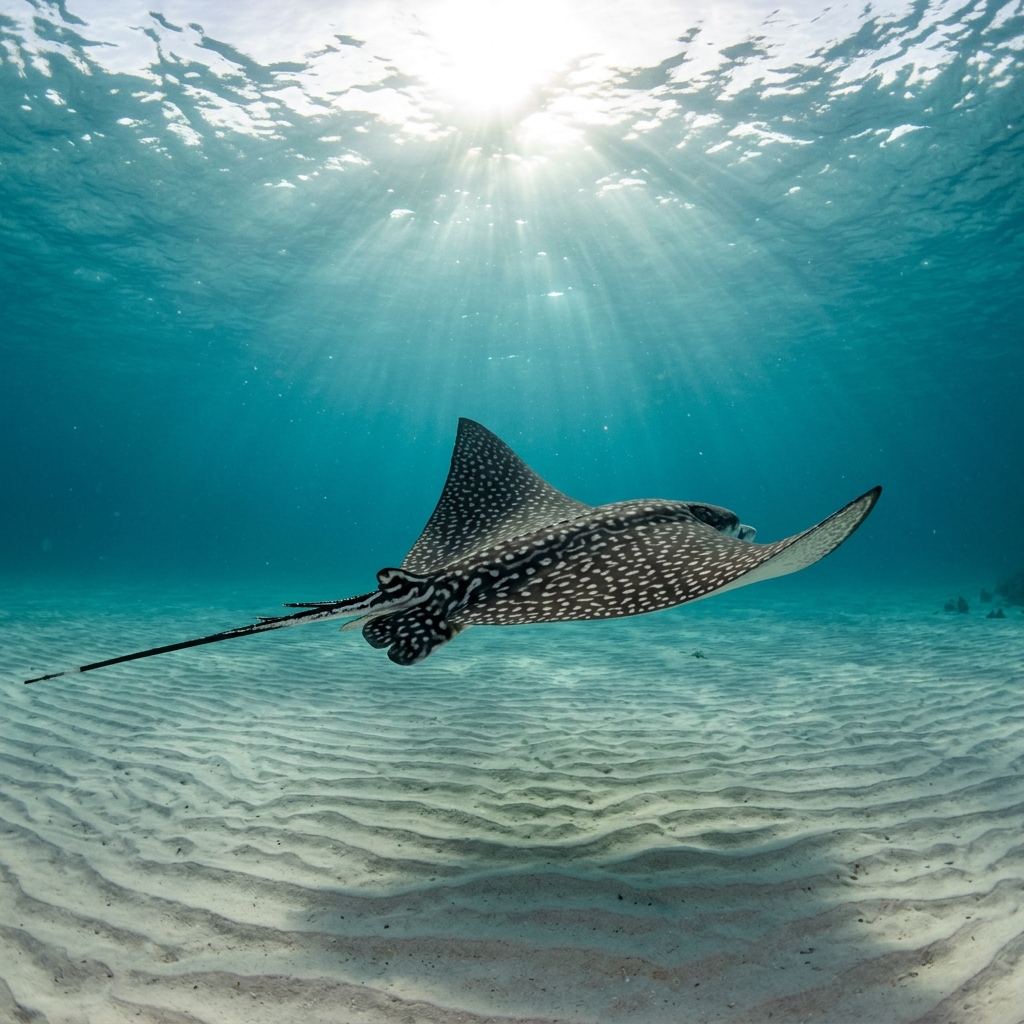
A large, flat-bodied ray with a distinctive dark blue-black or charcoal dorsal surface covered in white and pale yellow spots and rings, contrasting with a bright white underside. The long, whip-like tail, often two to three times the body length, and the sharply pointed, wing-like pectoral fins give it a silhouette unlike any other reef ray. In open water it appears to fly, flapping its wings in slow, powerful beats. Males can be identified by the paired claspers visible at the base of the tail.
Spotted eagle rays are typically seen cruising in mid-water, well above the reef or sandy bottom, often alone or in small loose groups. They use their distinctive duck-bill-shaped snout to excavate molluscs and crustaceans from soft sediment, sometimes leaving distinctive pits in sandy shallows. Around divers they are generally wary and will maintain distance, so slow, non-chasing observation from below tends to yield the longest encounters.
They are one of the few rays regularly observed leaping clear of the water, sometimes multiple times in quick succession. The purpose is debated, but it may help dislodge parasites or play a role in social signalling.
In the Northern Hemisphere, sightings concentrate from June through February, so late spring to winter covers the peak window. In the Southern Hemisphere, November through July is the stronger period, aligning with the warm-season months in places like Queensland and French Polynesia.
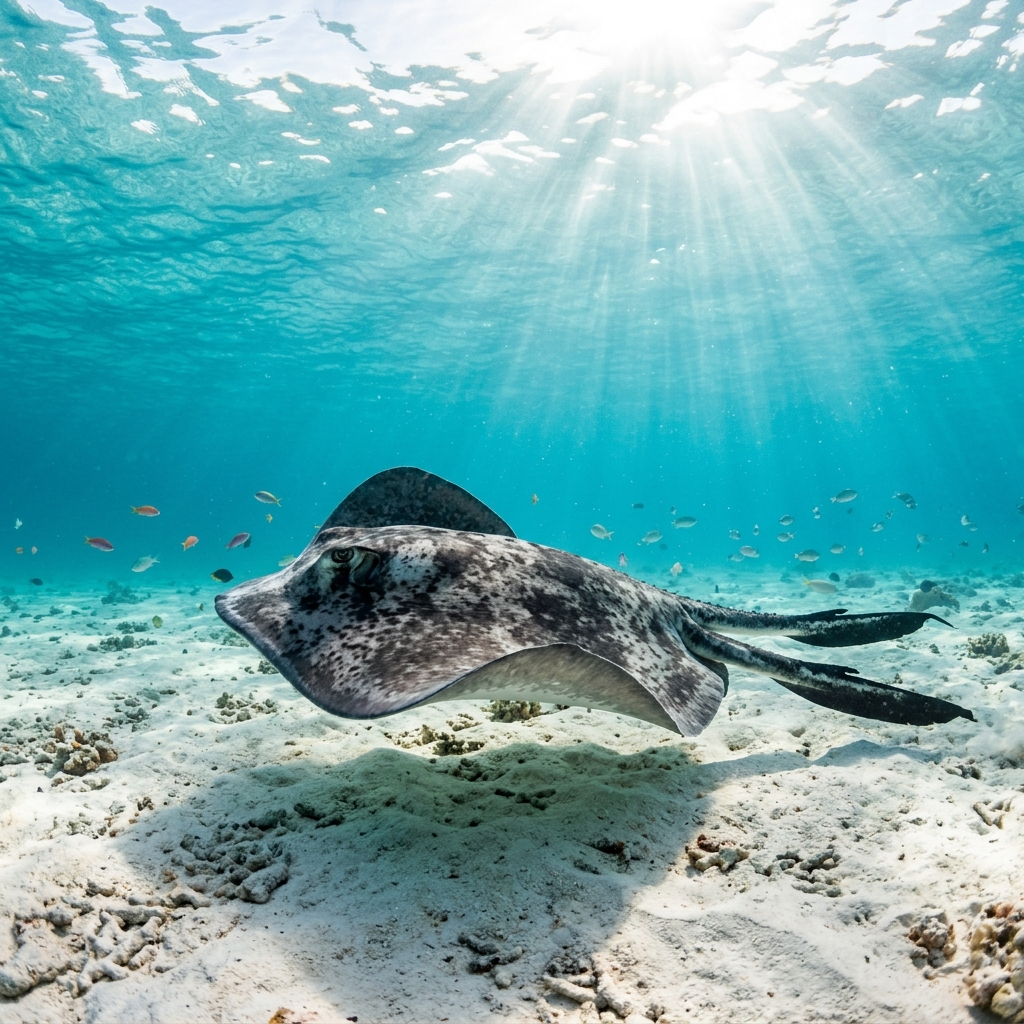
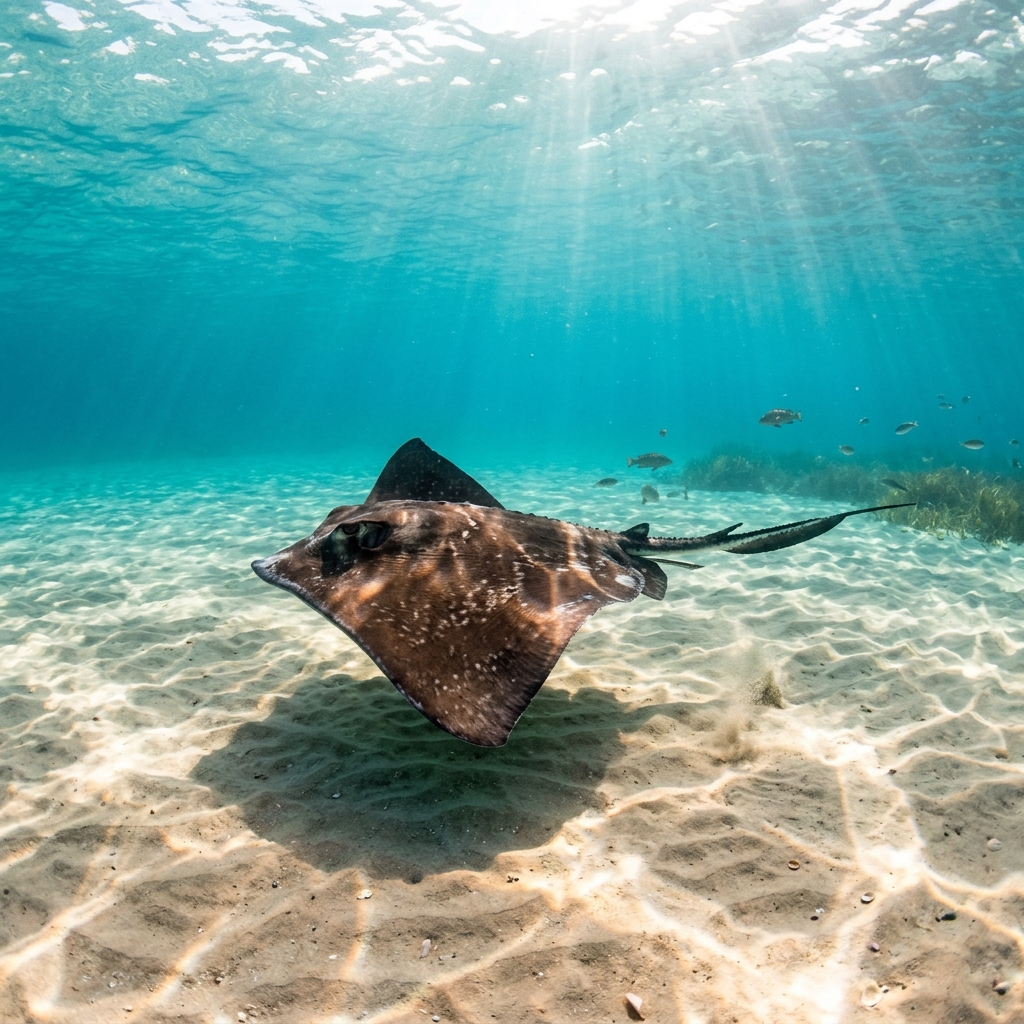
Reef neighbours a diver could mistake it for. Use the identification notes above to tell them apart.
Most commonly logged in the Maldives, where Male and Ari Atolls account for a large share of recorded sightings, making it the standout destination worldwide. Strong populations are also documented across Florida and the US Southeast, Praslin and La Digue in the Seychelles, Queensland in Australia, the Galapagos Islands, and Hawaii. The Philippines, French Polynesia, Indonesia, and Mexico round out the global spread of reliable locations.
Mapping where Spotted Eagle Ray is logged…
The Maldives, particularly Male and Ari Atolls, is the most commonly logged destination worldwide. Other strong areas include Florida and the US Southeast, Praslin and La Digue in the Seychelles, the Galapagos Islands, Queensland in Australia, Hawaii, and parts of the Philippines, French Polynesia, Indonesia, and Mexico.
In the Northern Hemisphere, June through February is the peak window. Southern Hemisphere divers in places like Queensland and French Polynesia do best from November through July. The species tolerates water temperatures from around 22 to 29 degrees Celsius, so it is present on tropical and subtropical reefs for much of the year.
Look for a large ray with a dark blue-black or charcoal back covered in white and pale yellow spots, a brilliant white underside, sharply pointed wing-like fins, and a very long whip tail. The characteristic flapping swimming motion and the distinctive duck-bill snout separate it from any flat-swimming stingray.
A typical adult has a disc width of around 160 centimetres across the wingspan, with the tail adding considerably more length. Large individuals can feel impressive in the water, often appearing bigger than expected as they cruise past.
They are not aggressive, but they do carry venomous spines at the base of the tail and can whip it defensively if threatened or cornered. The practical advice is to observe from a respectful distance, never chase the animal, and avoid hovering directly behind it.
Yes, they are currently listed as Endangered on the IUCN Red List. Bycatch, targeted fishing pressure in some regions, and coastal habitat loss are the main drivers of decline. Divers logging sightings and supporting no-touch dive operators contribute to monitoring and protection efforts.
The Spotted Eagle Ray is listed as endangered by the IUCN. Observe from a distance, avoid touching or feeding it, and report sightings to local marine research organisations.
Listed as Endangered on the IUCN Red List, the spotted eagle ray faces pressure from bycatch, targeted fishing in some regions, and habitat degradation. Divers can contribute by logging sightings on citizen-science platforms and choosing dive operators who enforce no-touch, no-chase policies around rays.
Site and sighting data is aggregated from diver logs, iNaturalist and GBIF. For taxonomy and conservation status: