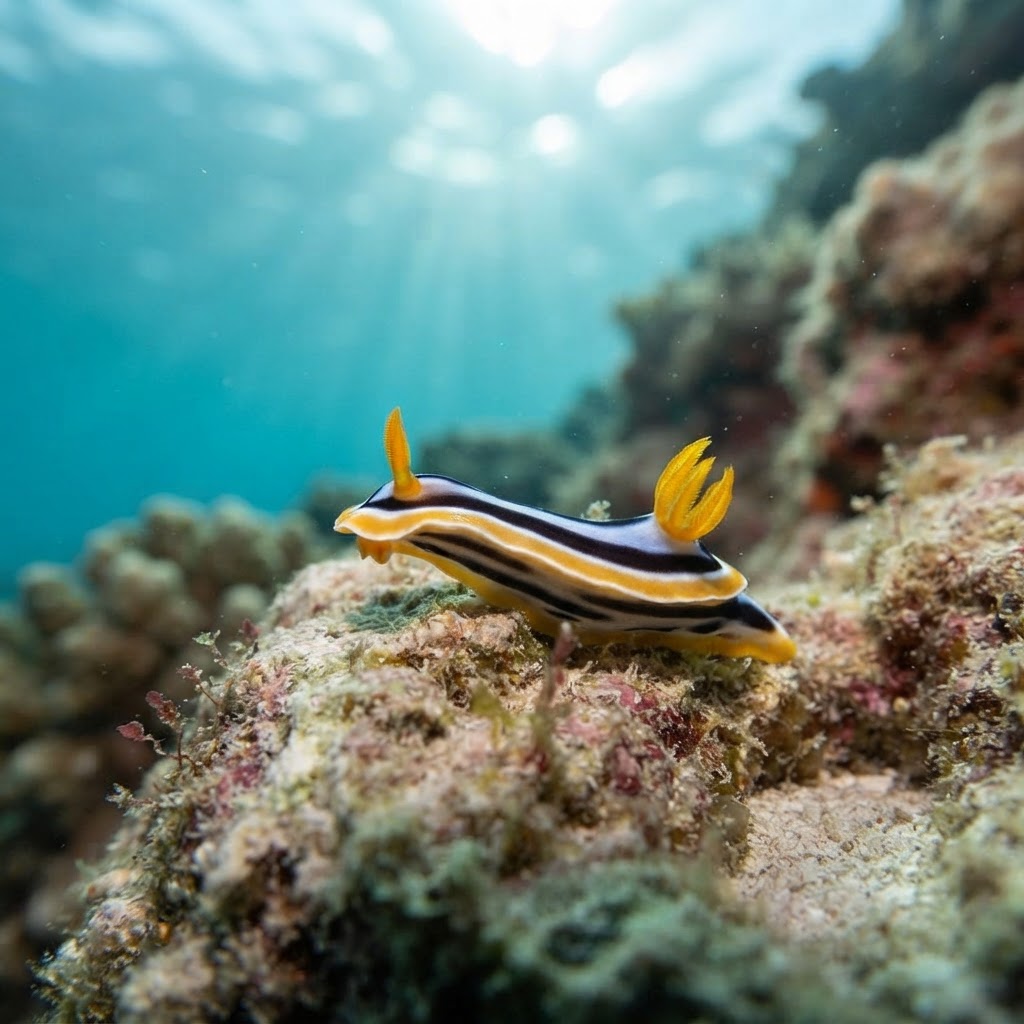
Chromodoris quadricolor
White, orange and black striped nudibranch found across South Sinai and the Egyptian Red Sea, year-round in 22 to 28C water.
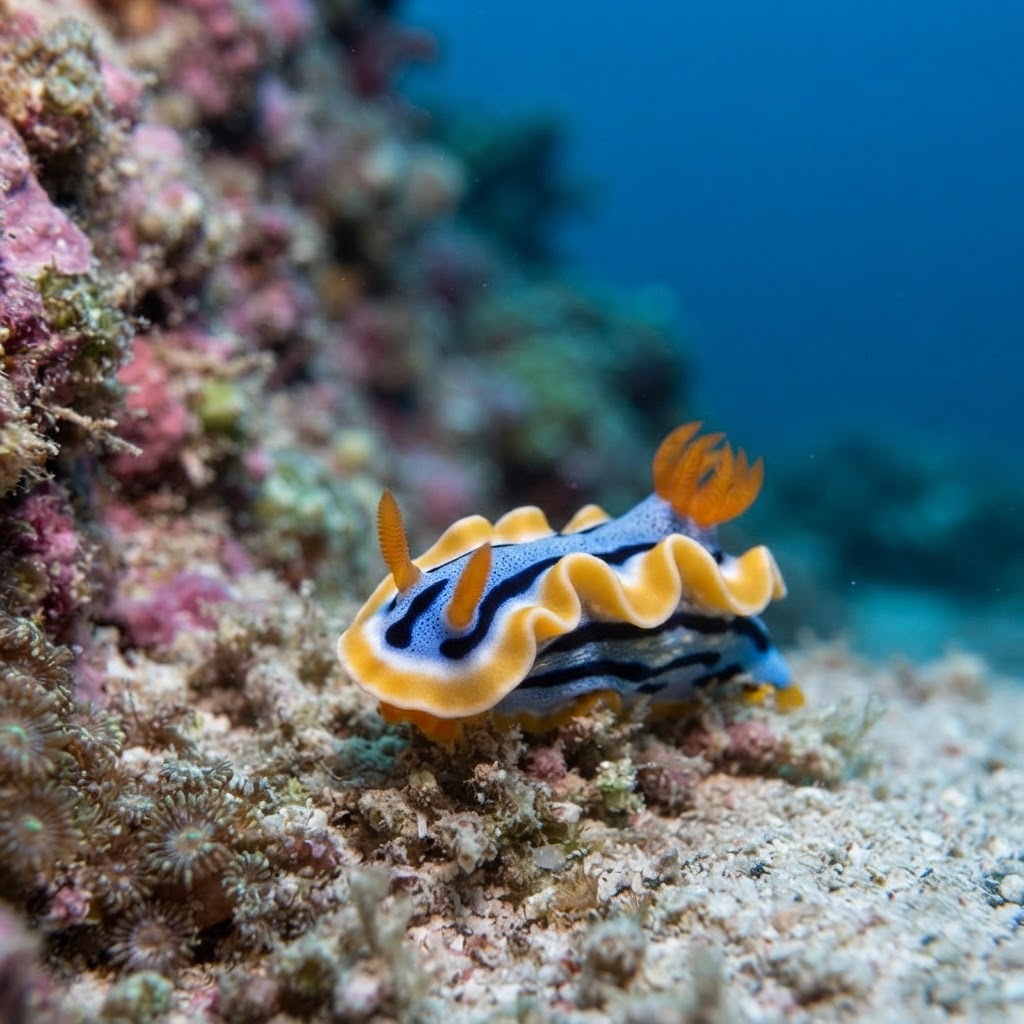
Cylindrical body about 2 cm long, patterned with black and white longitudinal stripes running the length of the mantle, edged by an orange-tipped border near the base. The rhinophores (paired sensory tentacles on the head) and gill tuft at the rear are typically tipped orange or black, matching the stripe pattern. It moves slowly across rubble and reef surfaces, low and close to the substrate, easy to miss unless you're scanning at close range.
Divers find it grazing slowly across rubble patches, reef walls and sandy gaps between coral, using its sense of smell to track down sponges to feed on. It pays no attention to divers and won't flee or hide, so a slow, close approach with a torch or macro lens is usually all it takes for a good look. Most sightings come from daytime reef dives rather than night dives, though it's active around the clock.
Its bright banding isn't for show: sea slugs in this family often incorporate toxic or foul-tasting compounds from the sponges they eat into their own tissue, and the bold stripes likely warn predators off before they take a bite.
No clear seasonal pattern in the sightings data, and with a comfortable range of roughly 22 to 28C across its Red Sea range, it's logged year-round rather than tied to a particular month.
Reef neighbours a diver could mistake it for. Use the identification notes above to tell them apart.
Most reliably found in Egypt's Red Sea, especially South Sinai, the Red Sea Riviera and Marsa Alam and the Deep South, where it turns up on the majority of logged dives targeting nudibranchs. It's also a solid find further along the Gulf of Aqaba in Jordan and Eilat, Israel, and along Saudi Arabia's Red Sea coast.
Mapping where Striped Pyjama Nudibranch is logged…
South Sinai and the wider Egyptian Red Sea are the strongest areas, with regular sightings also logged in Aqaba, Jordan, Eilat, Israel, and along Saudi Arabia's Red Sea coast.
There's no strong seasonal signal in the sightings, and water temperatures across its range stay in a comfortable 22 to 28C band, so it's found year-round on Red Sea reefs.
Look for a small, roughly 2 cm slug with bold black and white stripes running lengthwise along its body and an orange-edged margin near the base, crawling slowly over rubble or reef surfaces.
They're small, typically around 2 cm long, so divers usually need to look closely at rubble and reef substrate to spot one.
No, they pose no threat to divers. They have no means of stinging or biting and simply graze slowly across the reef regardless of who's watching.
It feeds on sponges and is thought to store some of the sponge's chemical defences in its own tissue, which may explain its bold warning-style stripes.
Site and sighting data is aggregated from diver logs, iNaturalist and GBIF. For taxonomy and conservation status:
Light-spotted Aegires
3,168 sites