Polycera quadrilineata
Small, striped, and easy to miss: Zeeland, the Lisbon Coast, and Northern Ireland are reliable spots to log this cool-water nudibranch year-round.
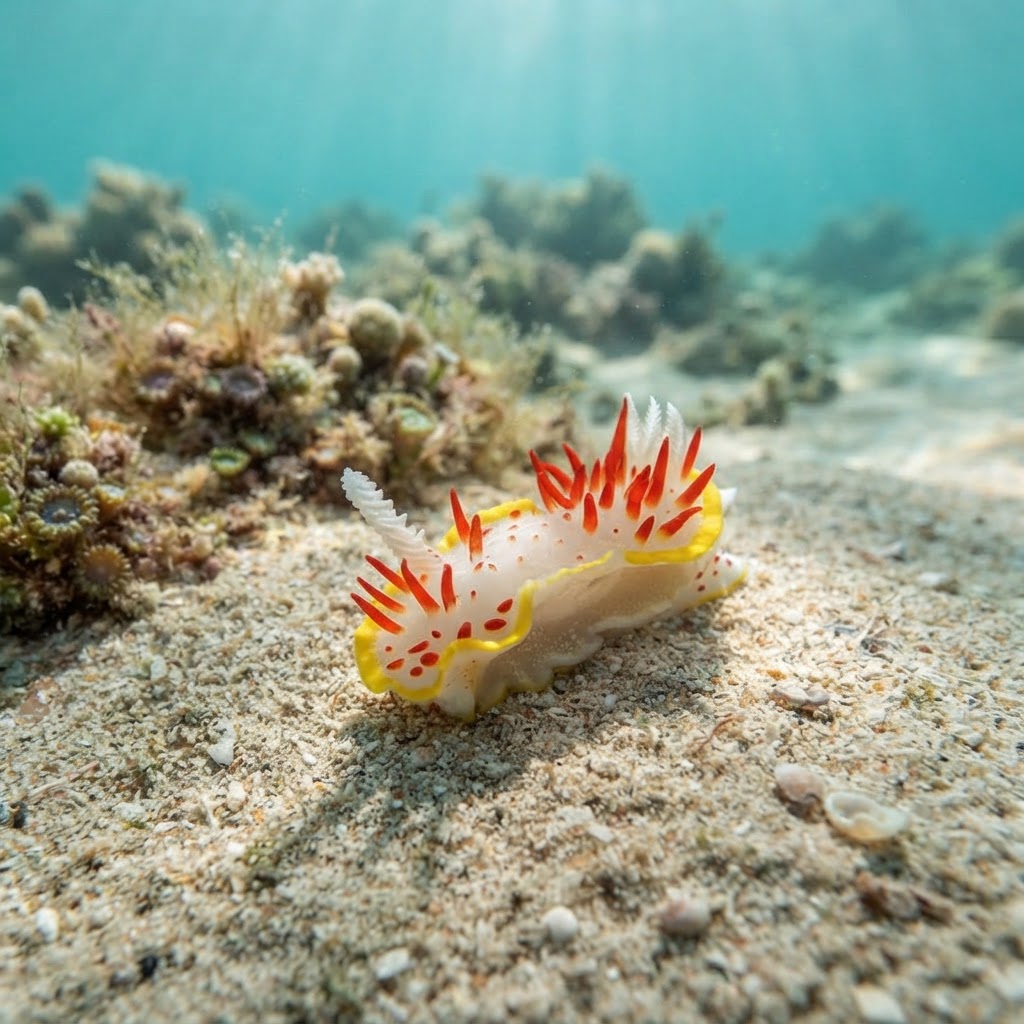
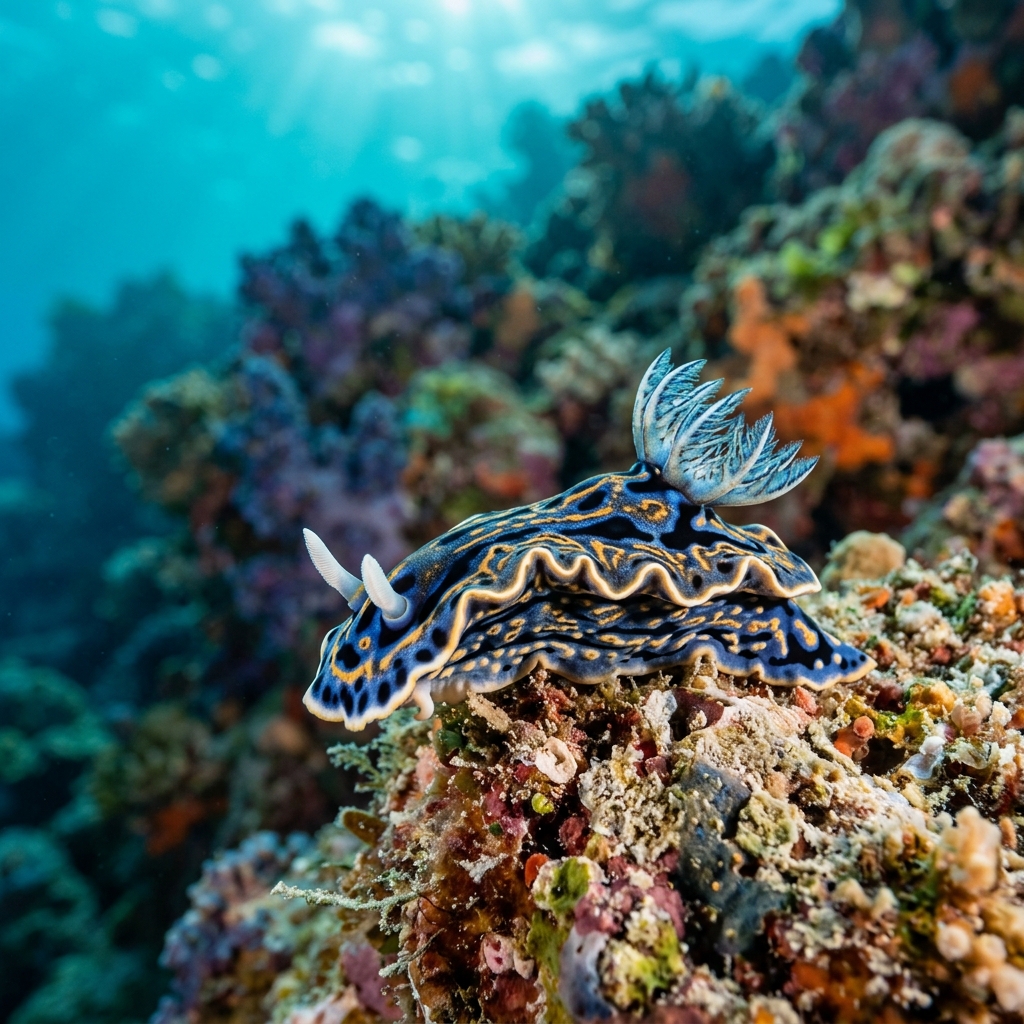
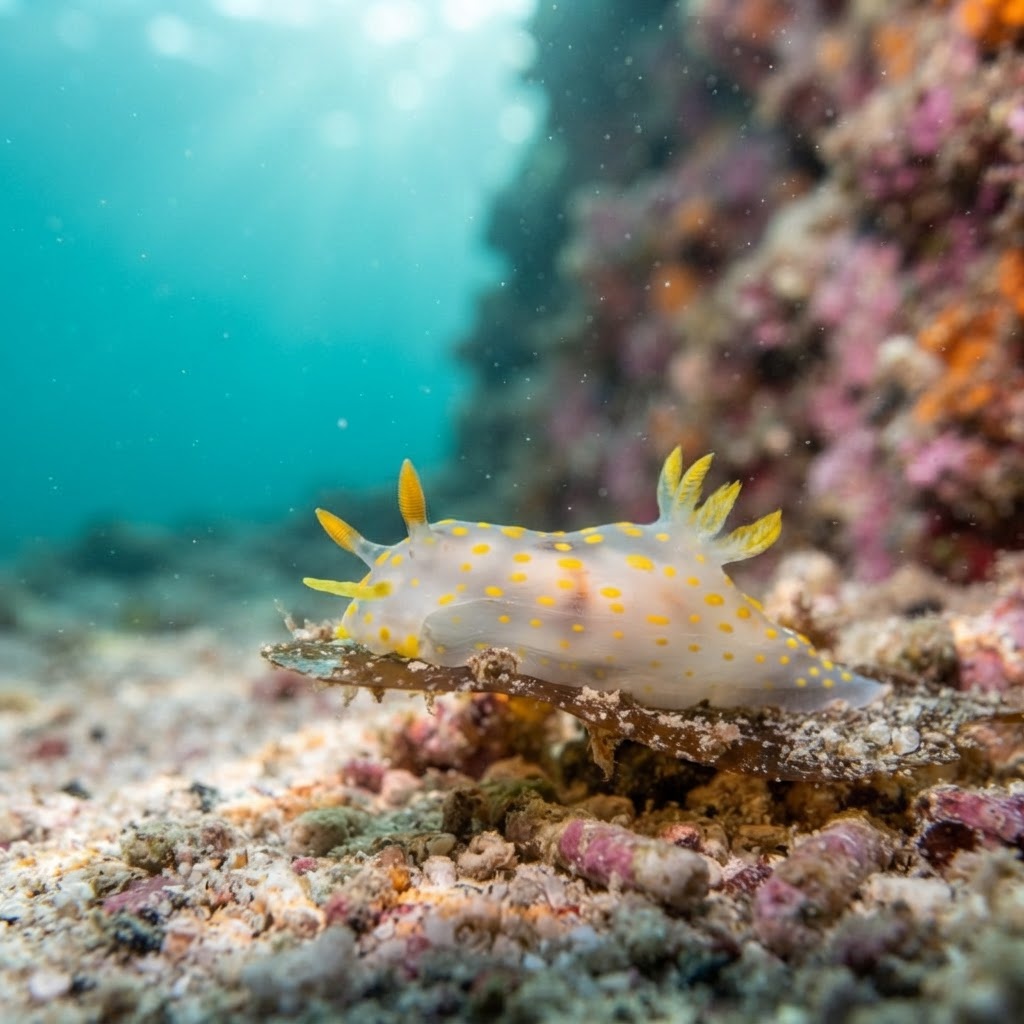
Small, translucent white to pale yellow body marked with four distinct yellow-orange lines running down the back, plus a pair of dark-tipped rhinophores (the sensory horns on the head) and feathery gills near the rear. It sits low and slow on rock, weed, and hydroid growth, rarely more than a couple of centimetres long, so divers usually spot it by scanning encrusted surfaces rather than open water.
Found grazing slowly over rock, algae, and hydroid-covered surfaces, usually tucked into cracks or low structure rather than out in open water. It shows no reaction to divers beyond retracting its gills slightly if disturbed, making it an easy, unhurried subject for close-up photos once you have your eye trained on the right texture of reef.
Like other nudibranchs, it feeds on hydroids and bryozoans and can reportedly incorporate their stinging cells for its own defence, which is part of why it is left alone by most reef predators.
Logged across the year with no clear seasonal spike in the data, consistent with a species comfortable across a wide 9.8 to 19.5C range, so cool-water Atlantic and North Sea sites can produce it in any month.
Reef neighbours a diver could mistake it for. Use the identification notes above to tell them apart.
Most reliably logged in the Netherlands, especially Zeeland, with strong numbers also out of the United Kingdom, France, Spain, and Portugal, where the Lisbon Coast is a particular hotspot. Northern Ireland, Brittany, the French Riviera and Provence, and Spain's Balearic Islands and Valencia coast all turn up regular sightings too, with smaller but steady counts from Norway, Sweden, and Malta.
Mapping where Fourline Nudibranch is logged…
Zeeland in the Netherlands is the single most productive region, with the Lisbon Coast in Portugal, Northern Ireland, Brittany, and the French Riviera also strong. It is a widely spread cool-water species across northern Europe and the Atlantic-Mediterranean coasts.
There is no strong seasonal pattern in the sightings, so it can be found year-round at sites within its temperature range of roughly 9.8 to 19.5C. Cooler months are not a barrier since it tolerates the low end of that range comfortably.
Look for a small, pale, near-translucent body with four yellow-orange lines running along the back and dark-tipped rhinophores on the head. It moves slowly over rock and hydroid growth and rarely reaches more than a couple of centimetres.
No, it poses no risk to divers. It is a small, slow-moving grazer with no ability to sting or bite a person.
Exact size data is not well documented for this species, but like most Polycera nudibranchs it is small, typically only a few centimetres long at most, so patient close-focus searching is key to spotting one.
Site and sighting data is aggregated from diver logs, iNaturalist and GBIF. For taxonomy and conservation status:
Blue Dragon
3,163 sites