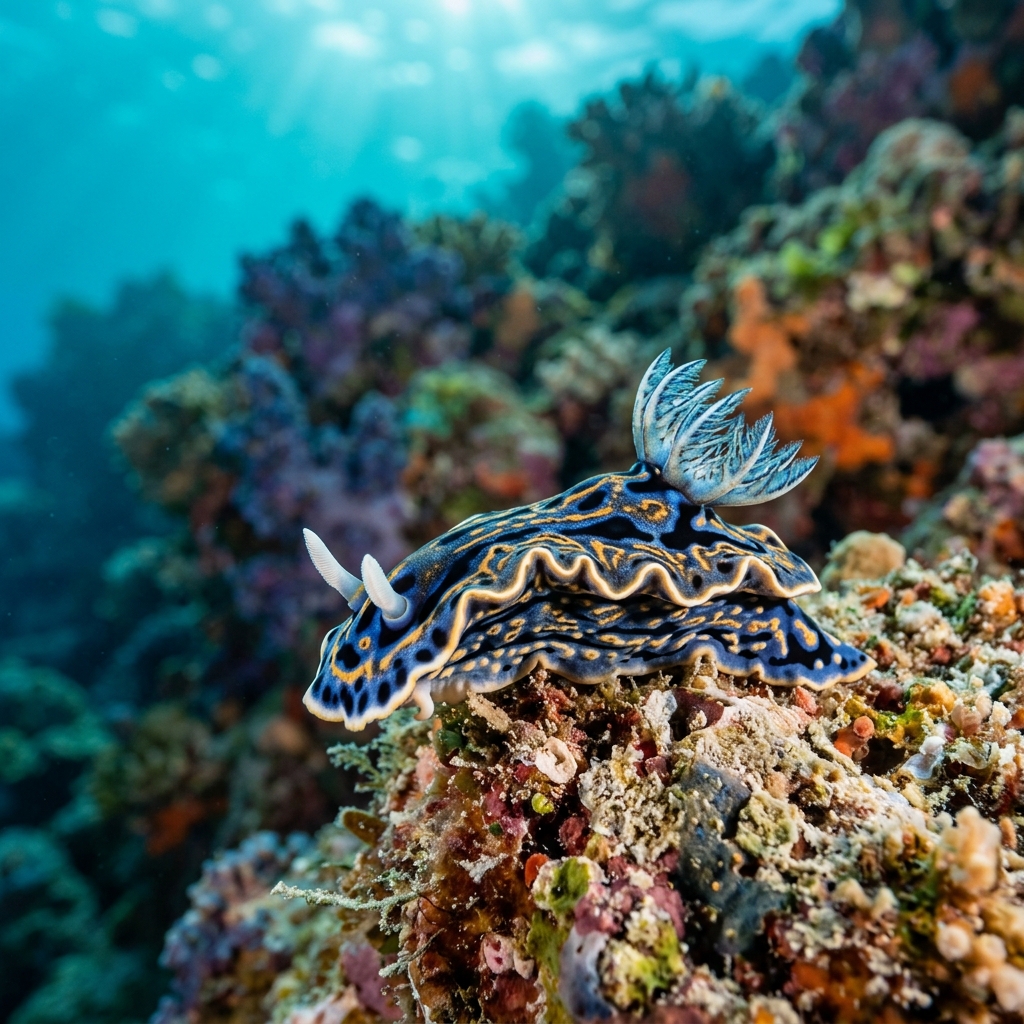
Aegires punctilucens
A pinpoint find in Northern Ireland and Brittany's cold water, 8.8 to 17.9C, logged year-round but always rare on the reef.
A small, low-profile nudibranch with a white to cream body covered in raised bumps (tubercles), several of which are tipped bright yellow. The body is narrow and elongated rather than broad, and it tends to sit tight against rock or algae rather than out in the open. Look closely at the substrate rather than the water column: at just a centimetre or two long, this one is easy to swim straight past.
Divers find this one parked on rock and algae-covered reef, moving slowly if at all, which makes it a patience find rather than an action sighting. It shows no reaction to divers beyond simply continuing to graze, so a slow scan of encrusted surfaces with a torch is the best way to spot one. Most logs describe it as rare even at sites where it is known to occur, so finding one is a case of careful looking rather than luck alone.
Like other nudibranchs, it almost certainly feeds on sponges, using its diet to help build the chemical defences that let a soft-bodied, shell-less animal survive in the open on the reef.
No clear seasonal pattern shows up in the data, and it turns up across a temperature range of 8.8 to 17.9C, which spans most of the diving year in these cold-water regions. Treat it as a year-round possibility rather than a seasonal target.
Most reliably logged in Northern Ireland, which accounts for the bulk of recorded sightings, with Wales adding a further UK record. Across the Channel, Brittany in France is the other strong location, giving divers two realistic regions to search: the cold, rocky coasts of the UK and northern France.
Mapping where Nudibranch is logged…
Northern Ireland is the strongest location on record, with further sightings in Wales and across the Channel in Brittany, France. All are cold-water rocky reef sites rather than tropical destinations.
There's no detected season in current sighting data, and it has been recorded across a wide temperature range from 8.8 to 17.9C. That points to a year-round presence in its UK and French range rather than a specific window.
Look for a small white to cream body with raised bumps, some tipped yellow, sitting low against rock or algae. Its size, a centimetre or two, means you need to look closely at the substrate rather than scan for movement.
Exact size data isn't recorded, but nudibranchs in this family are small, typically only a centimetre or two long, which is why they're so easy to overlook on a dive.
No. It poses no threat to divers and has no means of harming you; the only challenge is spotting it.
It's logged as rare at the vast majority of sites where it does occur, and its small size and habit of sitting still against encrusted rock make it easy to miss. Finding one usually means a slow, deliberate search rather than a chance encounter.
Site and sighting data is aggregated from diver logs, iNaturalist and GBIF. For taxonomy and conservation status:
Varicose Wart Slug
3,145 sites