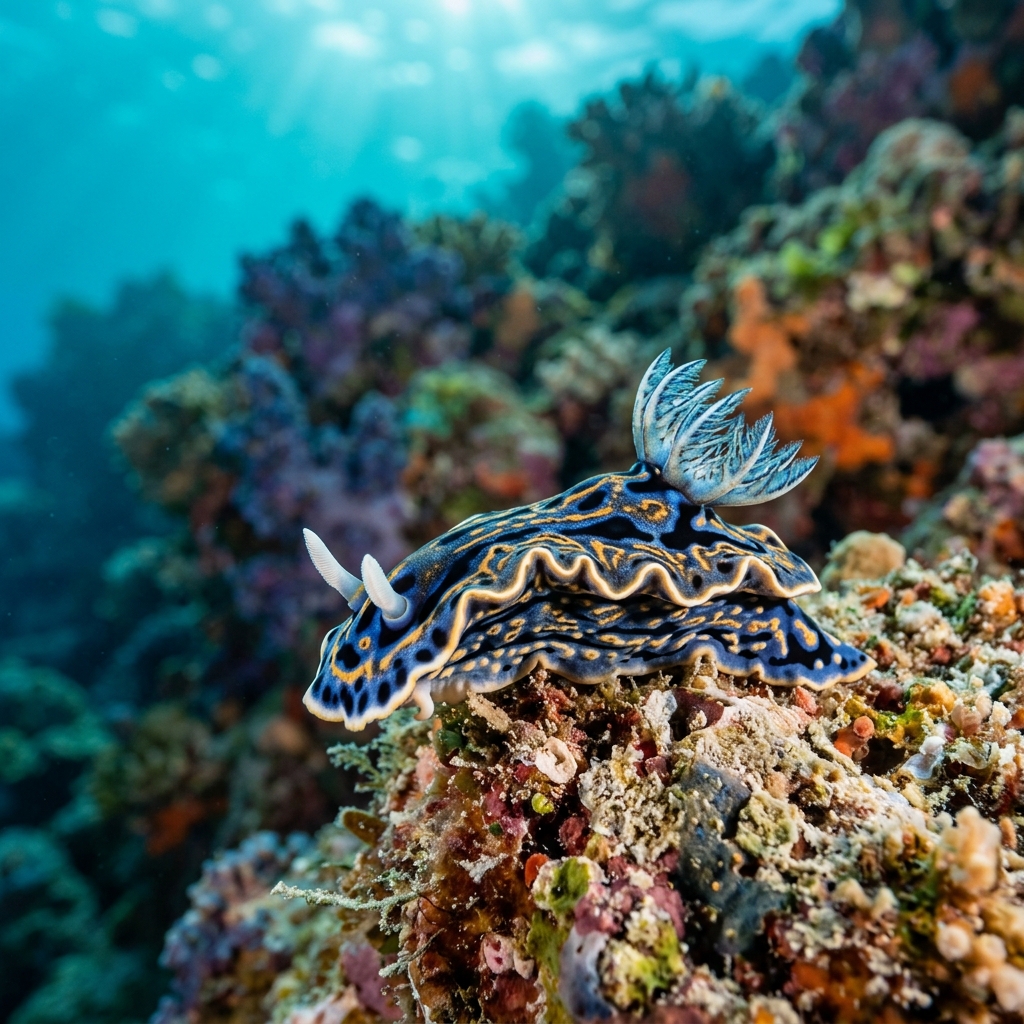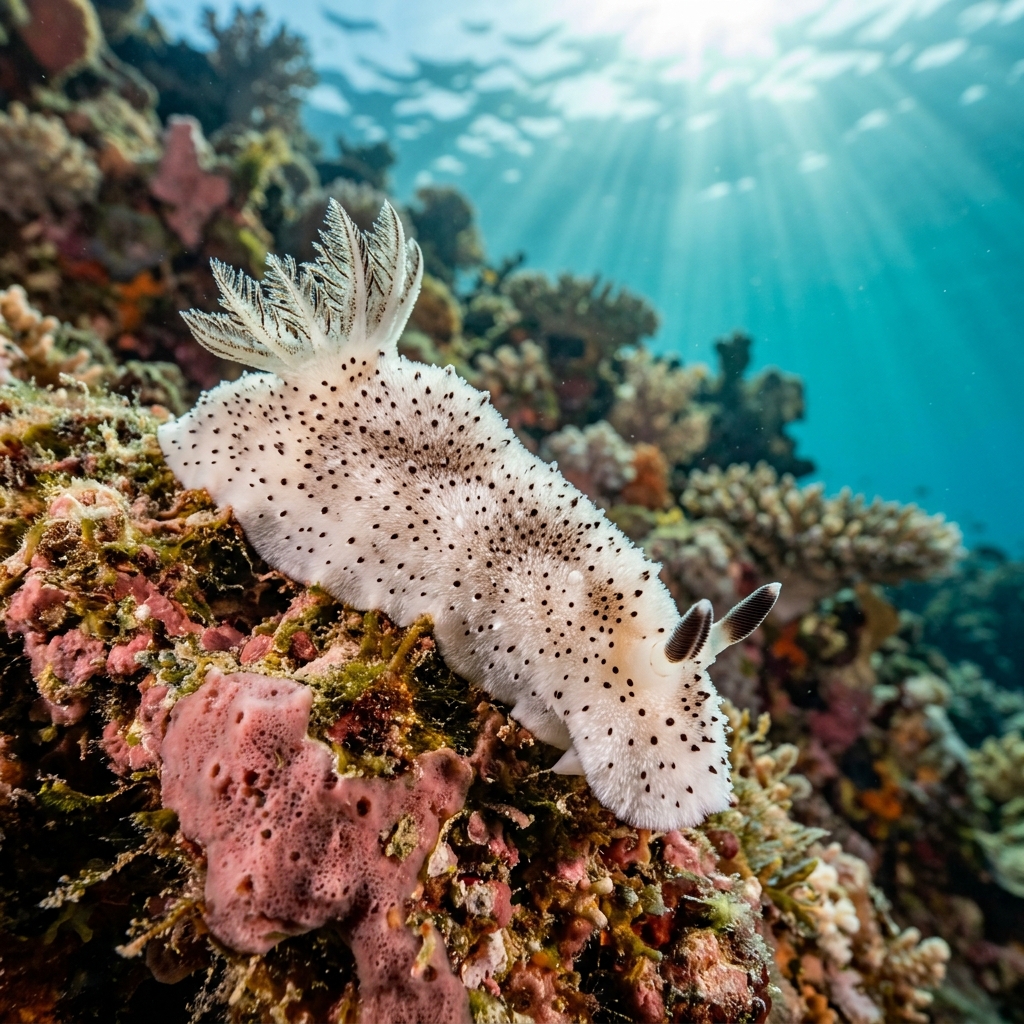
Jorunna spp.
Spot Jorunna nudibranchs across the Philippines, Japan and beyond. Most sightings fall Nov, May in the Northern Hemisphere. Here's what to look for.
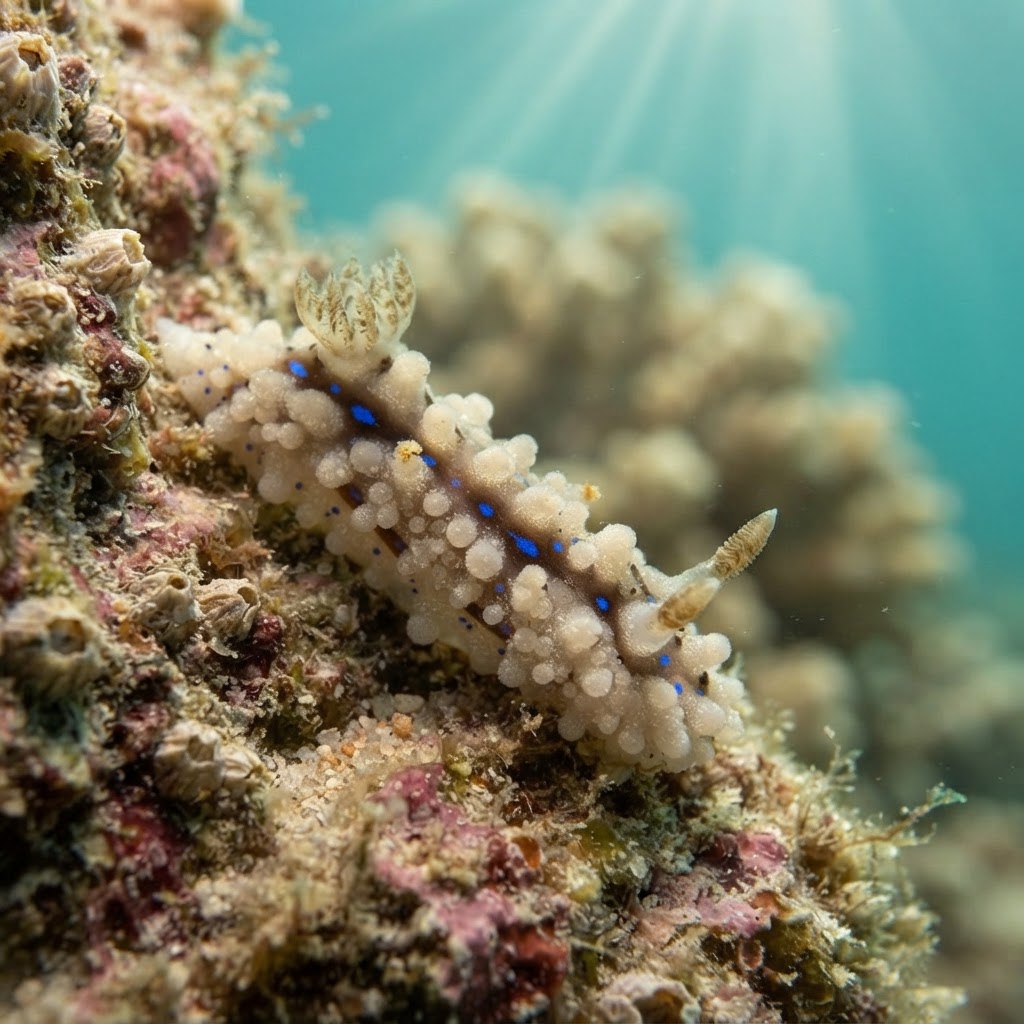
Jorunna nudibranchs are small dorid-type slugs (dorids have a rosette of gill plumes on the back rather than cerata along the sides) with a distinctly bumpy or granular mantle surface, giving them a velvety, almost fuzzy appearance. Most species in the group are pale cream, white, or grey with darker speckling or spotting, and all carry the characteristic tuft of retractable gills at the rear of the back. The widely photographed Jorunna parva has earned comparisons to a tiny rabbit thanks to its rounded shape and prominent black-tipped rhinophores. Look close to the substrate on rocky and coral reefs; they rarely stray into open water.
You will nearly always find Jorunna nudibranchs moving slowly across hard substrate, rubble, or encrusting sponge, often following the chemical trail of their preferred food. They pay little attention to divers and will continue grazing steadily even when a torch is shone on them. Searching shaded ledges, the undersides of rocks, and the base of coral heads at any time of day gives the best chance of an encounter.
Like all dorids, Jorunna species feed on sponges and sequester the sponge's defensive chemicals into their own tissues, making themselves unpalatable to most predators. The vivid rhinophores and gill plumes they display are an honest signal to would-be predators that the meal is not worth it.
In the Northern Hemisphere, sightings concentrate from November through May, making winter and spring the most productive window across the Philippines, Japan, and the Mediterranean. Southern Hemisphere data points to December and January as peak months, though the dataset there is limited.
Reef neighbours a diver could mistake it for. Use the identification notes above to tell them apart.
Jorunna nudibranchs are most commonly logged in the Philippines, where Luzon, the Central Visayas, and Palawan all show strong sighting records. Beyond the Philippines, Japan's Izu Peninsula, Indonesia, Australia's Queensland coast, and the Mediterranean coastlines of Italy, Greece, and France are all reliable hunting grounds. The wide temperature tolerance of the group, from about 10 °C to nearly 29 °C, means they turn up everywhere from warm tropical shallows to cool temperate rocky reefs in the United Kingdom and Brittany.
Mapping where Jorunna Nudibranch is logged…
The Philippines is the standout destination, with strong sighting records across Luzon, the Central Visayas, and Palawan. Japan's Izu Peninsula, Indonesia, Queensland in Australia, and Mediterranean sites in Italy, Greece, and France all produce reliable sightings. The group is also logged regularly on cooler temperate reefs around the United Kingdom and Brittany.
Northern Hemisphere divers see them most often between November and May, so a winter or spring trip to the Philippines or Japan is well-timed. In the Southern Hemisphere the peak appears to fall in December and January, though records from that region are still building.
Look for a small, oval dorid with a soft, granular or velvety mantle surface in white, cream, or pale grey, often with fine dark spots or speckling. A rosette of feathery gill plumes sits at the rear of the back, and the rhinophores at the front tend to be club-shaped and conspicuously marked. The fuzzy texture is the easiest single feature to key on when scanning the substrate.
Most Jorunna species are quite small. The well-known Jorunna parva typically reaches around 1 to 2 cm in length, and other members of the group fall in a similarly small range. Their modest size is part of why they are easy to overlook without a slow, methodical search of the reef.
No, Jorunna nudibranchs pose no risk to divers whatsoever. They are slow-moving grazers that ignore human presence entirely. The defensive chemicals they store from sponges deter fish predators but have no effect on divers who simply observe them without handling.
Jorunna nudibranchs are specialist sponge feeders. They locate sponge colonies by following chemical gradients through the water, then rasp away at the tissue. Crucially, they absorb the toxic or distasteful compounds from the sponge and retain them in their own skin, turning the sponge's chemistry into their own chemical armour.
Site and sighting data is aggregated from diver logs, iNaturalist and GBIF. For taxonomy and conservation status:
Varicose Wart Slug
3,145 sites