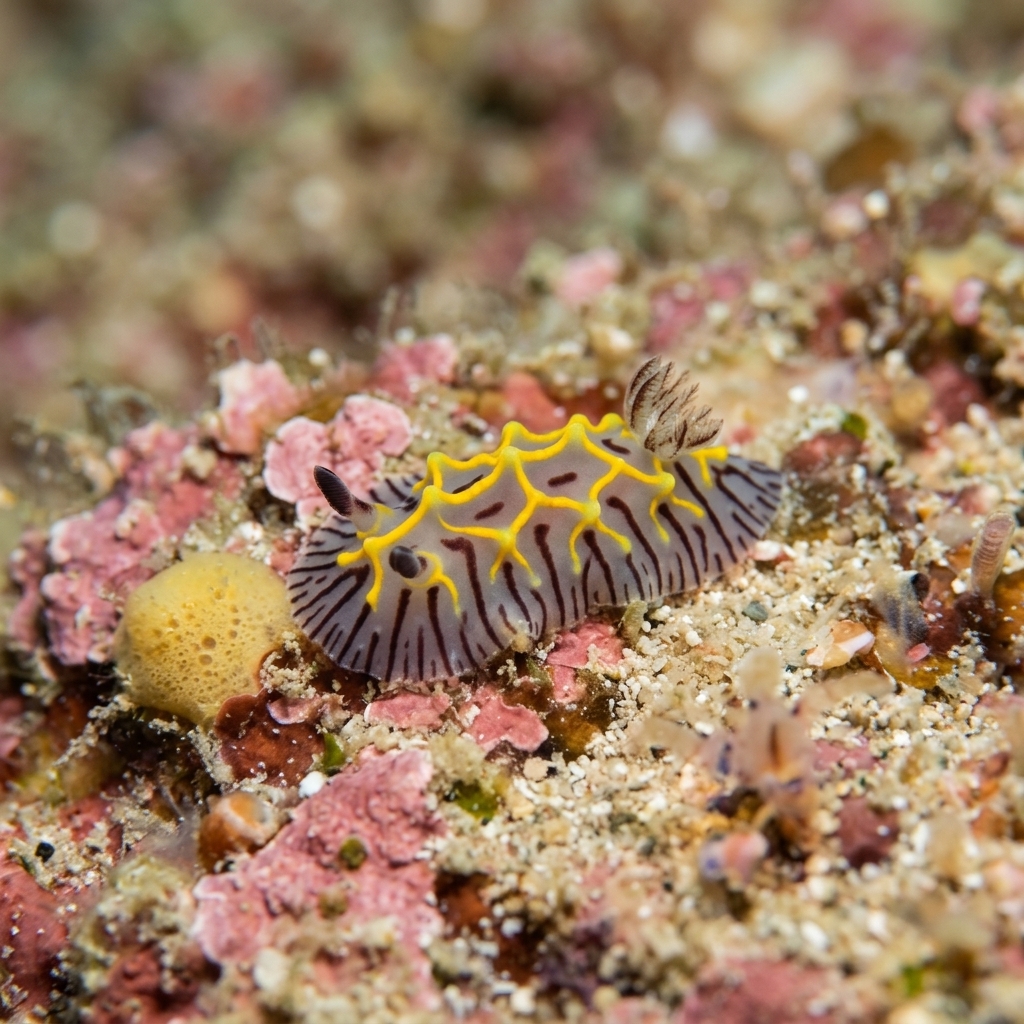
Halgerda willeyi
Spot Willey's Nudibranch in New Caledonia, Australia and Indonesia in warm 26-29°C waters. ID tips, top dive regions and what to expect.
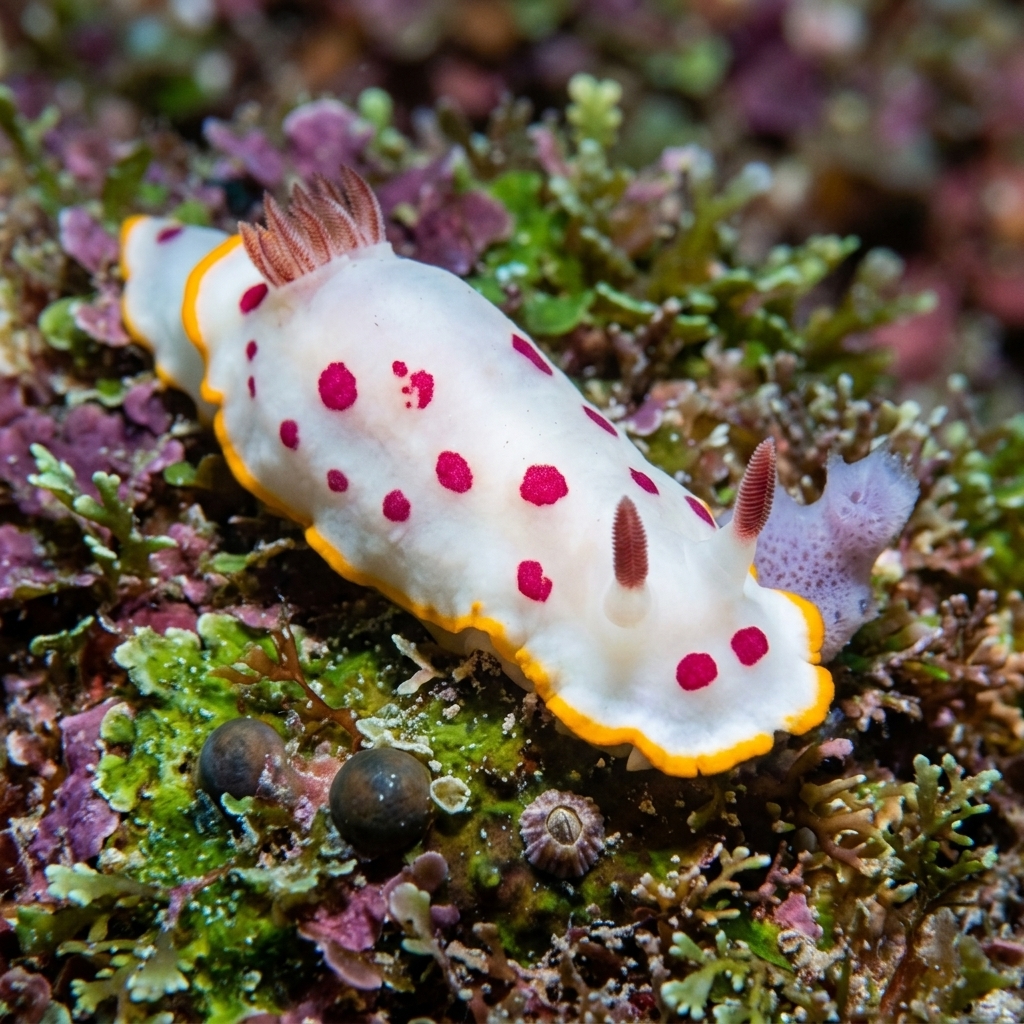
A pale, flattened nudibranch with a network of raised, ridge-like tubercles (bumpy projections on the body surface) outlined in orange or yellow, giving it a distinctive reticulated pattern. The gills and rhinophores (sensory head stalks) are usually tipped in a contrasting colour. It sits close to the reef substrate and moves slowly, making the bold surface patterning your main ID key underwater.
Like most dorid nudibranchs, it is found crawling slowly over reef rubble, sponge-covered rock and coral substrate, usually during day dives. It does not react strongly to diver presence and will simply continue its slow patrol. Look low on the reef, especially on encrusting sponges, which are the likely food source for this genus.
Halgerda nudibranchs are known to feed on encrusting sponges and are thought to sequester chemical compounds from their prey for chemical defence, making them unpalatable to most predators despite their conspicuous colouring.
No clear seasonal peak has emerged from the available data, so it is best treated as a year-round resident on Indo-Pacific reefs. It is consistently recorded in water temperatures of 26 to 29°C, pointing to warm tropical and subtropical reef habitats throughout the year.
Reef neighbours a diver could mistake it for. Use the identification notes above to tell them apart.
New Caledonia is far and away the most reliable place to find this species, with Île des Pins and Nouméa together accounting for the largest share of logged sightings. Queensland and New South Wales in Australia are the next best bets, followed by Bali and Lombok in Indonesia and the Visayas in the Philippines.
Mapping where Willey's Nudibranch is logged…
New Caledonia, particularly around Île des Pins and Nouméa, has the strongest concentration of sightings. It is also regularly logged in Queensland and New South Wales in Australia, across Bali and Lombok in Indonesia, and in the Visayas region of the Philippines.
There is no confirmed seasonal peak for this species. It appears year-round on warm Indo-Pacific reefs, consistently found in water temperatures between 26 and 29°C. Any visit to its core sites in New Caledonia or Australia is a reasonable opportunity.
Look for a pale, flattened body covered in a raised, ridge-like network outlined in orange or yellow. That reticulated surface texture is the clearest field mark. It sits on or close to the reef, moves very slowly, and its colourful ridges stand out against the substrate.
No. Willey's Nudibranch poses no risk to divers whatsoever. It is small, slow-moving and completely harmless. The only caution is to avoid touching or disturbing it, both for the animal's welfare and to avoid disrupting its behaviour.
Sightings lean uncommon to rare across most sites where it has been recorded. A handful of sites do record it as common, mostly in New Caledonia. Patience and slow, thorough reef searching, especially on sponge-covered surfaces, give you the best chance of a find.
Site and sighting data is aggregated from diver logs, iNaturalist and GBIF. For taxonomy and conservation status:
Light-spotted Aegires
3,168 sites