Goniobranchus splendidus
Find Splendid Goniobranch diving in New South Wales and Queensland, Australia. Best sightings run Sep, Mar in 18-23 °C water. ID tips inside.
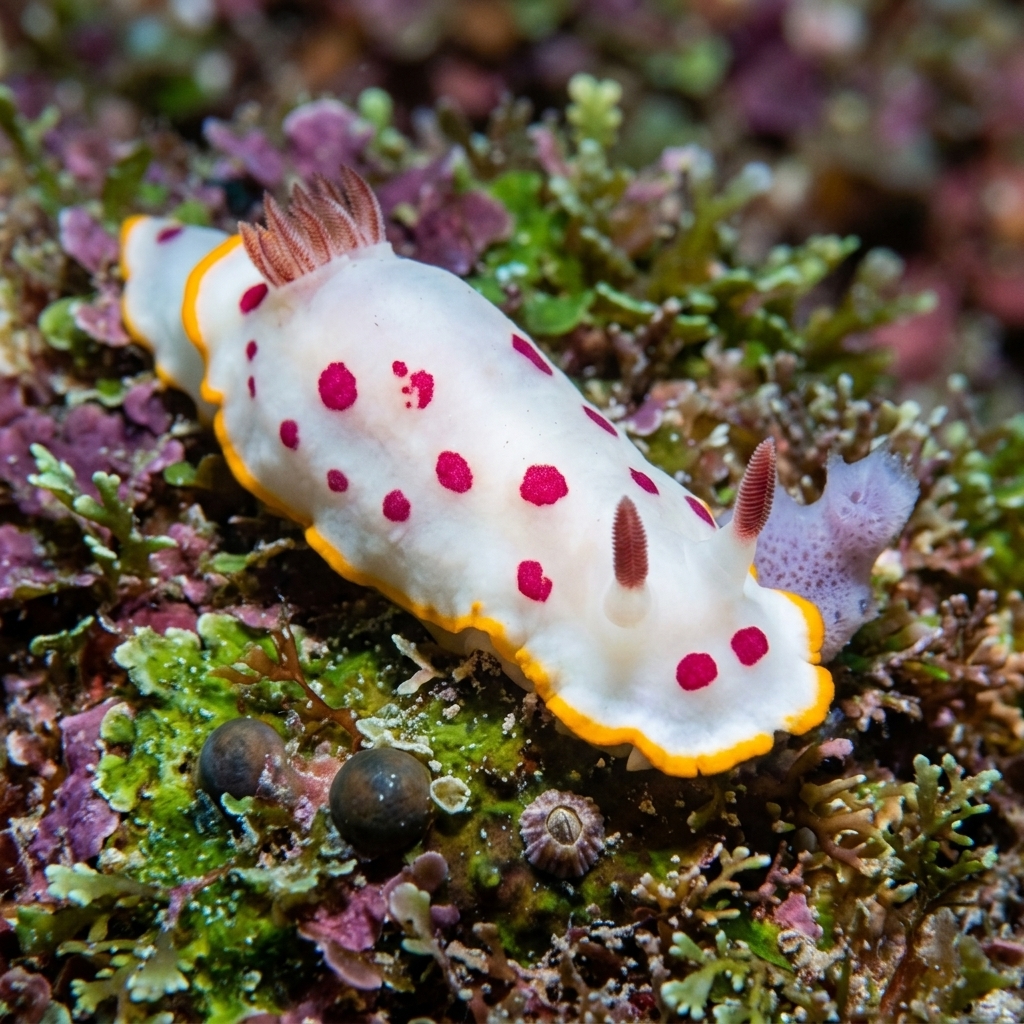
One of Australia's most recognisable nudibranchs, it carries a bright white mantle edged with a bold purple or violet border and scattered orange or red spots across the dorsal surface. The cerata (the feathery gill plumes on its back) are typically orange-tipped, making them pop against the white body even in low visibility. Body shape is the classic elongated chromodorid oval, broader at the front, tapering toward the tail. That white-and-purple-with-orange combination is the key underwater cue.
Like most chromodorids, it crawls slowly across rocky reef and rubble surfaces, grazing on sponges. When you find one it is typically unhurried and unbothered by diver presence, making it a cooperative subject to observe closely. Look low on the reef, on vertical sponge-encrusted walls and under ledge lips, which are favoured feeding microhabitats for this family.
Goniobranchus nudibranchs are simultaneous hermaphrodites, meaning every individual carries both male and female reproductive organs. When two meet they can exchange sperm simultaneously, which explains the occasional sightings of pairs side by side on the reef.
Sightings in the Southern Hemisphere concentrate between September and March, which corresponds to the Australian spring through late summer. Water temperatures in the observed range of 18.5 to 23.5 °C align well with this window along the New South Wales coast.
Almost all logged sightings come from Australia, with New South Wales accounting for the clear majority of recorded sites, followed by Queensland. A small number of sightings have also been logged in Tahiti. Within New South Wales, rocky reef dive sites along the temperate coast are the productive ground; Queensland sightings suggest it extends into subtropical waters as well.
Mapping where Splendid Goniobranch is logged…
The overwhelming majority of sightings are from Australia, particularly along the New South Wales coast and, to a lesser extent, Queensland. Rocky and sponge-covered reefs in temperate to subtropical Australian waters are your best bet, with a handful of records from Tahiti as well.
Sightings peak between September and March in the Southern Hemisphere, covering Australian spring through late summer. This aligns with the species' preferred cooler water temperatures of roughly 18 to 23 °C, which are most reliably found along the New South Wales coast during that window.
Look for a white oval nudibranch with a vivid purple border running around the edge of the mantle and scattered orange or red spots on the back. The orange-tipped gill plumes are a reliable finishing detail. No other common Australian nudibranch combines all three of those colour elements together.
No. Like all nudibranchs, it poses no threat to divers. The bright colouration is a warning to predators rather than to humans, advertising chemical defences derived from the sponges it eats.
They graze on sponges, as is typical for Goniobranchus nudibranchs. The species sequesters chemical compounds from the sponges it consumes and incorporates them into its own tissues as a defence against predation, which is partly why the vivid colours serve as an honest warning signal.
Site and sighting data is aggregated from diver logs, iNaturalist and GBIF. For taxonomy and conservation status:
Light-spotted Aegires
3,168 sites