Calcinus laevimanus
Striped legs and blue-green eyes: find zebra hermit crabs on shallow reef rubble in Okinawa, Hawaii and Orchid Island year-round.
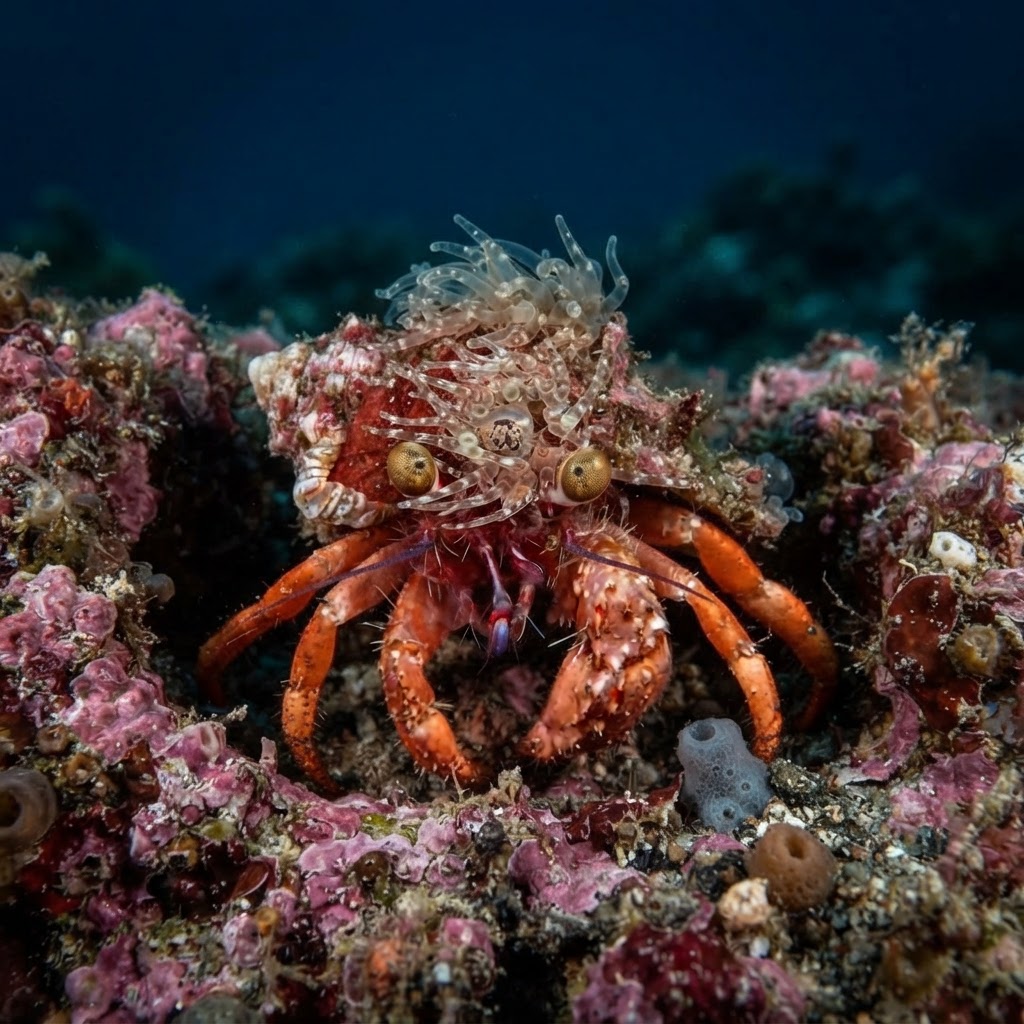
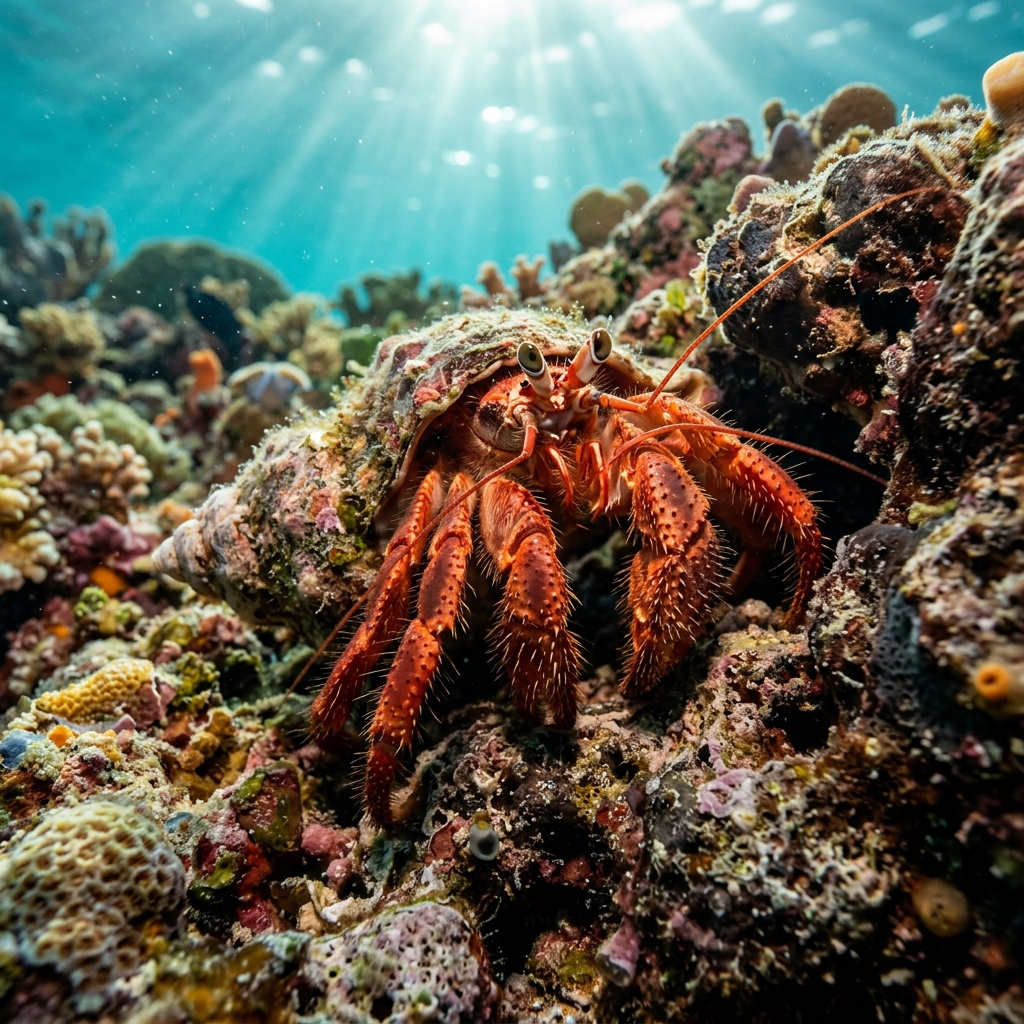
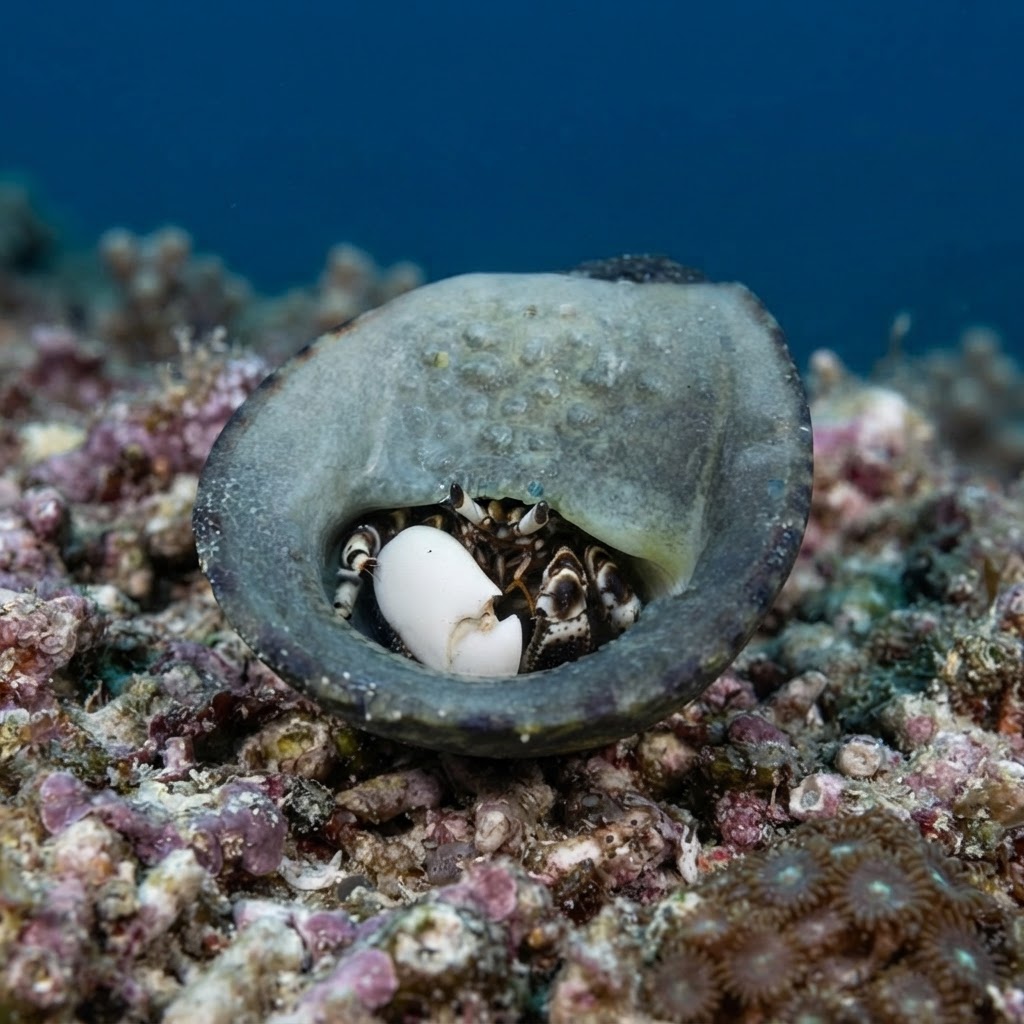
Look for legs banded in bold black-and-white stripes, almost like a barcode, extending from a scavenged snail shell. The claws are pale to orange with a granular texture, and the eyestalks carry bright blue-green eyes that catch a torch beam at night. Body size stays modest, easily overlooked among rubble and coral debris unless you scan closely.
Expect to find it picking over rubble patches and mangrove-fringed shallows, using its claws to scrape algae and detritus off rocks and dead coral. It is not shy exactly, but it tends to freeze or withdraw into its borrowed shell when a torch or hand gets close, then resumes foraging once left alone. Night dives tend to turn up more activity, when it wanders more openly across the substrate.
Like all hermit crabs it does not grow its own shell, so as it grows it has to find and move into a larger abandoned gastropod shell, and a shortage of the right-sized shells on a reef can limit how many crabs a patch can support.
No clear seasonal pattern shows up in the sightings, and with a comfortable range of roughly 23 to 29C it stays active on tropical and subtropical reefs all year, so any month works for a dedicated look.
Reef neighbours a diver could mistake it for. Use the identification notes above to tell them apart.
Most reliably logged in Japan, especially around Okinawa and the Ryukyu Islands, and in Hawaii, with strong numbers also on Taiwan's Orchid Island and around Kenting. It also turns up on Reunion's Saint-Paul coast, in Bali, on Mauritius near Grand Baie, and along South Africa's KwaZulu-Natal coast, making it a widespread but locally uncommon find across Indo-Pacific and southwest Indian Ocean reefs.
Mapping where Left-handed Hermit Crab is logged…
Japan's Okinawa and Ryukyu Islands and Hawaii are the strongest areas, with good numbers also around Taiwan's Orchid Island and Kenting, Reunion's Saint-Paul coast, Bali, Mauritius, and KwaZulu-Natal in South Africa.
There is no strong season in the sightings data, and its comfortable temperature range keeps it active on reefs year-round, so it can be found in any month.
Check the legs for crisp black-and-white banding, look for pale to orange granular claws, and note the bright blue-green eyes on the eyestalks. It is usually tucked into a scavenged snail shell on rubble or reef debris.
Exact size figures are not well documented for this species, but like most Calcinus hermit crabs it stays small, easy to miss unless you are scanning rubble closely.
They never build their own shell, instead recycling empty gastropod shells and trading up to a bigger one as they grow, so shell availability on a reef directly limits the local population.
Site and sighting data is aggregated from diver logs, iNaturalist and GBIF. For taxonomy and conservation status:
European Green Crab
2,469 sites