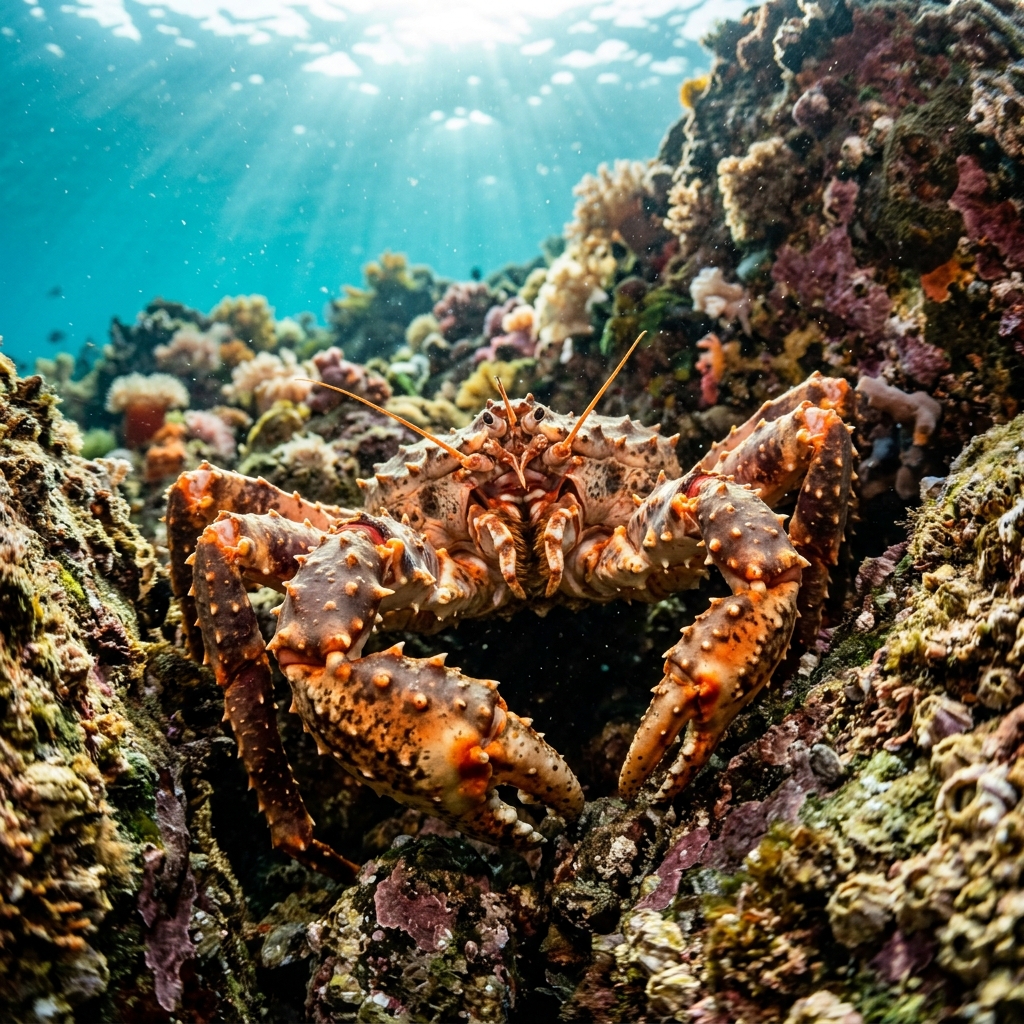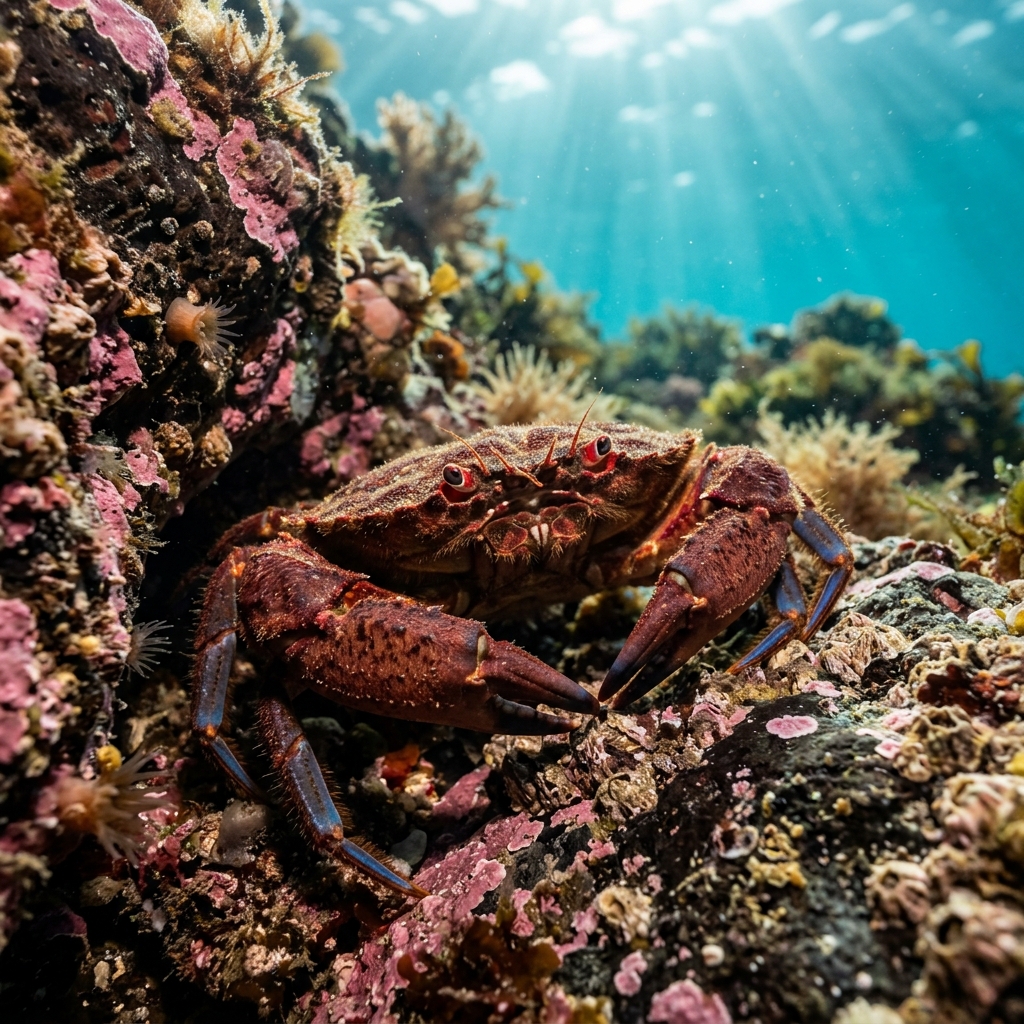
Carcinus maenas
Spot European green crabs year-round in Brittany, the English South Coast and Zeeland. Cool-water (8-14 °C) and commonly logged across dozens of sites.
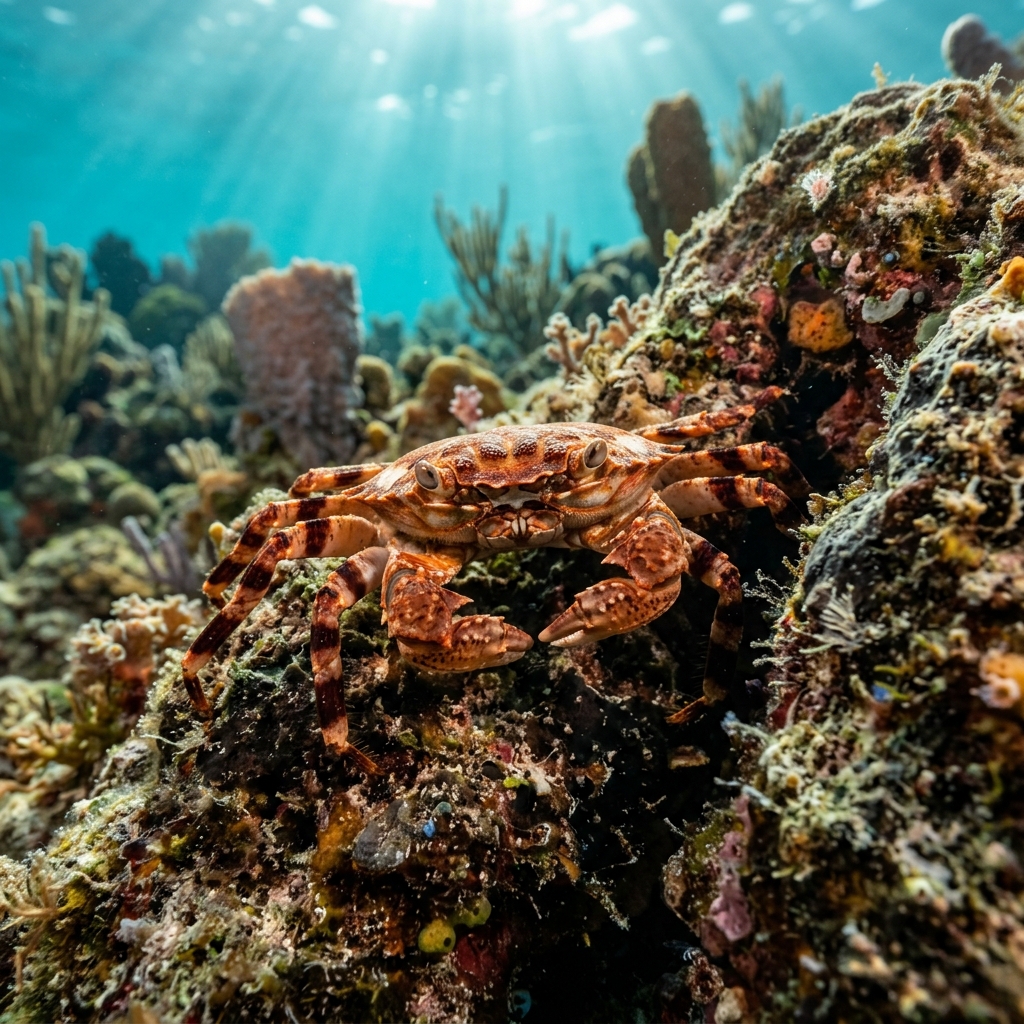
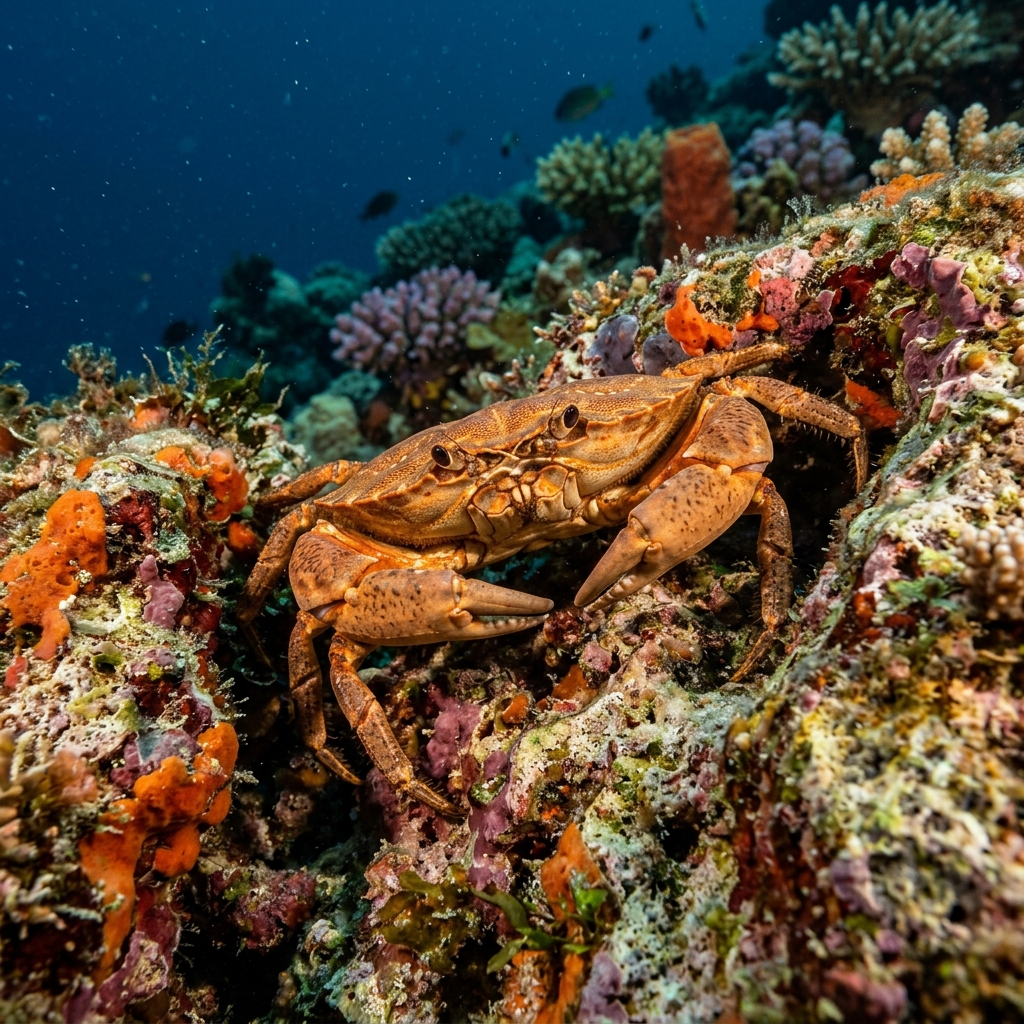
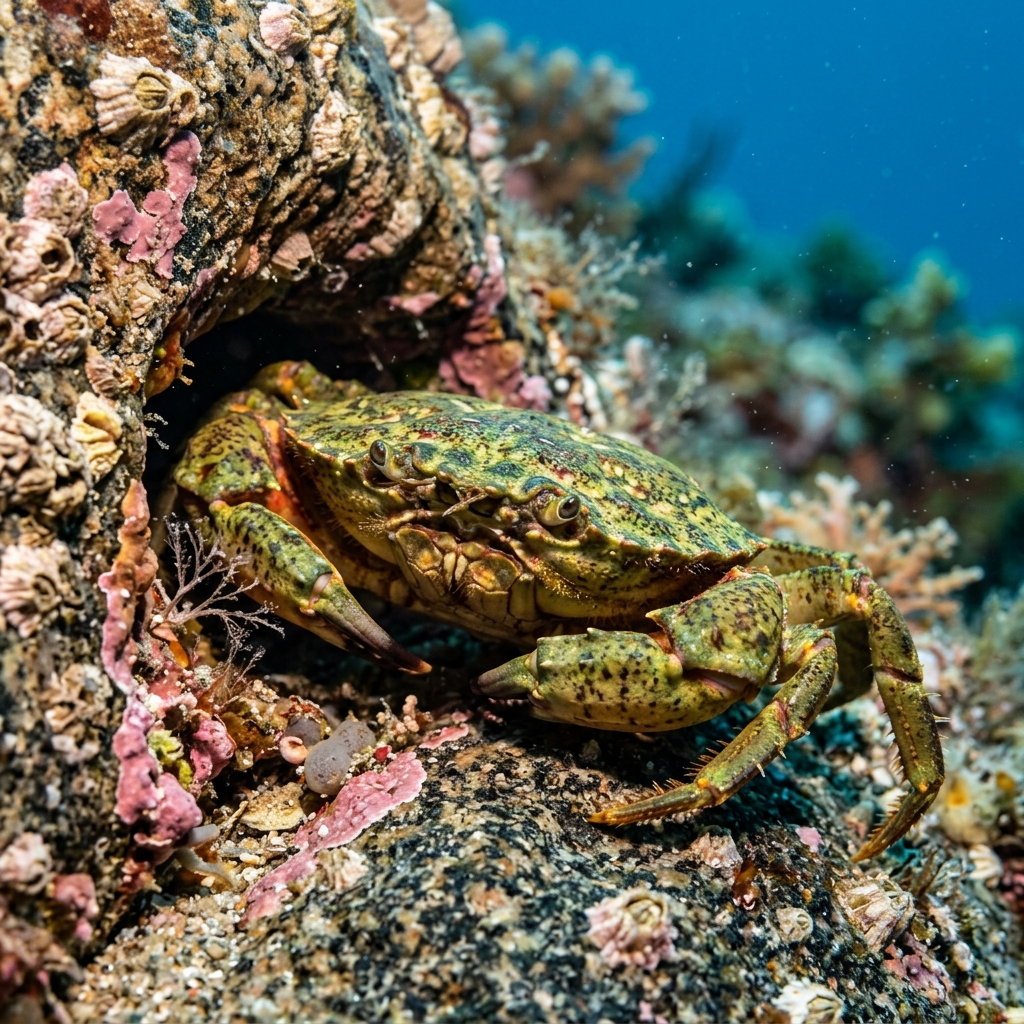
A small, flattened crab typically around 4 cm across, with a distinctly fan-shaped carapace (the hard upper shell) that is widest at the front and tapers towards the rear. Colouration is highly variable, usually a mottled mix of green, brown, orange, and yellow on the topside, with a yellowish-green underside. The front edge of the shell has five blunt teeth on each side, which is one of the most reliable field marks underwater. Males have a narrow, triangular abdomen folded flat against the belly, while females carry a broader, rounded abdomen often visible when they are carrying eggs.
Typically found tucked under rocks, in crevices, or picking through kelp and weedy substrate in very shallow water. When a diver approaches, they tend to back away quickly and disappear under cover, so slow, patient movements give you a much better look. They are active daytime foragers, and you will often catch them mid-scavenge, turning over debris or investigating anything that smells edible.
Outside their native Atlantic range, European green crabs are one of the world's most widespread marine invertebrate invaders, having established themselves on every temperate coastline they have reached, from the Pacific coast of North America to southern Australia and South Africa. Their success comes down to a remarkable tolerance for fluctuating salinity and temperature, allowing them to thrive in estuaries where most crabs struggle.
Present year-round with no concentrated season, which makes sense given their tolerance for cold water, they are regularly observed between 8 and 14 °C, a stable temperature range across temperate North Atlantic sites throughout the year.
Most commonly logged across the United Kingdom and France, with particularly strong populations in Brittany and Normandy, the South Coast of England, and Scotland's west coast. The Netherlands, especially Zeeland, and Northern Ireland also see reliable sightings, and populations are well established along the North American Atlantic seaboard from Nova Scotia and the Bay of Fundy down through the northeastern United States.
Mapping where European Green Crab is logged…
They are most reliably encountered across the United Kingdom, France, the Netherlands, and Ireland. Top regions include Brittany and Normandy, Zeeland in the Netherlands, the South Coast of England, and Nova Scotia in Canada. They are also well established along the northeastern United States coastline.
They are present year-round across their range. Unlike many species tied to warm-water seasons, green crabs thrive in cool temperate water between roughly 8 and 14 °C, so there is no single peak season, any dive on a rocky or weedy temperate shore is a fair opportunity.
Look for the distinctive fan-shaped carapace, widest at the front, with five blunt teeth along each side of the front edge. Colouration ranges from green to brown to orange, so colour alone is unreliable; the shell shape and those front teeth are the key marks. Size is also a useful clue: adults are typically around 4 cm across.
Most individuals divers encounter measure around 4 cm across the carapace. They rarely exceed 9 cm even in ideal conditions, which makes them one of the smaller shore crabs you will find across European and North Atlantic sites.
No. They pose no real risk to divers and will almost always retreat rather than stand their ground. Like any crab, they can give a sharp pinch if handled roughly, but observing them in the water without touching them means there is nothing to worry about.
Their tolerance for a wide range of temperatures and salinity levels has allowed them to establish populations far beyond their native Atlantic range, including the Pacific coasts of North America and Australia. In those regions they compete with and displace native crabs and can significantly alter shellfish beds and intertidal habitats.
Site and sighting data is aggregated from diver logs, iNaturalist and GBIF. For taxonomy and conservation status:
Sally Lightfoot Crab
2,422 sites