Caesio varilineata
Blue-and-yellow schooling fish common in Oman's Daymaniyat Islands and Thailand's Koh Phi Phi, in water around 27-29C year-round.
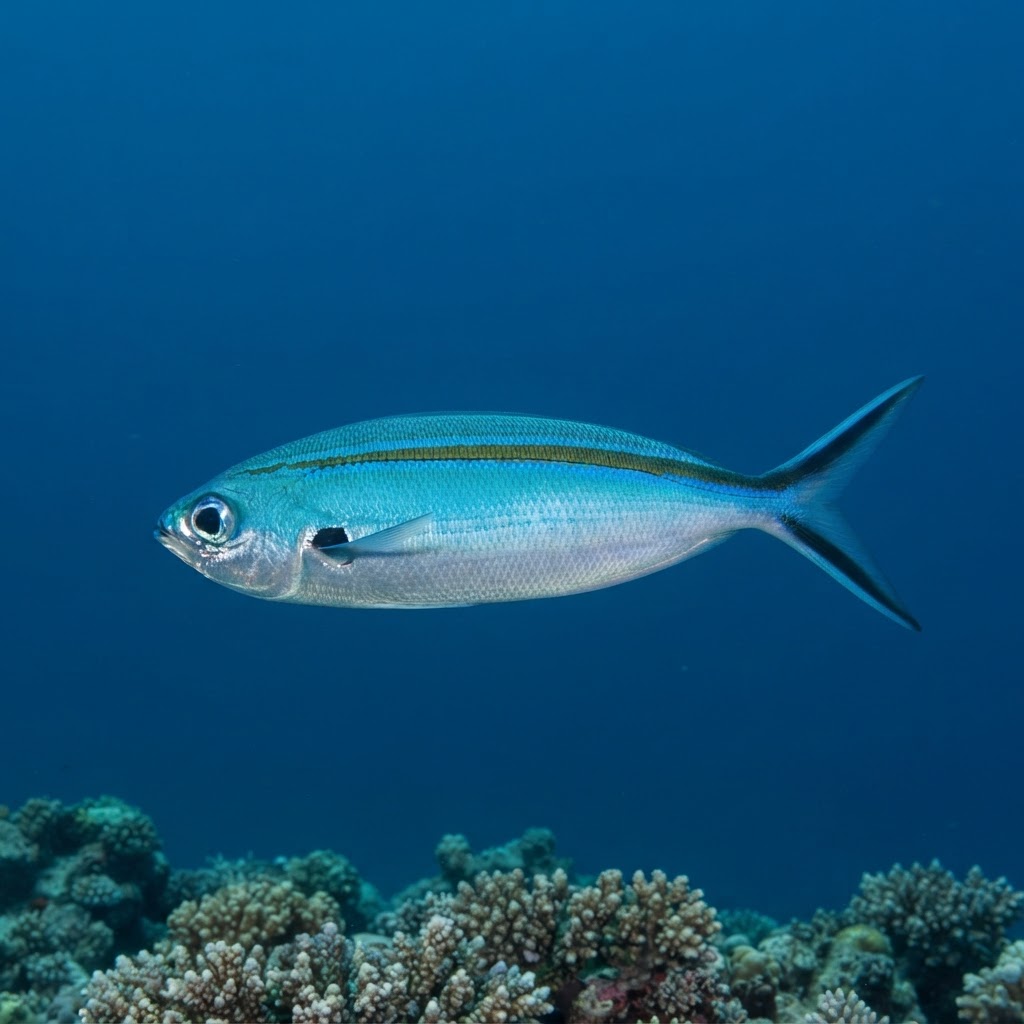
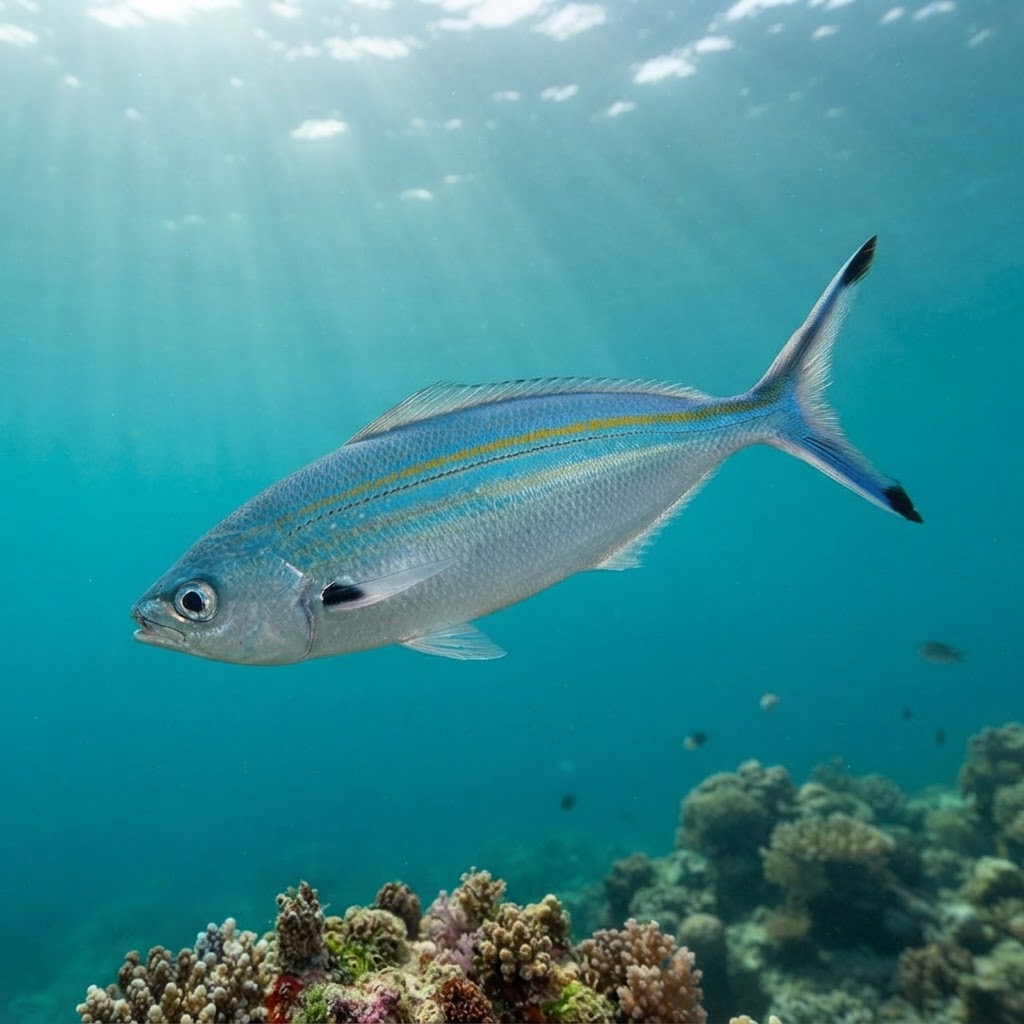
Slim, torpedo-shaped body around 28cm long, built for fast open-water swimming rather than reef-hugging. Blue-grey back fading to silvery white below, with a yellow stripe running along the lateral line and a forked tail that's often tipped in darker colour. Usually seen in loose schools rather than alone, which is often the quickest giveaway before you even settle on the fine markings.
Look for them mid-water off reef walls and drop-offs, moving in loose, fast-swimming schools that peel apart and regroup rather than holding a tight formation. They generally ignore divers, more interested in picking plankton out of the current than in what's watching them, which makes them an easy, unhurried subject for wide-angle shots on a drift dive.
Like other fusiliers, they feed by picking zooplankton straight out of open water rather than grazing the reef, which is why you'll usually find them stationed over drop-offs and current-swept points rather than tucked into coral.
No clear seasonal pattern in the sightings data, and with a comfortable range of 26.7 to 29.3C, these are warm-water reefs where fusiliers show up year-round rather than on a set migration schedule.
Reef neighbours a diver could mistake it for. Use the identification notes above to tell them apart.
Most reliably logged in Oman, especially around the Daymaniyat Islands and Muscat, and a strong presence in Thailand around Koh Phi Phi. Also a regular sighting in the Maldives' Central Atolls and the Seychelles' Inner Islands, with smaller numbers reported off the UAE's East Coast and Egypt.
Mapping where Variable-lined Fusilier is logged…
Oman is the strongest region, particularly the Daymaniyat Islands and Muscat, followed by Koh Phi Phi in Thailand and the Central Atolls of the Maldives. Smaller populations turn up in the Seychelles' Inner Islands, the UAE's East Coast, and Egypt.
There's no strong seasonal pattern in the sightings, so they're considered a year-round fish on the warm reefs they inhabit, which sit around 27 to 29C most of the time.
Look for a slim, silvery-blue body around 28cm long with a yellow line along its side, swimming in loose schools rather than solo. The forked tail and constant mid-water motion help separate it from reef-hugging snappers.
They reach around 28cm in length, a typical size for schooling fusiliers on Indo-Pacific reefs.
No. They're a harmless, plankton-feeding schooling fish that pays divers little attention and poses no risk in the water.
Site and sighting data is aggregated from diver logs, iNaturalist and GBIF. For taxonomy and conservation status:
Emperor
2,052 sites