Aegires villosus
A rare macro find with real strongholds in Luzon, Bali and Western Australia, in warm 24-30C reef water year-round.
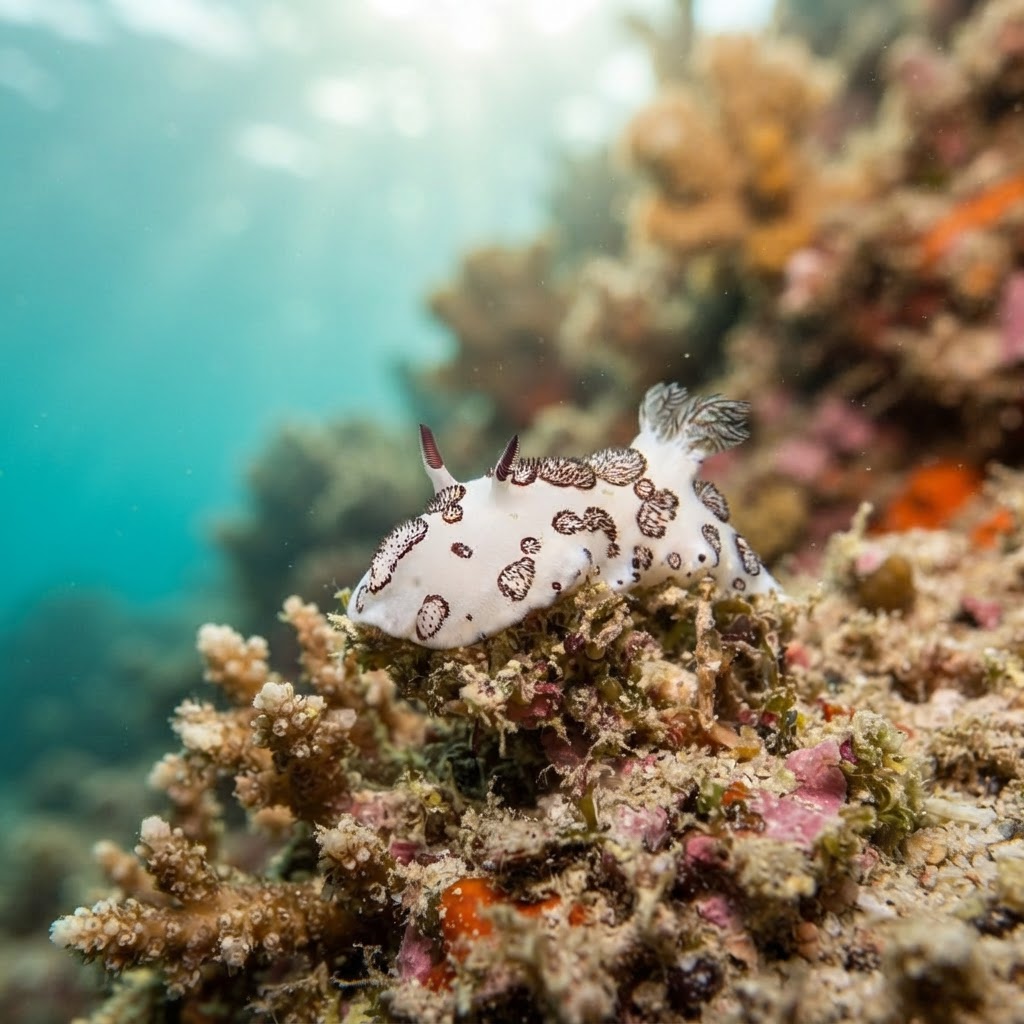
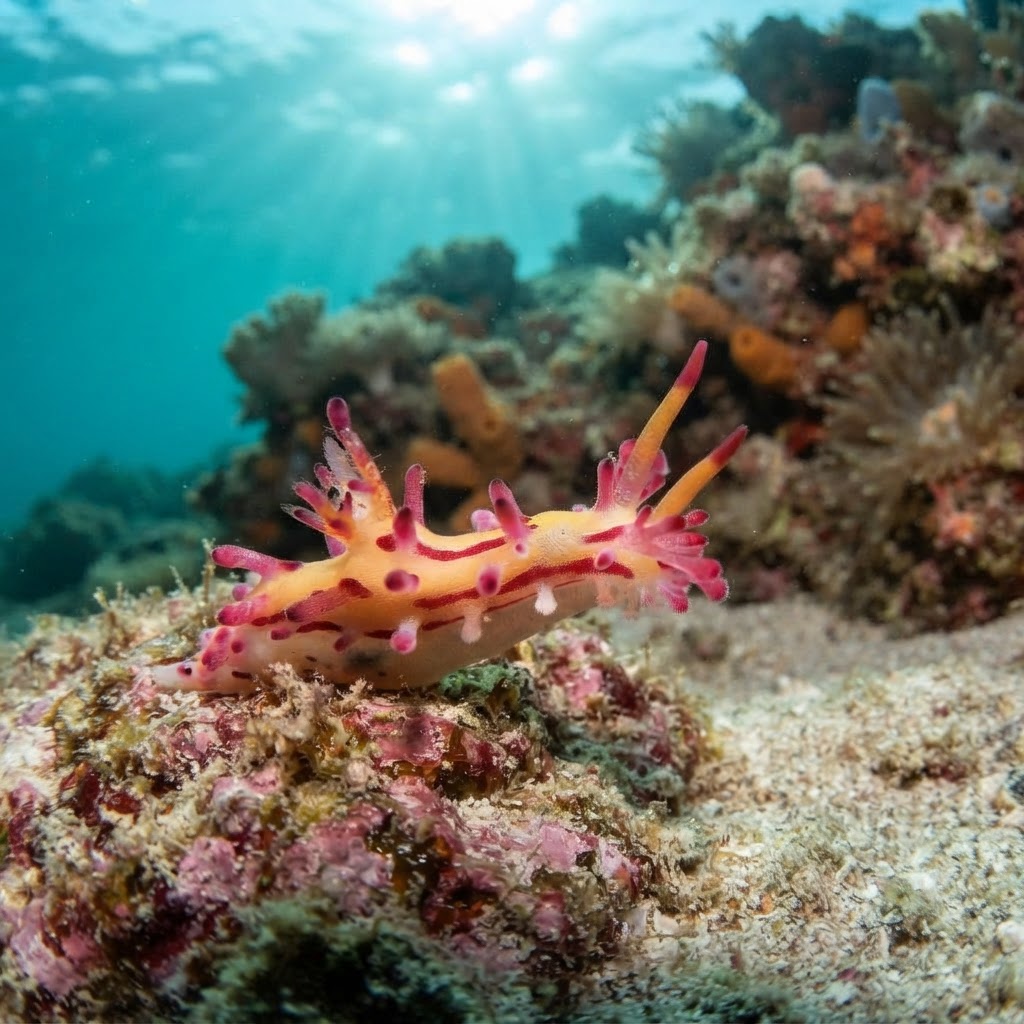
A small, warty-looking nudibranch whose body is studded with rounded tubercles (knobbly bumps) that catch the light in warm orange to pinkish hues, giving it that sunset-tinged look against darker reef rubble. The soft-coral-like texture and low, encrusted profile make it easy to swim straight past unless you are already scanning close to the substrate. Rhinophores (the paired sensory horns on the head) are usually visible as short, clubbed stalks set slightly apart from the body's bumpy surface.
Divers find it sitting motionless on rubble, sponge-encrusted rock or low reef structure, doing what most dorids do best: grazing slowly over its food source and barely reacting to a torch or camera hovering close by. It shows no flight response and will simply keep crawling at its own pace, which makes it a forgiving macro subject once you have actually located one.
Like other dorids in the Aegiridae family, it almost certainly feeds on encrusting sponges, using that diet to build the distinctive tuberculate, camouflaged skin divers use to spot it.
Sightings sit in warm water between roughly 24 and 30C, and there is no detectable seasonal pattern in the logs, so treat it as a year-round possibility on tropical and subtropical reefs rather than something tied to a particular month.
Reef neighbours a diver could mistake it for. Use the identification notes above to tell them apart.
Luzon in the Philippines is by far the strongest area for this species, logged at far more sites there than anywhere else, with Bali in Indonesia and Western Australia also producing consistent finds. Smaller but real numbers come from Peninsular Malaysia's east coast, plus occasional records from Sulawesi and even the UAE's east coast and South Australia.
Mapping where Sunset Knobbed Dorid is logged…
Luzon in the Philippines is the most reliable region, with additional sightings logged in Bali, Indonesia and Western Australia. Smaller numbers turn up on Malaysia's east coast and occasionally in Sulawesi, the UAE and South Australia.
There is no clear seasonal pattern in the sighting data, and it turns up in water from about 24 to 30C, so it is best treated as a year-round find on tropical reefs rather than a seasonal target.
Look for a small, bumpy-bodied nudibranch with rounded tubercles across its back in warm orange to pink tones, sitting still on rubble or encrusted rock. Its low, warty profile and clubbed rhinophores help separate it from smoother, brighter nudibranch species.
Exact size data is not confirmed for this species, but like most Aegiridae dorids it is a small macro subject, generally a few centimetres or less, best searched for with a careful eye or magnifying lens rather than spotted from a distance.
No, this species poses no threat to divers. It is a slow-moving, stationary grazer that can be observed and photographed safely at close range without disturbing it.
Site and sighting data is aggregated from diver logs, iNaturalist and GBIF. For taxonomy and conservation status:
Blue Dragon
3,163 sites