Uranoscopidae spp.
Stargazers are masters of disguise across Florida, the Mediterranean, and Australia. Learn where to find them and how to spot those upward-facing eyes.
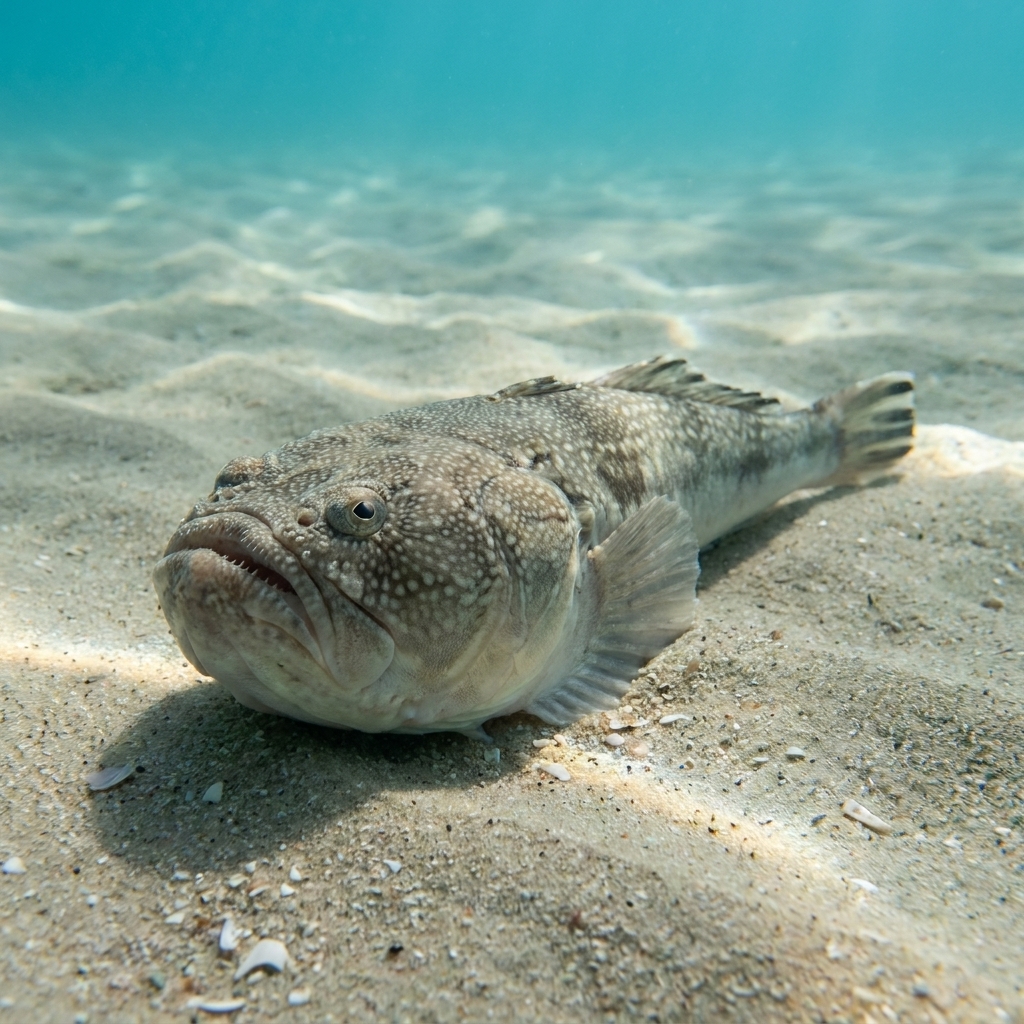
Stargazers are ambush predators built for disappearing into sand or gravel, so most of what you see is just a flat, wide head flush with the seabed. The eyes sit on top of the head and face almost directly upward, giving them an unmistakable scowling expression. Body colour varies across the family from sandy brown to mottled grey, blending with whatever substrate the fish has chosen to bury itself in. The wide, nearly vertical mouth is usually the second thing you notice, often fringed with small skin flaps.
You rarely spot a stargazer moving; the encounter is almost always a stationary fish with its body buried to the gill covers in soft sediment, eyes and mouth exposed and aimed skyward, waiting for prey to pass overhead. They tend to ignore divers who hover calmly above them, but if approached too closely they may sink deeper into the sand or bolt a short distance and rebury. Sandy or silty patches adjacent to reef structure are the most productive places to search, and a slow, methodical scan along the seabed edge is the most reliable technique.
Several members of the family can generate electric discharges from modified eye muscles, and many also carry venomous spines near the gill covers and pectoral fins, making this unassuming buried fish one of the more electrogenically and venomously equipped animals on the sandy bottom.
No clear seasonal peak has emerged from the sighting data, so stargazers are treated as year-round targets. Their observed temperature range of 10.5 to 27.9 °C means they show up in both warm tropical shallows and cooler temperate waters, so the season to dive for them depends on when diving conditions are best at your chosen destination.
Reef neighbours a diver could mistake it for. Use the identification notes above to tell them apart.
Stargazers are most commonly logged in the United States, Australia, Italy, Spain, and Greece, with the strongest concentration of sites in Florida and the Southeast, followed by Queensland in Australia and the Izu Peninsula and Hachijojima in Japan. The Mediterranean is particularly well represented, with strong records across the Costa Blanca, Attica, and both Sicilia and Sardegna regions.
Mapping where Stargazer is logged…
Stargazers turn up across a wide range of destinations. Florida and the Southeast United States lead the records, with strong showings in Queensland, Australia, and the Izu Peninsula in Japan. Mediterranean divers regularly encounter them along the coasts of Greece, Italy, Spain, and Turkey.
There is no clearly defined season for stargazers in the dive data. They have been recorded in water temperatures from around 10 to 28 °C, so they are present year-round across both temperate and tropical dive destinations. Your best bet is to target sandy-bottomed dive sites whenever conditions allow.
Look for a wide, flat head with upward-pointing eyes buried flush with a sandy or gravelly bottom. The rest of the body is usually hidden beneath the substrate. The near-vertical, wide mouth with a perpetual frown is the giveaway. Colour varies from pale sandy brown to mottled grey, matching the surrounding sediment.
Stargazers are not considered dangerous to divers. However, many species within the family carry venomous spines near the gill covers and pectoral fins, so you should never attempt to handle one. Observe from a respectful distance and avoid placing hands on sandy bottoms without looking first.
Yes, several species in the stargazer family can generate small electric discharges from muscles near the eyes. This is used to stun prey or deter threats. It makes stargazers one of the very few marine fish groups that combine both electric and venomous capabilities, which is a remarkable trait for an animal that looks like a grumpy patch of sand.
Site and sighting data is aggregated from diver logs, iNaturalist and GBIF. For taxonomy and conservation status:
Rabbitfish
3,313 sites