Priacanthidae spp.
Spot bigeyes on reefs from Sharm el Sheikh to the Maldives. Warm-water hunters with comically large eyes, here's where, when, and how to find them.
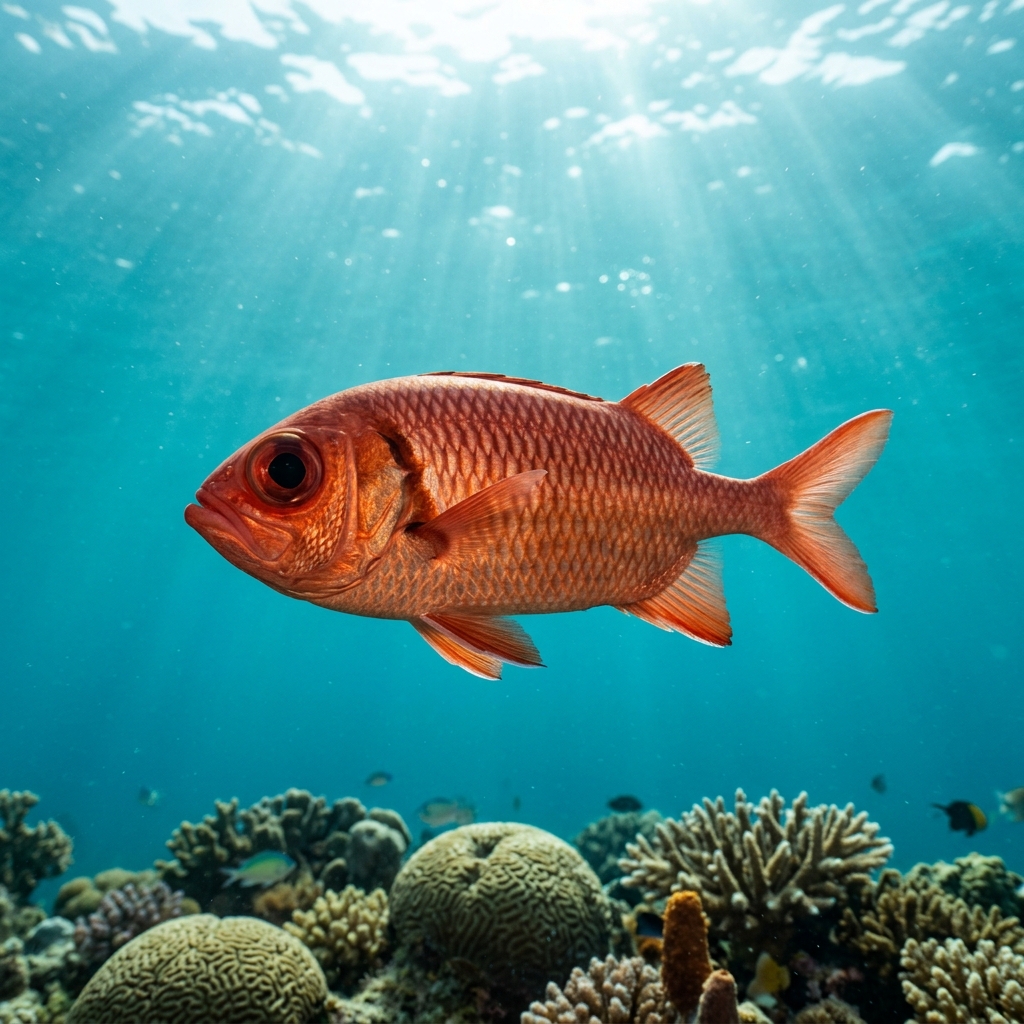
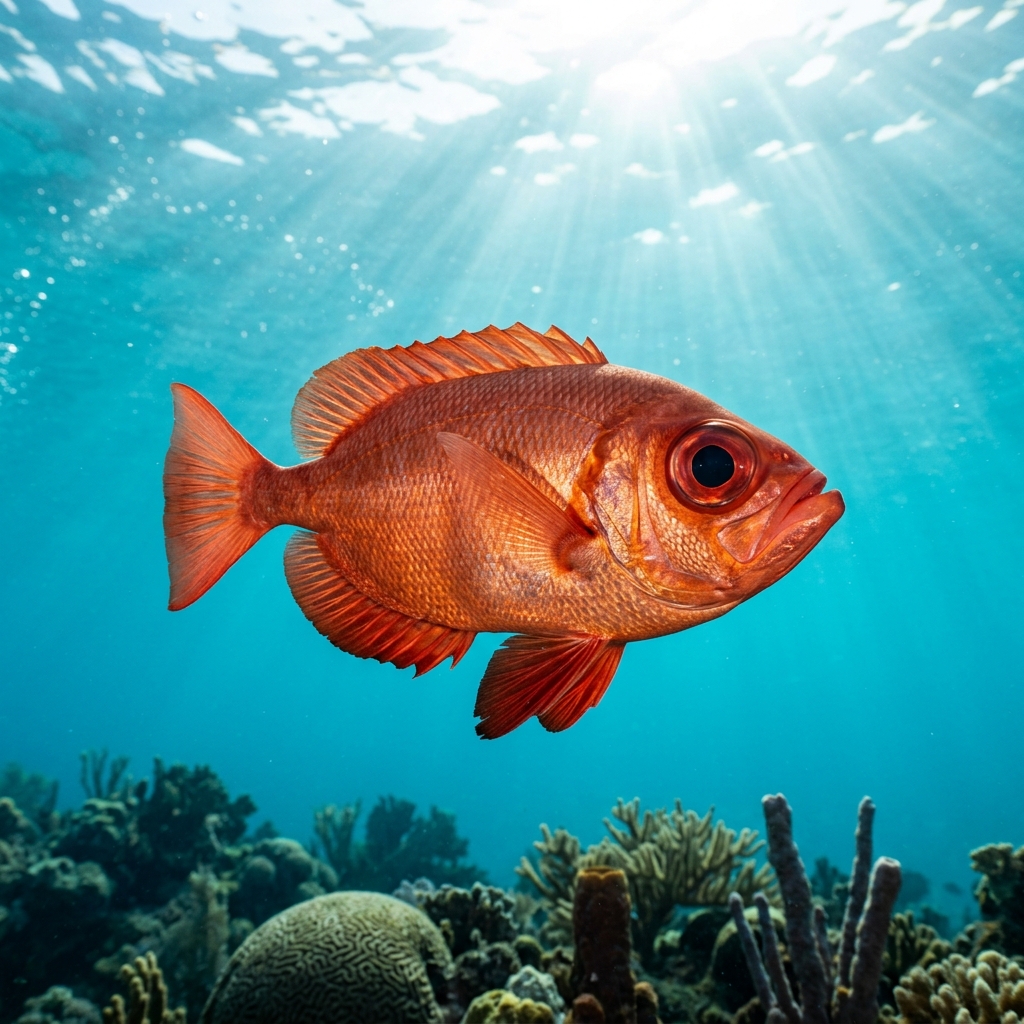
Large, almost comically oversized eyes are the giveaway, disproportionate even by reef-fish standards, and clearly adapted for low-light hunting. Most bigeyes are deep red or reddish-pink in colour, though some species can pale to a blotchy silver-pink when disturbed or in brighter water. The body is deep and laterally compressed (flattened side to side), with rough, spiny fins held upright. Look for them hovering close to the reef ceiling or tucked under ledges, usually within a metre or two of the structure.
Bigeyes are nocturnal hunters that spend daylight hours sheltering in reef crevices, beneath overhangs, or in cave entrances, often hanging motionless in small loose groups. Approach slowly and they tend to hold their position rather than flee, making for relaxed observation. At night they move into open water to feed on zooplankton and small invertebrates, so a torch dive gives you the best chance of watching them actively hunting.
Those outsize eyes are not just for looks, the enlarged pupil gathers more light, giving bigeyes excellent vision in near-darkness and making them effective hunters on moonless nights when most reef fish are inactive.
In the Northern Hemisphere they are present year-round, which makes sense given their preference for warm water in the 23 to 29 °C range, temperatures that tropical reef destinations maintain throughout the year. In the Southern Hemisphere, sightings concentrate between October and May.
Most commonly logged in the Maldives, the Egyptian Red Sea (particularly around Sharm el Sheikh and Marsa Alam), and across Indonesia and the Philippines. Strong populations are also recorded in Florida and the US Southeast, along Brazil's Rio de Janeiro and São Paulo coast, and around Queensland, Australia.
Mapping where Bigeyes is logged…
Bigeyes are widely distributed across tropical reefs. The strongest records come from the Maldives, the Egyptian Red Sea around Sharm el Sheikh and Marsa Alam, Indonesia, and the Philippines. They are also well logged along the Florida coast, Brazil's Rio de Janeiro and São Paulo coast, and in Queensland, Australia.
On Northern Hemisphere tropical reefs they can be found throughout the year, their preferred water temperatures of around 23 to 29 °C are consistently available. In the Southern Hemisphere, sightings are concentrated between October and May. Night dives at any time of year offer the best chance to see them actively feeding rather than just resting under ledges.
The name says it all, look for a deep-bodied fish with eyes that seem far too large for its head. Most species are reddish to pinkish-red with rough, spiny fins. They tend to hover motionless under overhangs or at cave entrances, which helps narrow down the ID even before you clock the eyes.
Size varies across the family, but most species encountered on reef dives are in the range of 20 to 40 cm. A few species can approach 50 cm, but the majority divers see are palm-sized to roughly forearm-length.
Their oversized eyes are an adaptation for nocturnal hunting. The large pupil collects more available light, giving bigeyes sharp vision in the near-darkness of reef crevices and open water at night. During the day they rest in sheltered spots; after dark they move out to hunt zooplankton and small invertebrates.
Site and sighting data is aggregated from diver logs, iNaturalist and GBIF. For taxonomy and conservation status:
Soldierfish
3,612 sites