Zeus faber
John Dory appear most in Jan, Apr, with strong sightings off South Coast England, Sardinia and Brittany. Here's where and when to find one.
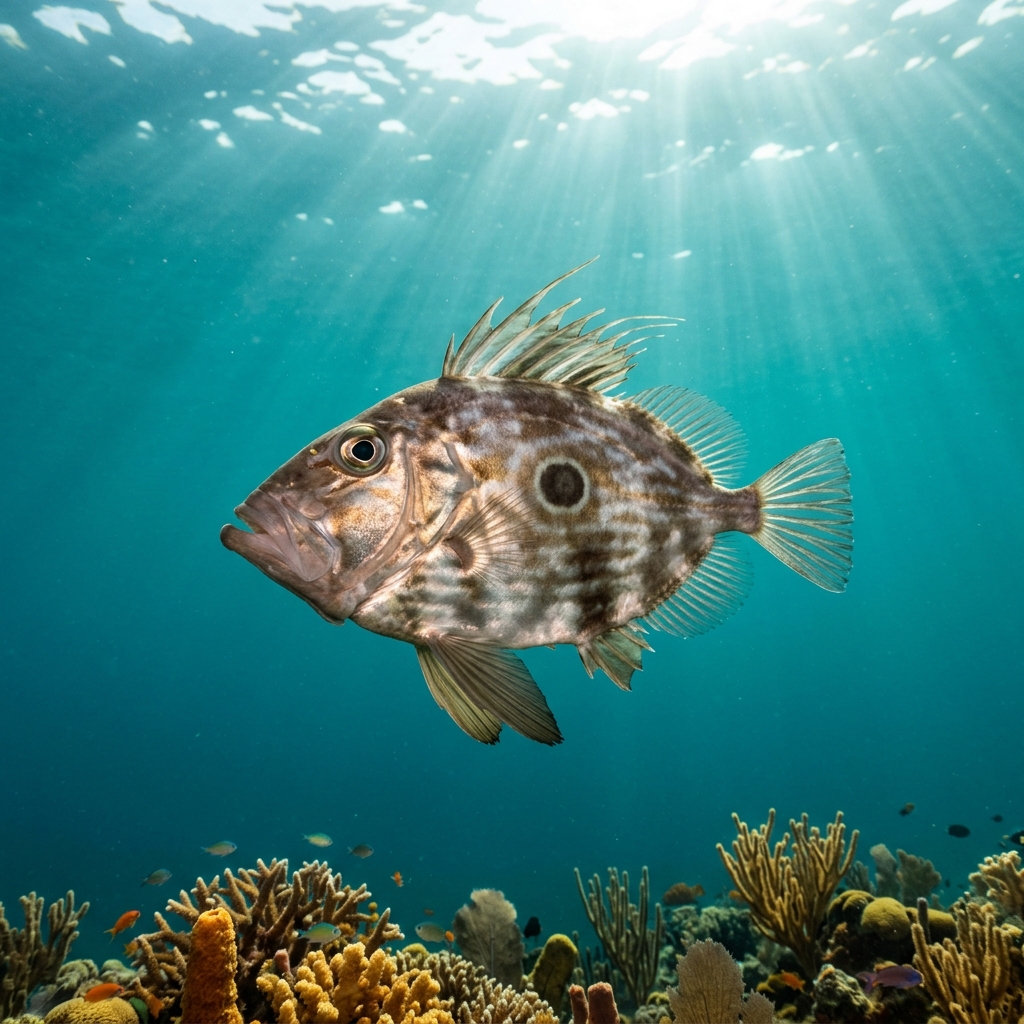
A deeply compressed, disc-shaped body makes it look almost invisible head-on and enormous from the side. The colouring is silver-olive to yellowish-grey, and the single most useful field mark is a large, dark circular blotch on each flank, often ringed in pale yellow. The first dorsal fin carries long, trailing spines that fan out dramatically when the fish is alert. It moves slowly and deliberately, stalking prey with its body angled slightly downward, which is distinctive even at a distance.
John Dory are almost always seen alone, drifting slowly through mid-water or close to sandy or rocky bottoms, body angled nose-down as they stalk small fish. They are not bothered by divers at close range and will often simply continue hunting, which makes for a relaxed encounter. Their approach is stealthy rather than fast: they use their transparent fins to creep within striking distance before snapping out that remarkably extendable jaw.
That distinctive black spot on the flank is thought to function as a false eye to confuse prey and deter predators, a trick that works especially well when the fish turns side-on.
In the Northern Hemisphere, sightings concentrate strongly between January and April, so winter and early spring are the months worth targeting in European waters. This aligns with the species' preference for cooler conditions, observed at water temperatures as low as around 7°C.
John Dory are most widely logged across the Mediterranean and northeastern Atlantic, with Italy, Greece, Spain, France and the United Kingdom leading the site count. The best-represented regions are Brittany and Normandy, the South Coast of England, Sardinia and Tuscany, and Attica in Greece, where sightings are recorded most consistently. Australia also has a meaningful presence, and the species turns up regularly around Japan's Izu Peninsula.
Mapping where John Dory is logged…
The species is logged across a wide spread of European and Mediterranean waters, with particularly strong representation around Italy, Greece, France, Spain and the United Kingdom. Top regions include Brittany and Normandy, South Coast England, Sardinia and Tuscany, and Attica in Greece. Australia and Japan's Izu Peninsula are also reliable areas.
In the Northern Hemisphere, diver sightings peak between January and April. The species favours cooler water, so winter and early spring in the Mediterranean and northeastern Atlantic are the prime window. Targeting these months substantially improves your odds over a summer visit.
Look for a very flat, round-bodied fish that nearly disappears edge-on. The giveaway is a bold, dark circular spot on each side of the body. Combined with long trailing dorsal spines and a slow, nose-down hunting posture, there is really nothing else it could be mistaken for in its range.
Adults commonly reach around 40 to 65 cm in length, though the compressed body shape makes them look larger side-on than they really are. Despite their wide profile, they are relatively light fish for their apparent size.
It uses a highly protrusible (extendable) jaw that can shoot forward to engulf small fish before they have time to react. The John Dory stalks prey by drifting in slowly at an angle, often using its own body as camouflage, then strikes in a fraction of a second. Divers who watch one hunt are usually rewarded with this behaviour if they stay still.
Site and sighting data is aggregated from diver logs, iNaturalist and GBIF. For taxonomy and conservation status:
Soldierfish
3,612 sites