Dendrodoris guttata
A rare nudibranch find logged in Mindanao, Philippines and Western Australia, in warm reef water between 22 and 30C.
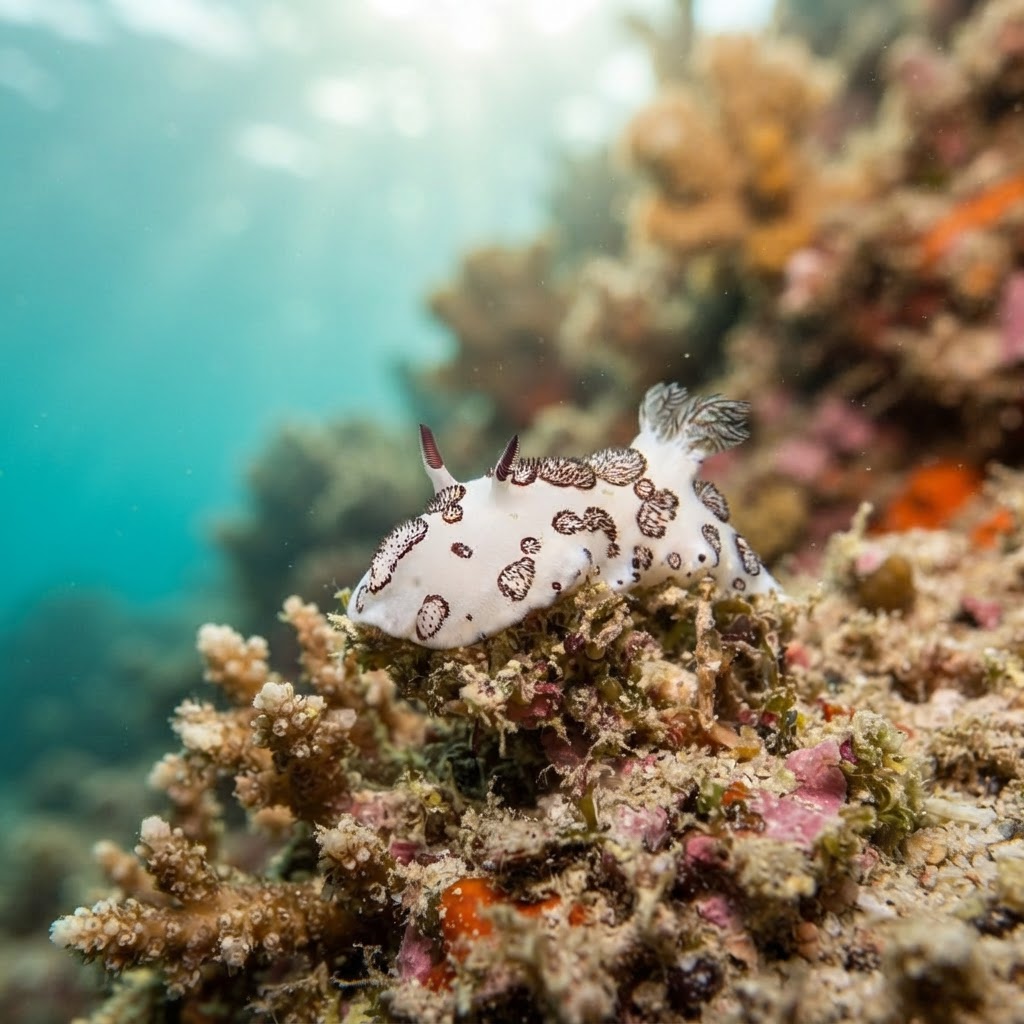
Small, soft-bodied nudibranch with a dark body surface covered in pale, rounded spots that give it a polka-dot look. Like other Dendrodoris species it lacks a hard shell and has a smooth, rubbery mantle rather than the frilly gills of many other nudibranchs, with feathery gill tufts visible near the rear if you look closely. Size in the water is small, so divers usually spot it on close reef scans rather than from a distance.
Divers log this one moving slowly across reef substrate or resting in the open on hard bottom, doing what most Dendrodoris nudibranchs do: grazing sponges at an unhurried pace. It shows no real reaction to divers beyond continuing to crawl, so a slow, careful look with a torch on a night or day reef scan is the best way to pick it out among the sponge-covered rock it feeds on.
Dendrodoris nudibranchs, this species included, lack the radula (the rasping tongue most snails and slugs use to feed) as adults and instead absorb sponge tissue directly, a feeding style shared across the genus.
No clear seasonal pattern shows up in the sighting data, and its observed range of 21.9 to 29.7C spans typical year-round tropical and subtropical reef temperatures, so there is no strong reason to time a trip around a particular month.
Reef neighbours a diver could mistake it for. Use the identification notes above to tell them apart.
Logged sightings so far come from Mindanao in the Philippines and Western Australia, making this a real two-country find rather than a species with a wide known range. Both logged sites report it as rare, so treat any sighting as a bonus rather than a target on a dive plan.
Mapping where Polka-dot Sucking Dorid is logged…
Confirmed sightings come from Mindanao in the Philippines and Western Australia in Australia. It is logged as rare at both sites, so it is a possible find rather than a reliable one on any single dive.
There is no detected season in the sighting data. It has been recorded in water between roughly 22 and 30C, a range typical of tropical reefs year-round, so timing your trip around a particular month is not necessary.
Look for a small, soft-bodied slug with a dark mantle covered in pale round spots and no hard shell. Feathery gill tufts sit near the rear of the body, and it moves slowly across sponge-covered rock or reef substrate.
Exact size data is not documented for this species, but it sits in the small size class typical of Dendrodoris nudibranchs, meaning divers generally spot it during close, deliberate reef scans rather than at a glance.
As an adult it has no radula, the rasping feeding tongue most sea slugs use. Instead, like other Dendrodoris species, it feeds by absorbing sponge tissue directly, a trait shared across its genus.
Site and sighting data is aggregated from diver logs, iNaturalist and GBIF. For taxonomy and conservation status:
Blue Dragon
3,163 sites