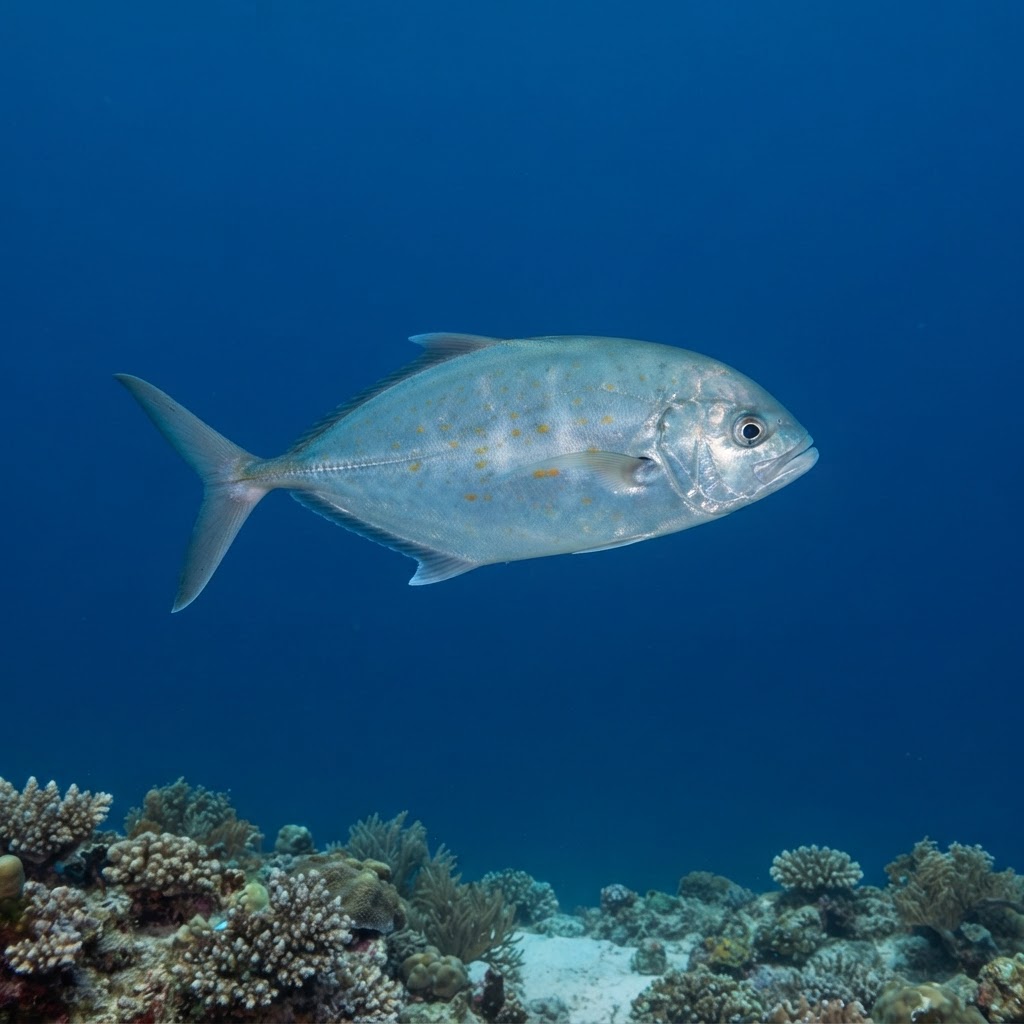
Flavocaranx bajad
Common in Egypt's Marsa Alam and Raja Ampat reefs, this silver jack with orange flank spots shows up year-round in warm 25-29C water.
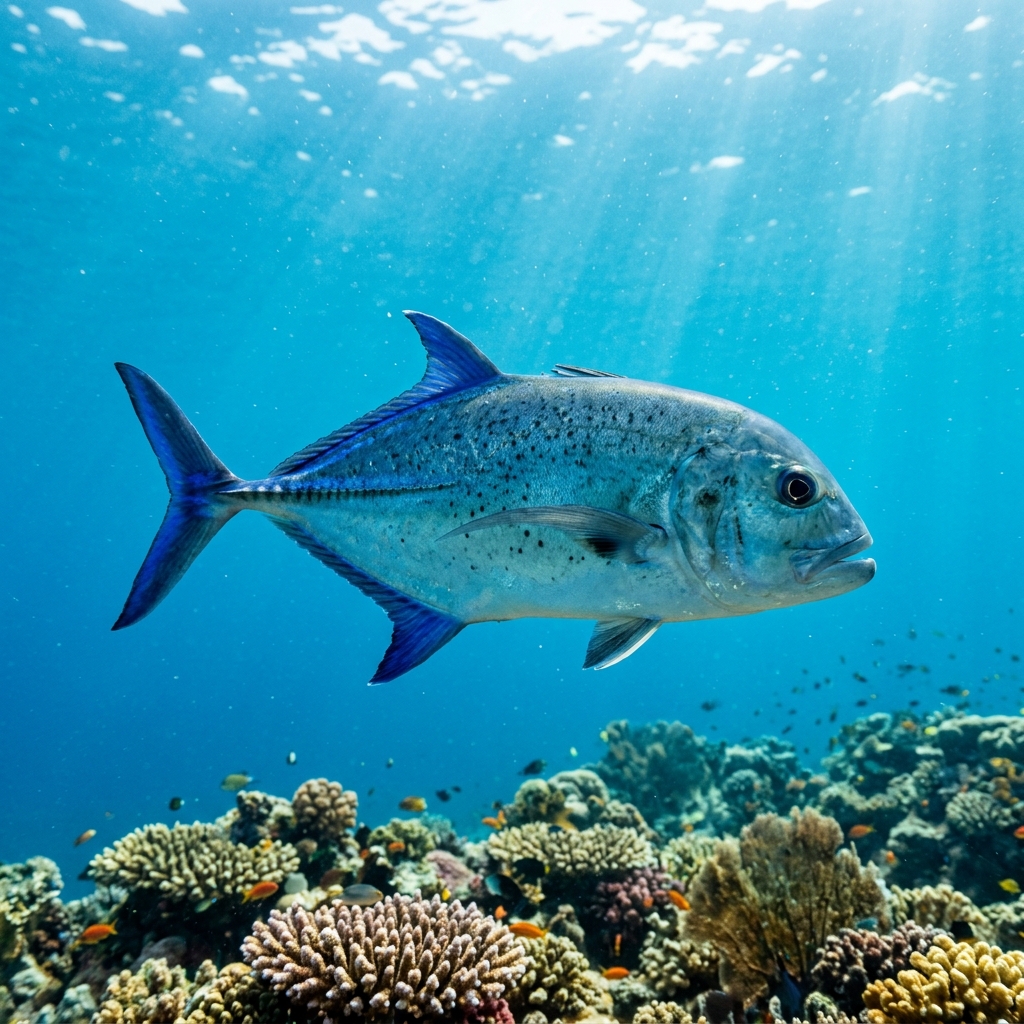
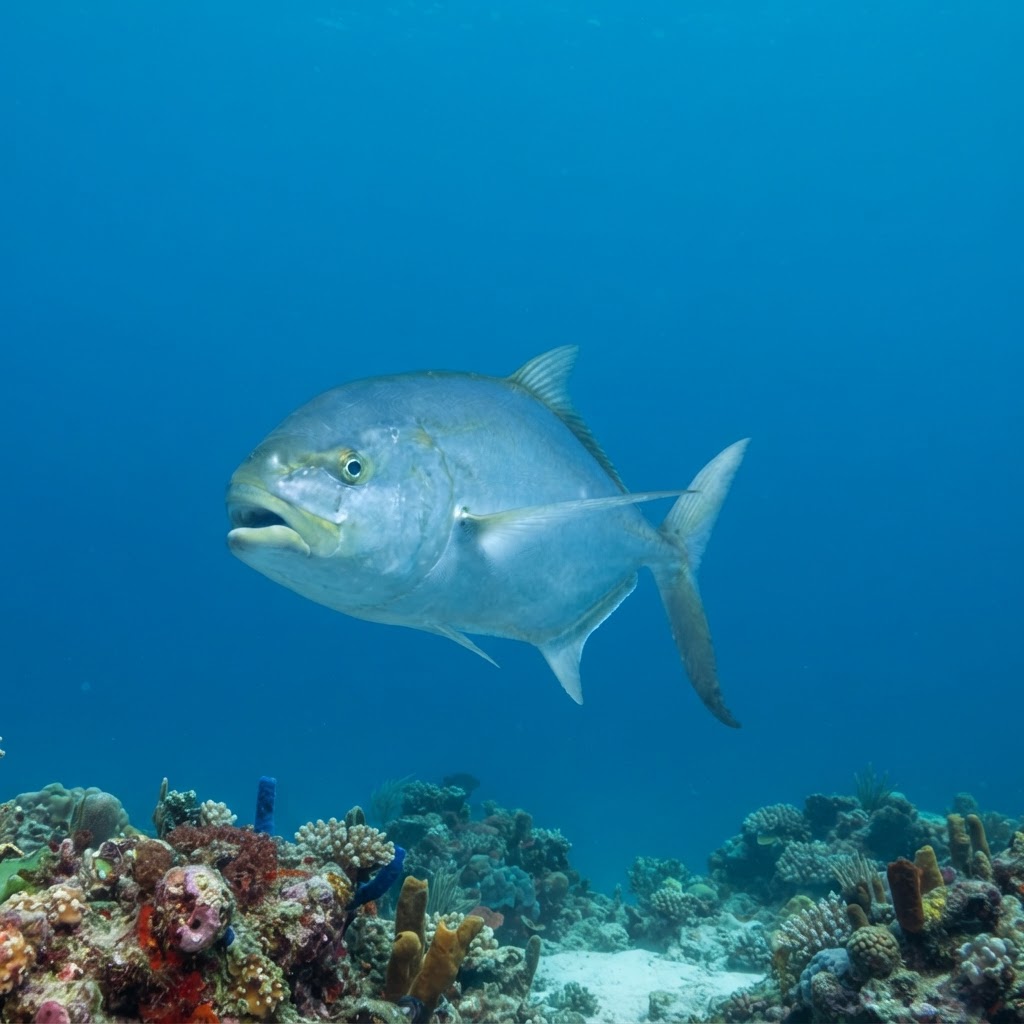
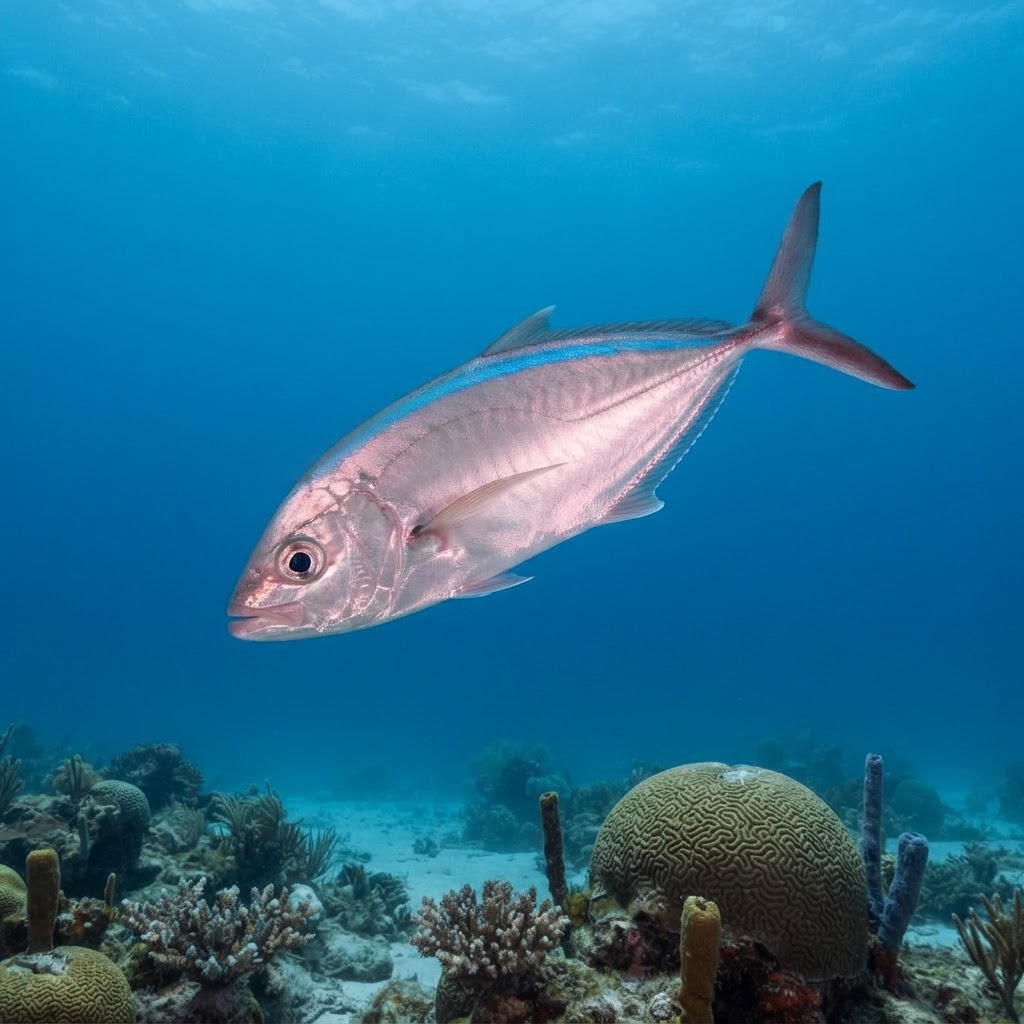
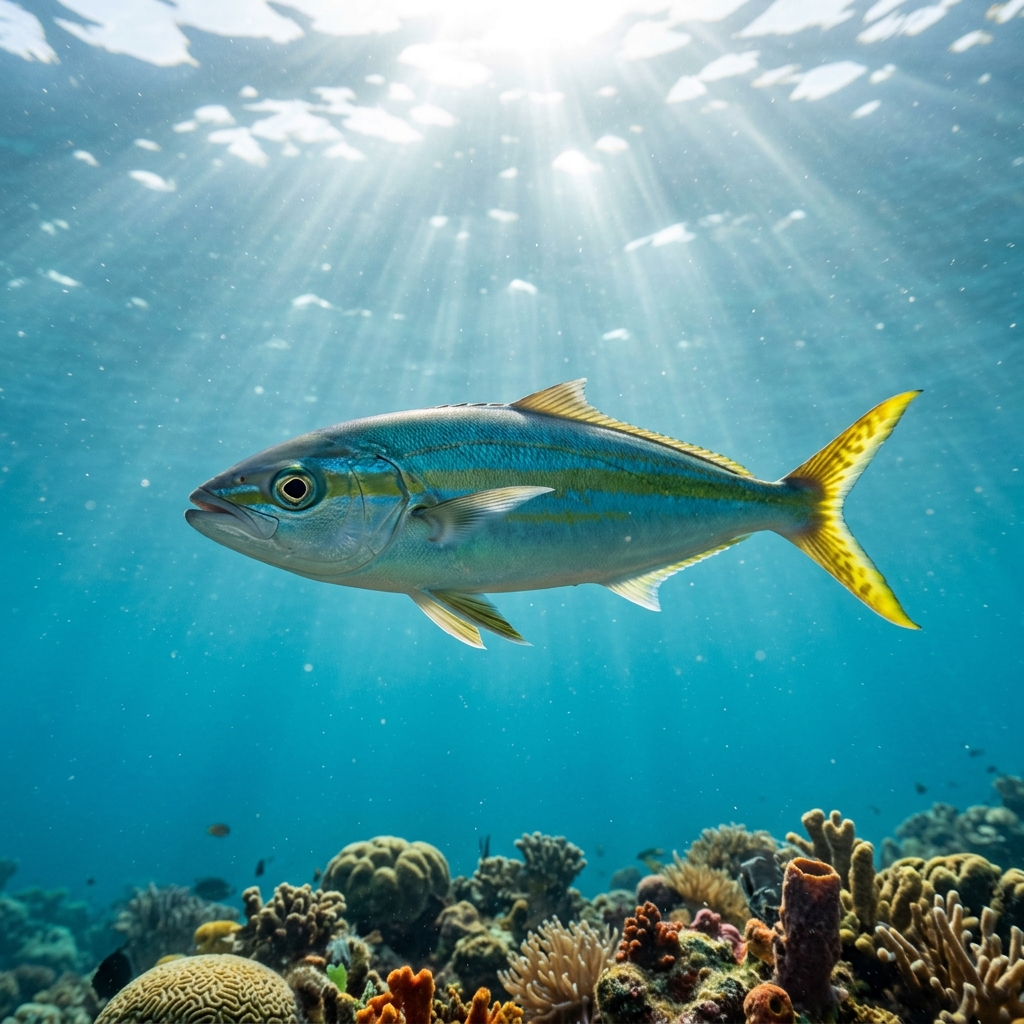
Look for a deep-bodied, silvery jack around 38 cm with a scatter of small orange to yellow spots along the upper flanks, easiest to pick out when sunlight hits the body at an angle. The profile is classic trevally: a steep forehead, forked tail, and a slightly compressed, oval-shaped body built for quick bursts rather than sustained speed. It usually shows singly or in small loose groups over reef rather than in the open-water schools some other jacks form.
Divers most often find it patrolling close to reef structure, cruising slowly over coral heads or hovering near drop-offs while scanning for smaller fish and invertebrates to ambush. It tends to be unbothered by divers, holding its distance rather than fleeing outright, which makes for steady if not close-up viewing. Most sightings are of single fish or small loose groups rather than the tight schools associated with some other jacks.
Despite the name, the orange spotting can fade or look almost absent on some individuals depending on light and depth, so divers often rely on the overall body shape and silvery jack profile as much as the spots themselves.
No clear seasonal pattern shows up in sighting data, so treat this as a year-round species. It sits comfortably in 25.5 to 29.2C water, which covers Red Sea, Indonesian, and Thai reefs for most of the year, so timing your trip around water temperature rather than a specific month is the better approach.
Reef neighbours a diver could mistake it for. Use the identification notes above to tell them apart.
This is a Red Sea regular, most commonly logged around Marsa Alam and the Deep South and South Sinai in Egypt, with a further stronghold in Raja Ampat, Indonesia. It also turns up reliably at Koh Tao in Thailand and the Daymaniyat Islands in Oman, with smaller but consistent numbers from Palawan in the Philippines and the Red Sea Riviera.
Mapping where Orange-spotted Trevally is logged…
Egypt is the standout location, especially Marsa Alam and the Deep South and South Sinai, with strong numbers too in Raja Ampat, Indonesia and around Koh Tao, Thailand. The Daymaniyat Islands in Oman are another reliable spot.
There is no strong seasonal signal in sighting data, so it is considered a year-round species. It favours water between roughly 25.5 and 29.2C, which fits most of the year on the reefs where it is found.
Look for a silvery, deep-bodied jack around 38 cm with small orange spots scattered along the upper flanks, a steep forehead, and a forked tail. It is usually seen alone or in small groups cruising close to reef structure rather than in big open-water schools.
They typically reach around 38 cm in length, making them a mid-sized reef jack rather than one of the larger open-water trevallies.
No, they pose no danger to divers. They are carnivorous reef predators focused on small fish and invertebrates, and they typically keep a comfortable distance from divers rather than approaching.
Site and sighting data is aggregated from diver logs, iNaturalist and GBIF. For taxonomy and conservation status:
Bigeye Trevally
2,591 sites