Thuridilla neona
A 1cm neon slug logged mostly on Queensland reefs, warm water 21.5-27.5C, present year-round for sharp-eyed divers.
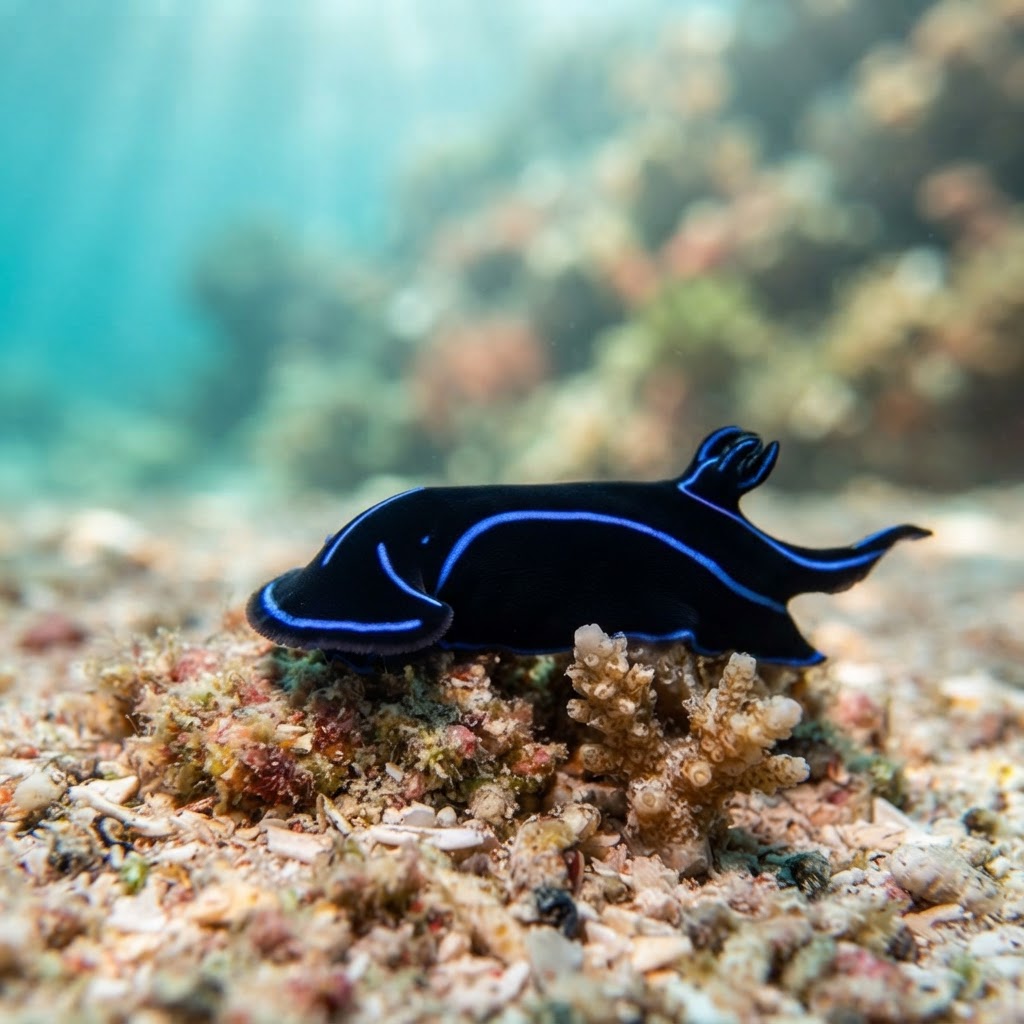
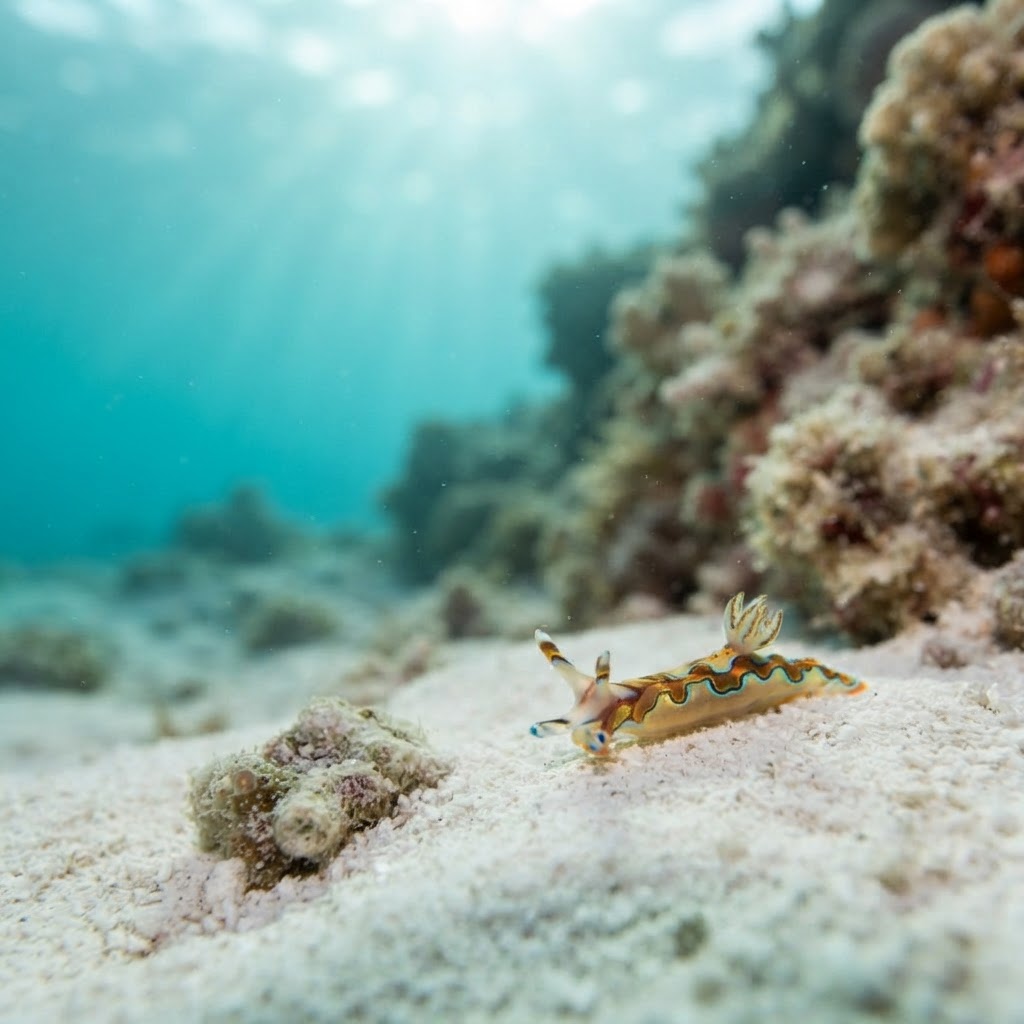
Barely a centimetre long, so you're hunting for a bright streak rather than a shape. Look for a slender, elongated body carrying iridescent blue longitudinal stripes over an orange to yellow-green background, with rolled parapodial flaps (the wing-like side lobes) running along its length. The head end tapers to a pair of short, upward-curling rhinophores (sensory horns), and the overall effect underwater is closer to a fleck of coloured glass than an animal until it moves.
Found grazing slowly over algae-covered rock and rubble, usually tucked into cracks or low-light corners where its colour blends with encrusting growth rather than standing out. It shows no reaction to divers beyond continuing to feed, since it has no real means of fleeing and little reason to. Most sightings come from divers deliberately scanning small patches of reef rather than spotting it in open water.
Like other sap-sucking slugs in its family, it feeds on algae and can retain the algae's chloroplasts in its own tissue, effectively running a bit of photosynthesis inside its own body between meals.
No clear seasonal pattern shows up in the data, and its comfortable range of 21.5 to 27.5C spans most of the tropical and subtropical diving calendar, so treat it as a year-round find on the reefs where it's known.
Reef neighbours a diver could mistake it for. Use the identification notes above to tell them apart.
Most reliably logged on reef sites around Queensland, Australia, which accounts for the bulk of recorded sightings, with an additional record from New South Wales. It also turns up in Hawaii, United States, so both the western and central Pacific are worth checking if you're specifically hunting this one.
Mapping where Neon Thuridilla is logged…
Queensland, Australia is by far the strongest region for sightings, with additional records from New South Wales and Hawaii in the United States. It's a species you find by searching reef crevices closely rather than by picking a famous dive site.
There's no detected seasonal pattern, and its water-temperature niche of 21.5 to 27.5C covers most of the year on the reefs where it's recorded, so sightings are essentially year-round.
Look for a slender 1cm slug with iridescent blue stripes running along an orange or yellow-green body, plus small upturned rhinophores at the front. Its tiny size means most divers spot it only when deliberately scanning algae-covered rock and rubble.
About 1cm long, making it one of the smaller sea slugs divers try to photograph, and easy to miss without a slow, close look at the substrate.
No. It poses no threat to divers and has no means of harming anyone; the main challenge is simply finding it given its small size.
It belongs to a group of slugs that can hold onto chloroplasts from the algae they eat, letting their tissue carry out a limited amount of photosynthesis for a while after feeding.
Site and sighting data is aggregated from diver logs, iNaturalist and GBIF. For taxonomy and conservation status:
Light-spotted Aegires
3,168 sites