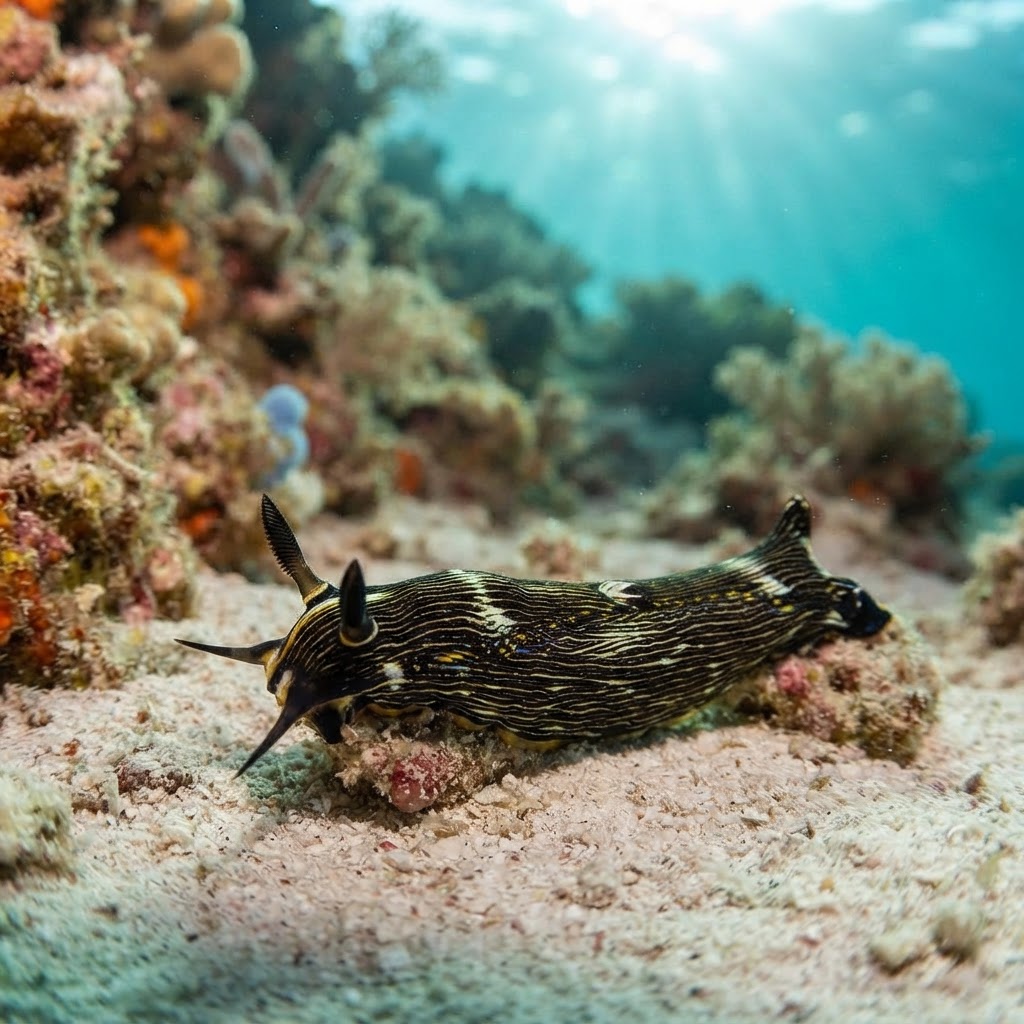
Navanax gemmatus
Sighted across Colombia's Caribbean Coast and Guadeloupe's Grande-Terre in warm 25-31C water, this slug rewards divers who scan the sand at night.
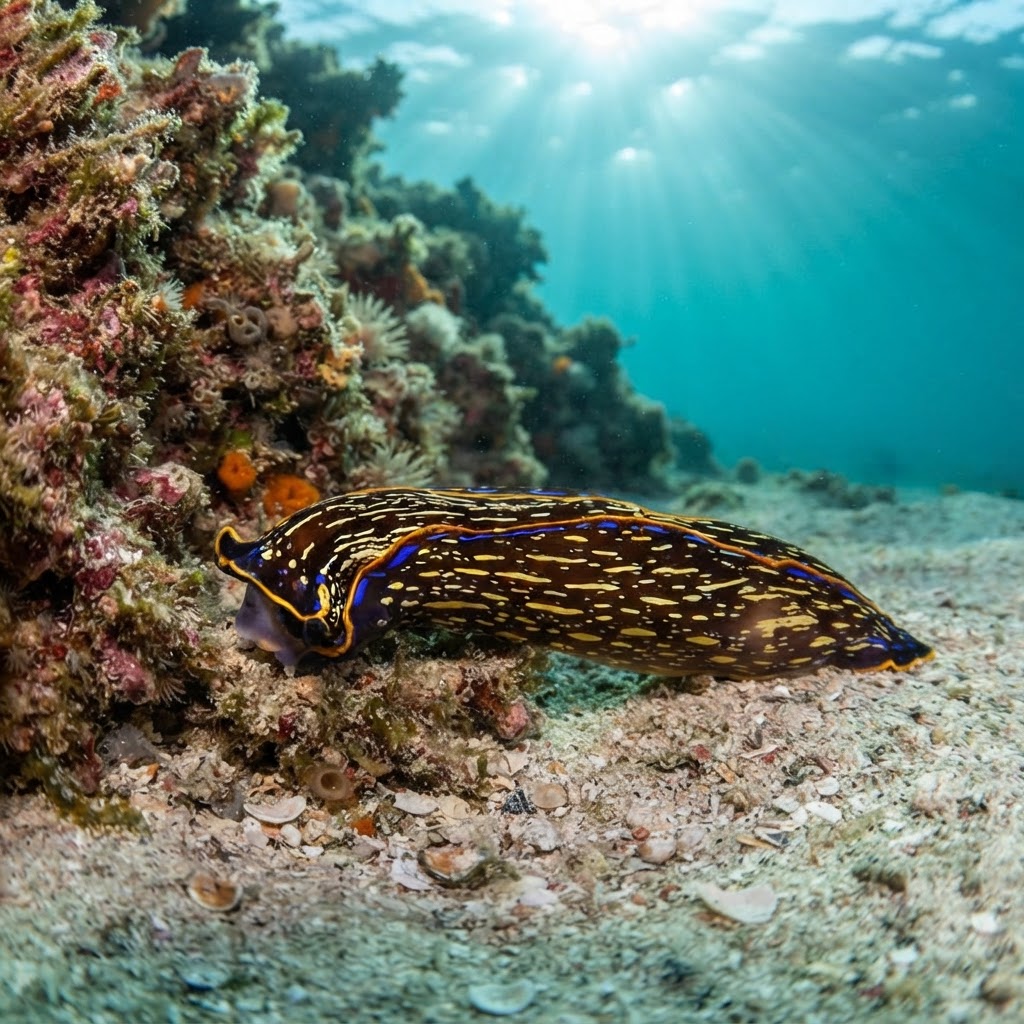
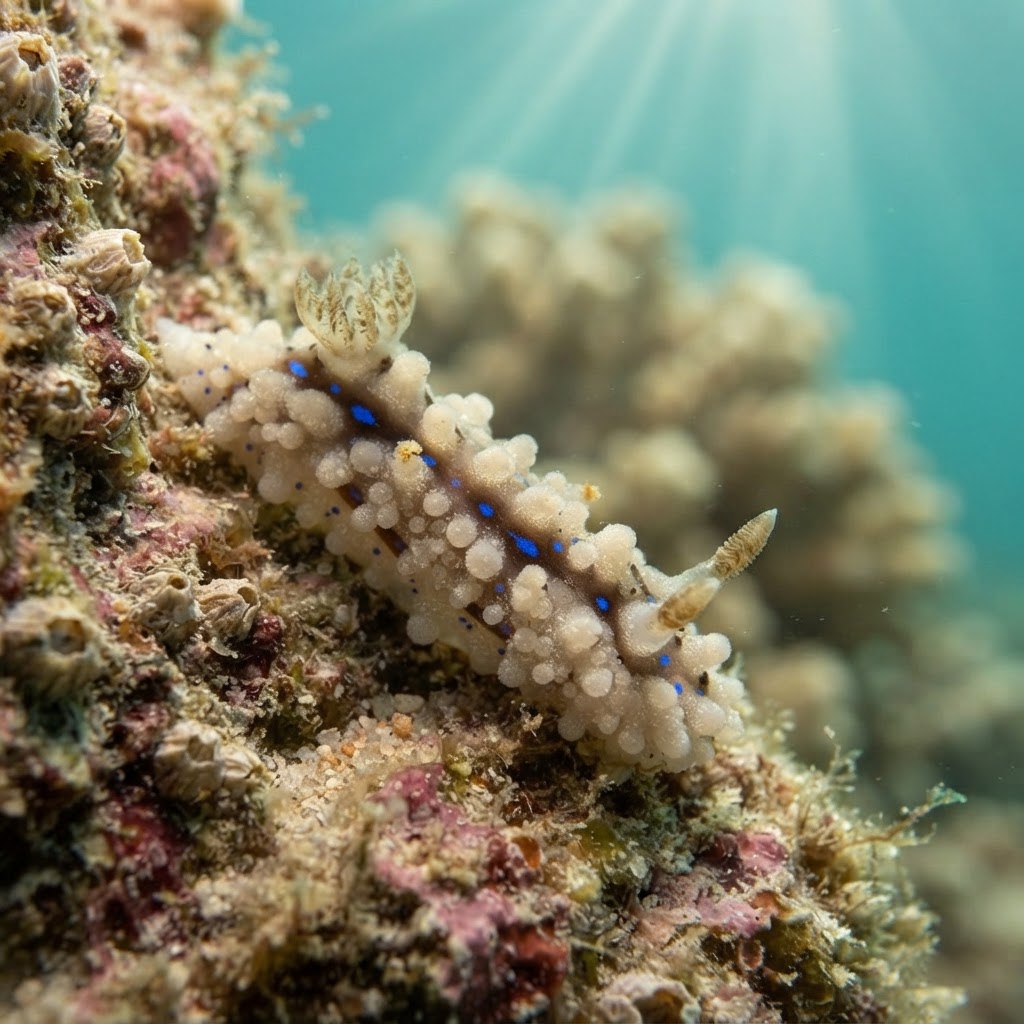
Elongate and soft-bodied, stretching out as it glides across sand or rubble, with a golden-to-olive-brown body scattered with iridescent blue spots and fine pale lines running lengthwise. The head end is rounded and blunt, without the projecting tentacles or rhinophores that give away many other sea slugs, and the body tapers to a pointed tail. Look for it moving in a smooth, unhurried slide over open bottom rather than clinging to coral or sponge.
Divers most often find it cruising slowly across open sand, rubble, or seagrass patches rather than perched on coral, usually solo. It shows little reaction to a diver's presence, continuing its steady glide across the bottom, which makes for an easy, unhurried subject once spotted. Most logs describe it as an uncommon find, so a careful look at bare sand patches near a reef edge is often what turns one up.
Members of this family are active hunters of other sea slugs and sea hares, tracking prey across the sand by following their slime trails, a rare predatory habit among slugs most divers assume are simple grazers.
No clear seasonal pattern shows up in the sightings, and with a comfortable temperature range of roughly 25 to 31C it turns up on these Caribbean reefs year-round rather than in a particular month.
Reef neighbours a diver could mistake it for. Use the identification notes above to tell them apart.
Most reliably logged along Colombia's Caribbean Coast and across Guadeloupe, especially Grande-Terre, Basse-Terre, and Îles des Saintes, with smaller but consistent numbers around Willemstad and the south coast of Curacao. A single US Virgin Islands record around Saint John rounds out the known range in the data.
Mapping where Jewelled Navanax is logged…
It shows up most often on Colombia's Caribbean Coast and across Guadeloupe, particularly Grande-Terre, Basse-Terre, and Îles des Saintes. Smaller numbers are logged around Curacao's Willemstad and south coast, with an occasional sighting near Saint John in the US Virgin Islands.
There is no strong seasonal signal in the sightings, so it is treated as a year-round find. Its comfort range of about 25 to 31C matches these Caribbean reefs for most of the year, so timing your trip around the season is not necessary.
Look for an elongate, soft-bodied slug in golden-brown tones with scattered iridescent blue spots and fine pale stripes, gliding smoothly over sand or rubble. It lacks obvious head tentacles, giving it a blunt, streamlined front end compared to many other sea slugs.
Unlike many sea slugs that graze algae or sponge, this species and its relatives actively hunt other slugs and sea hares, following their slime trails across the sand to track them down. It is one of the few predatory slugs a diver is likely to encounter on a reef.
Site and sighting data is aggregated from diver logs, iNaturalist and GBIF. For taxonomy and conservation status:
Light-spotted Aegires
3,168 sites