Thuridilla moebii
A speckled sea slug logged year-round in Western Australia and Reunion's Saint-Paul, in 22.7-28.7C reef water. Here's how to spot one.
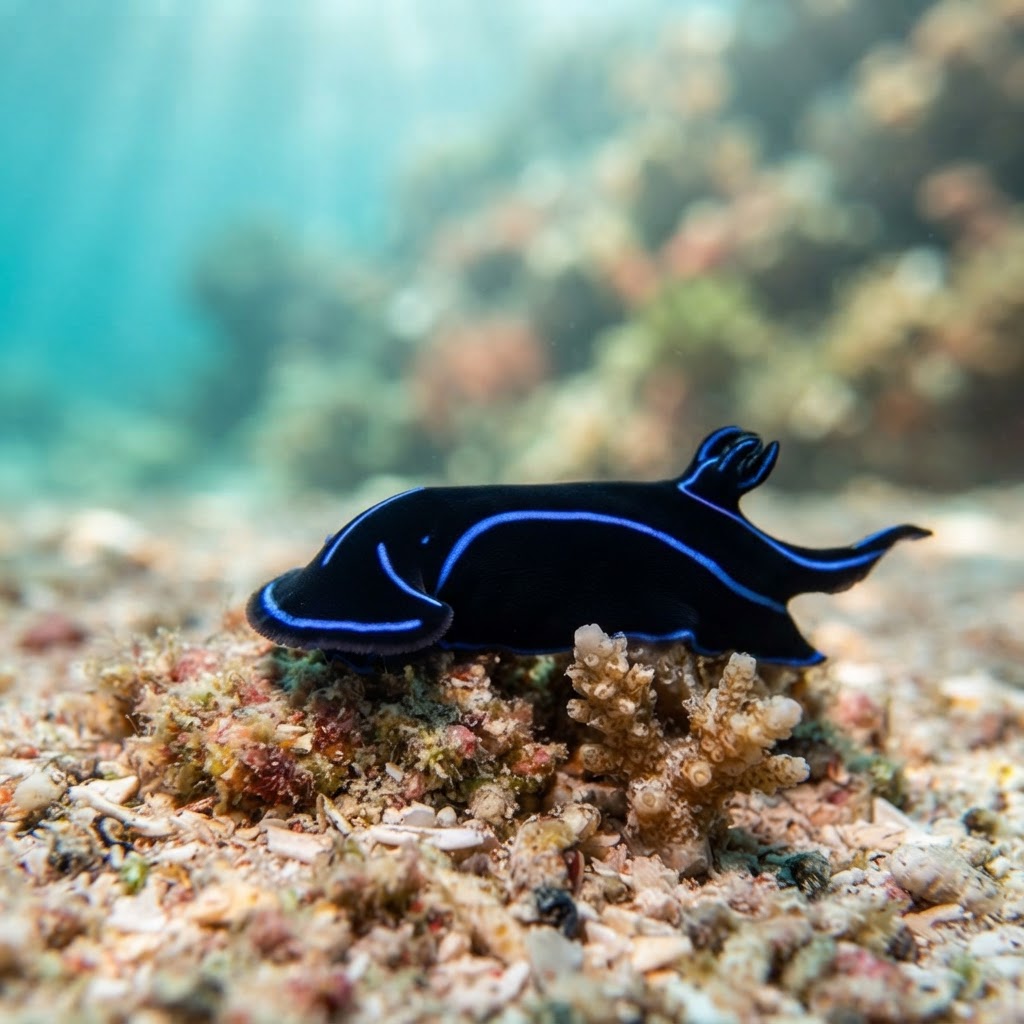
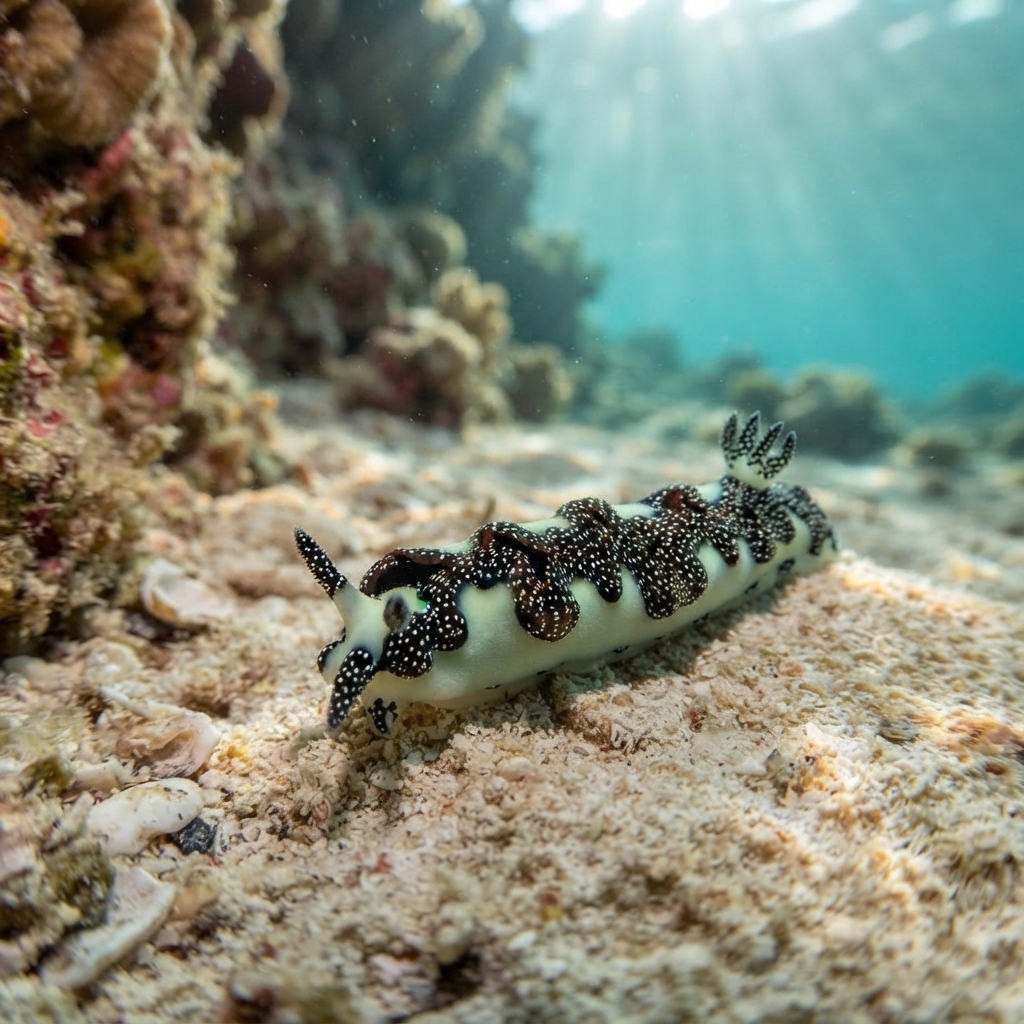
A slender sea slug with a dark, almost black body scattered with fine white to pale blue speckling, giving it the starry look behind the name. The edges of the parapodia (the flap-like wings running down its sides) are often lined in electric blue or turquoise. It sits only a few centimetres long, moving slowly across rock and rubble, so divers usually spot it as a small dark smudge with a bright rim rather than at a distance.
Divers find it grazing slowly over rock, rubble and algae-covered surfaces, usually low on the reef where it can be easy to miss against the substrate. It shows no reaction to divers beyond its usual unhurried crawl, making it a patient photo subject once you've picked it out. Most logs describe it as uncommon to rare at a given site, so it rewards a slow look rather than a swim-by.
Like other members of its family, it likely feeds on algae and can incorporate the algae's chloroplasts into its own tissue, a trick called kleptoplasty that lets some sacoglossan slugs run on borrowed photosynthesis for a while after feeding.
No clear seasonal pattern shows up in the sighting data, so treat it as a year-round find. It's been logged in water from 22.7 to 28.7C, a comfortable range for most of the year on the reefs where it turns up.
Reef neighbours a diver could mistake it for. Use the identification notes above to tell them apart.
Most reliably logged in Western Australia, which accounts for the bulk of sightings, with a strong secondary population around Saint-Paul in Reunion and a smaller record from nearby Saint-Pierre. Outside these two countries it has not been logged with any regularity, so Western Australia and Reunion's west coast are the places to plan around.
Mapping where Milky Way Sap Sucker is logged…
Western Australia has the most logged sightings, with a further cluster around Saint-Paul in Reunion and a smaller record at Saint-Pierre. It hasn't been reported with any regularity outside these two countries.
There's no detected seasonal pattern, so sightings happen year-round. It's been recorded in water between 22.7 and 28.7C, which covers most of the diving calendar at its known sites.
Look for a small, slow-moving slug with a dark body flecked with fine white or pale blue speckles and a bright blue-edged margin along its sides. It's usually found low on the reef against rock or rubble rather than out in the open.
Exact size data isn't available, but like most Thuridilla sea slugs it stays small, typically only a few centimetres long, which is why divers often overlook it against the substrate.
It belongs to a slug family known for kleptoplasty, where they feed on algae and hold onto the algae's chloroplasts inside their own tissue, effectively running on stolen photosynthesis for a while afterwards.
Site and sighting data is aggregated from diver logs, iNaturalist and GBIF. For taxonomy and conservation status:
Light-spotted Aegires
3,168 sites