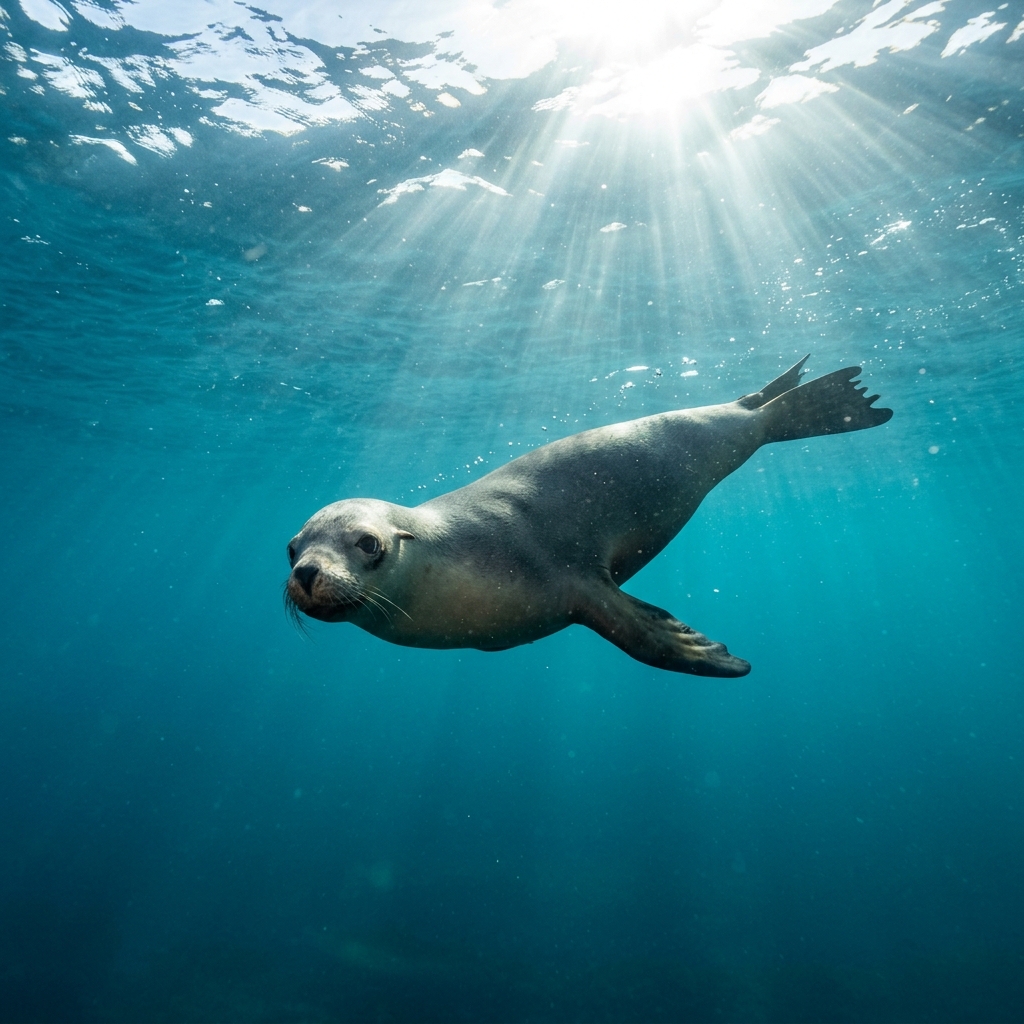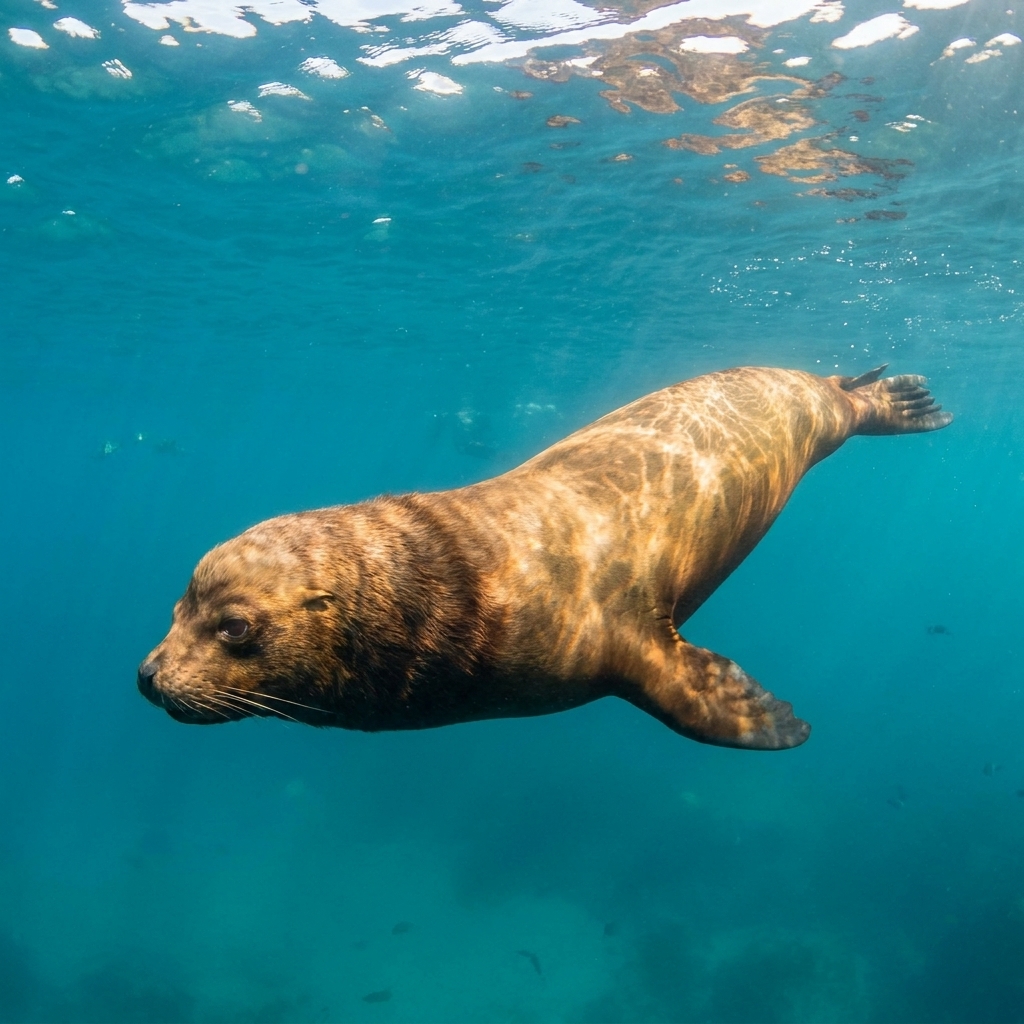
Arctocephalus forsteri
Curious and playful, long-nosed fur seals are most reliably seen in Western Cape, Western Australia and New Zealand from June through April.
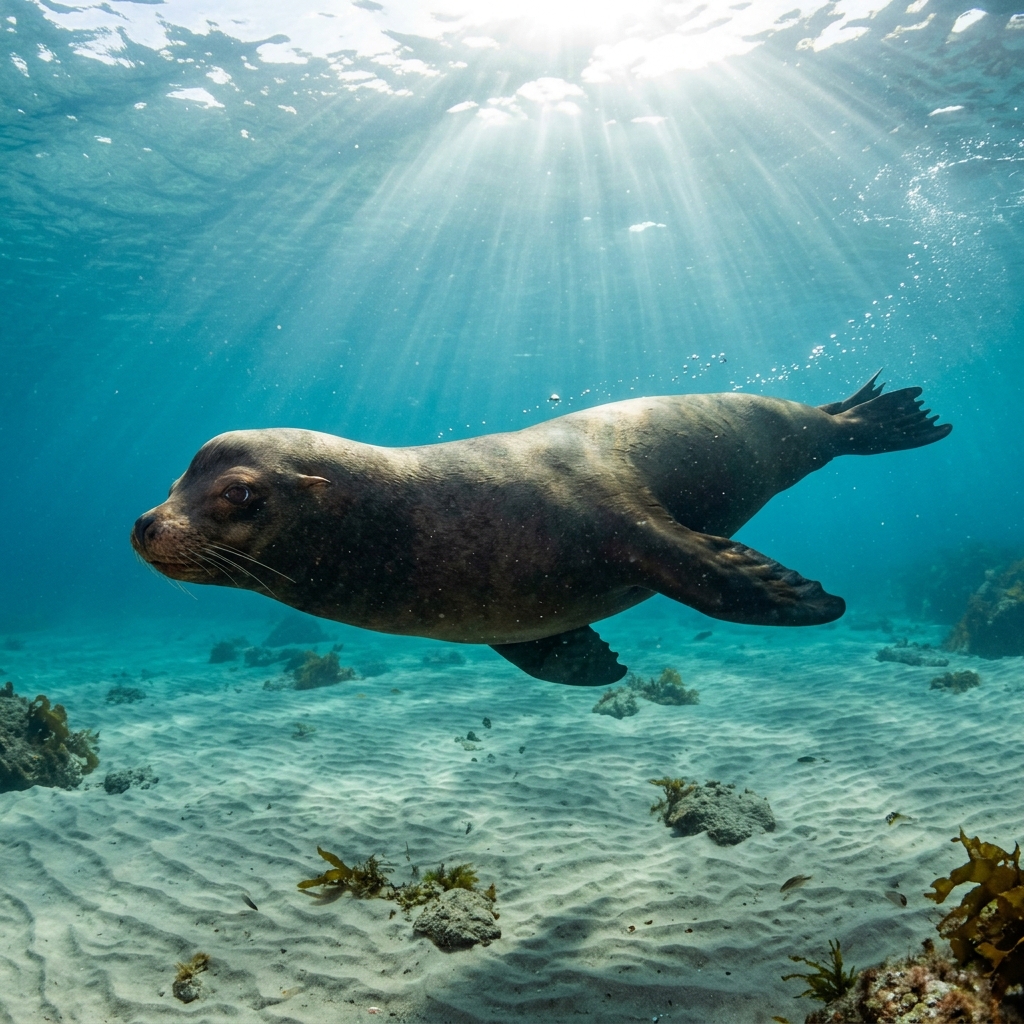
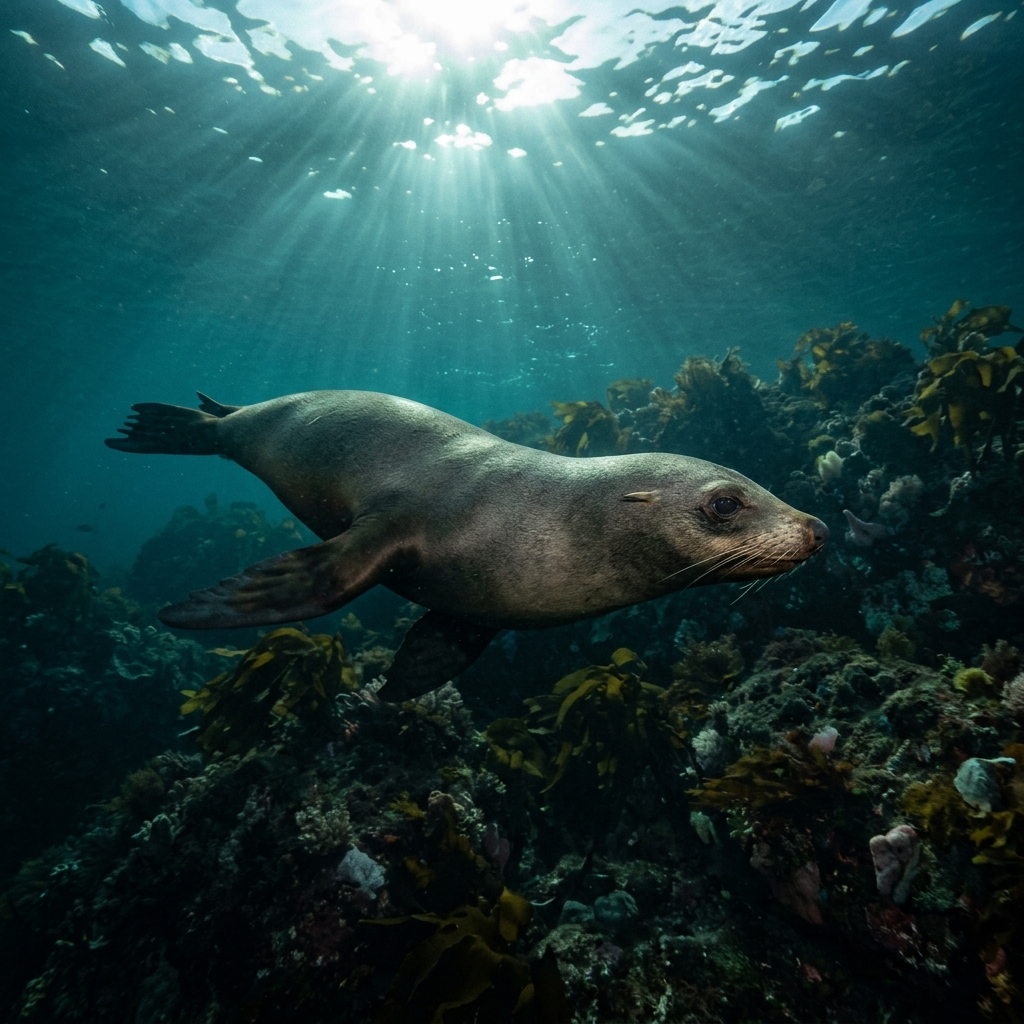
A medium-sized fur seal reaching roughly 140 cm, with a distinctively long, narrow snout that sets it apart from most other southern fur seals. Coat colour is dark chocolate-brown, often appearing nearly black when wet, with paler tones on the chest and belly as the fur dries. Males are noticeably bulkier, with a thicker neck and broader chest; females are slender and roughly half the body mass. Underwater, look for the long pointed muzzle first, it is the quickest field mark at distance.
Long-nosed fur seals are inquisitive around divers and will often spiral in close for a look, especially younger animals. They are most active during the day, and you may catch them hunting fish and squid on the reef or simply loafing on rocks before slipping into the water. Social groups can be lively, playful sparring and loud vocalisations are part of the normal scene, so take a moment to watch the interactions between individuals rather than focusing only on the animal nearest to you.
Despite a habitat listed as bathydemersal (deep, near the seafloor), these seals are capable of remarkably deep foraging dives and can cover considerable distances from their haul-out colonies in a single feeding trip.
Sightings concentrate from June through April across the Southern Hemisphere range, suggesting only a brief mid-autumn lull in May. Water temperatures at logged sites typically run between about 11 and 22 °C, pointing to cool to warm temperate conditions rather than any single season.
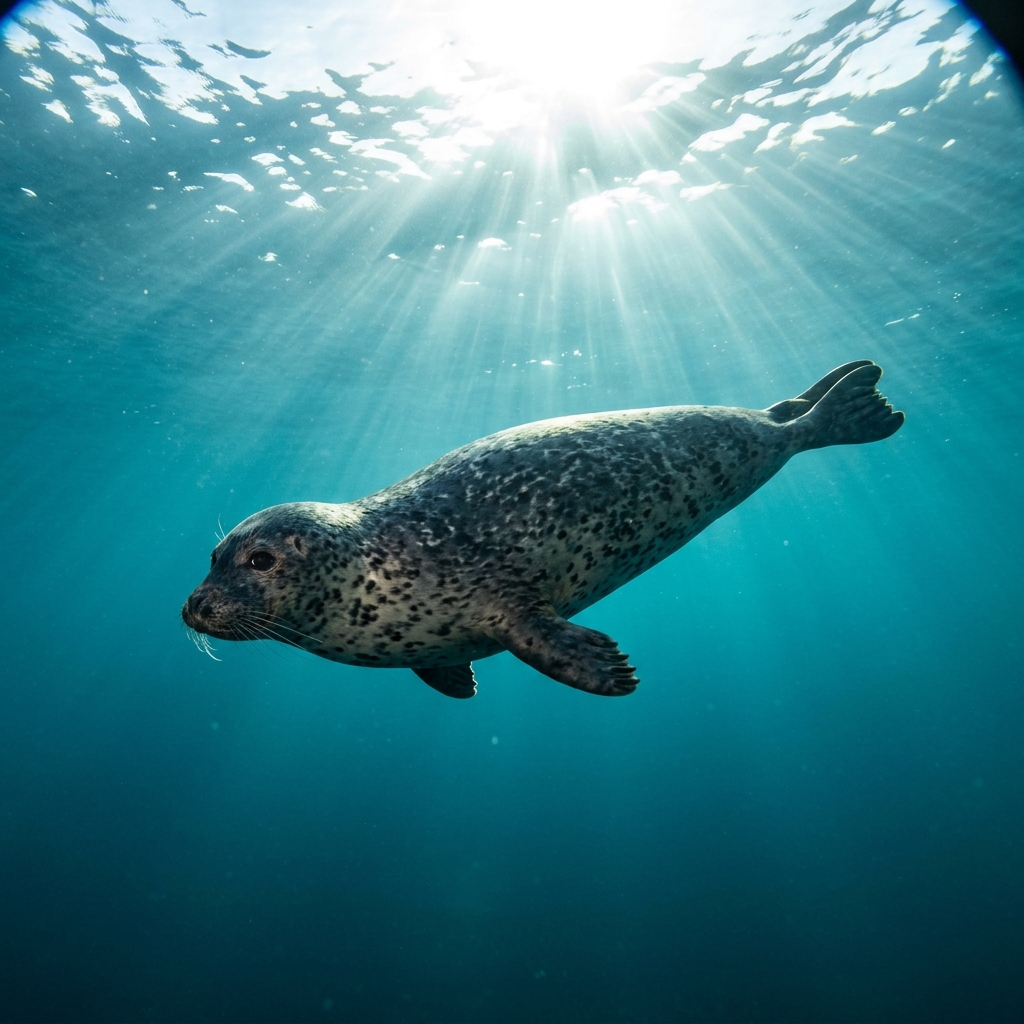
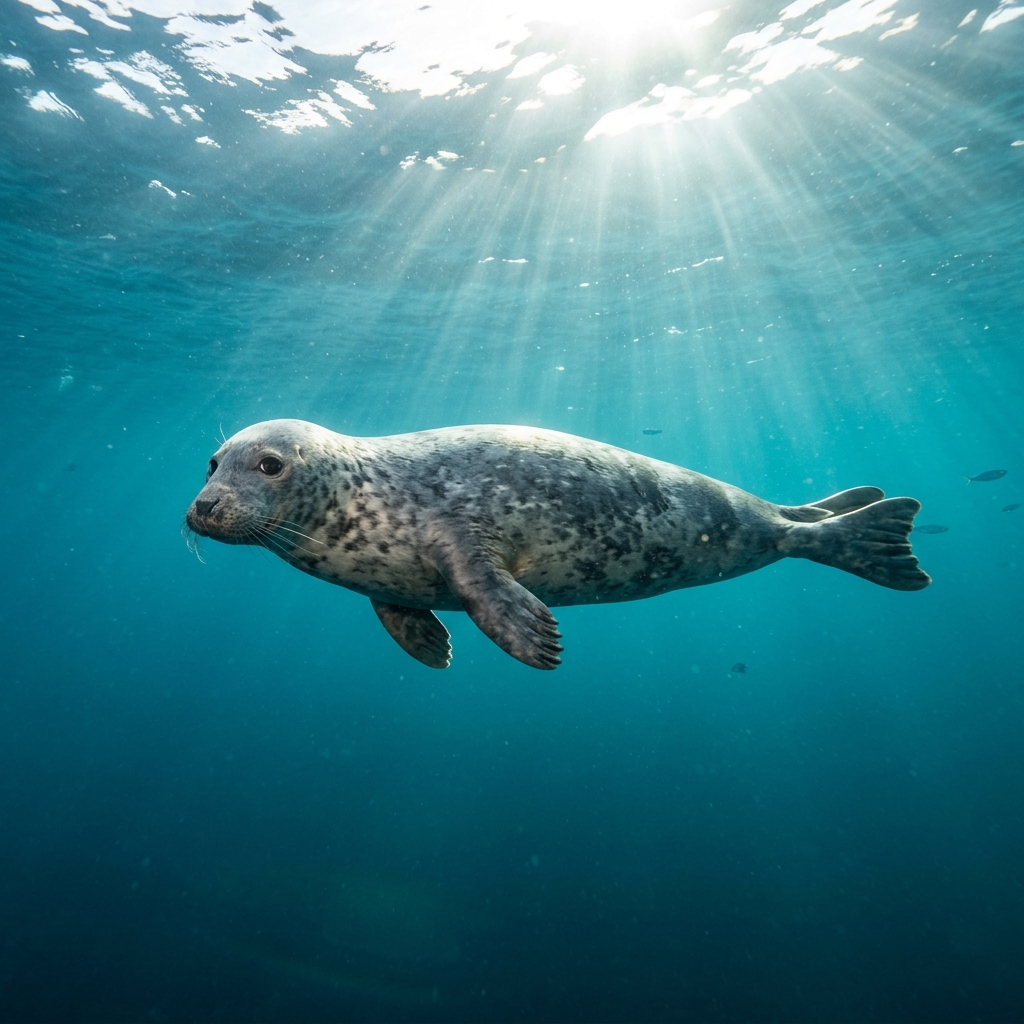
Reef neighbours a diver could mistake it for. Use the identification notes above to tell them apart.
Most commonly logged in Australia, particularly in Western Australia, Victoria, South Australia, and Tasmania, and across New Zealand from the Central North Island south through the Coromandel and Bay of Plenty. South Africa's Western Cape is another strong hub, with sightings spread across more than a hundred sites in that region alone. Argentina and Chile also hold populations, though records there are sparser.
Mapping where Long-nosed Fur Seal is logged…
The strongest diving populations are found in Australia (especially Western Australia, Victoria, and South Australia), across New Zealand, and along South Africa's Western Cape coast. Argentina and Chile hold smaller populations. Most sightings are logged at temperate, rocky reef sites close to established haul-out colonies.
Sightings are recorded across most of the year, concentrating from June through April in the Southern Hemisphere. There is a slight dip in records around May, though this may partly reflect reduced dive activity in that period rather than a true absence of the animals.
Key in on the long, narrow snout, it is more pointed than on other fur seals in the same range. The coat appears dark brown to near-black when wet. Males are noticeably bulkier with a thicker neck; females are much slimmer. At close range the elongated muzzle makes identification straightforward.
Adults typically reach around 140 cm in length. Males are significantly larger and heavier than females, with a thicker neck and broader chest; females are roughly half the body mass of males. In the water, a large male can look surprisingly imposing compared with the slender females in the same group.
They are not considered dangerous to divers. They are wild animals and should be treated with respect, avoid sudden movements and do not attempt to touch them. Curious individuals, especially juveniles, may approach very closely, which is normal exploratory behaviour rather than aggression.
Site and sighting data is aggregated from diver logs, iNaturalist and GBIF. For taxonomy and conservation status:
South American Fur Seal
305 sites