Thuridilla lineolata
A centimetre-long streak of blue and orange on Visayas reefs, found year-round in warm 26-32C water.
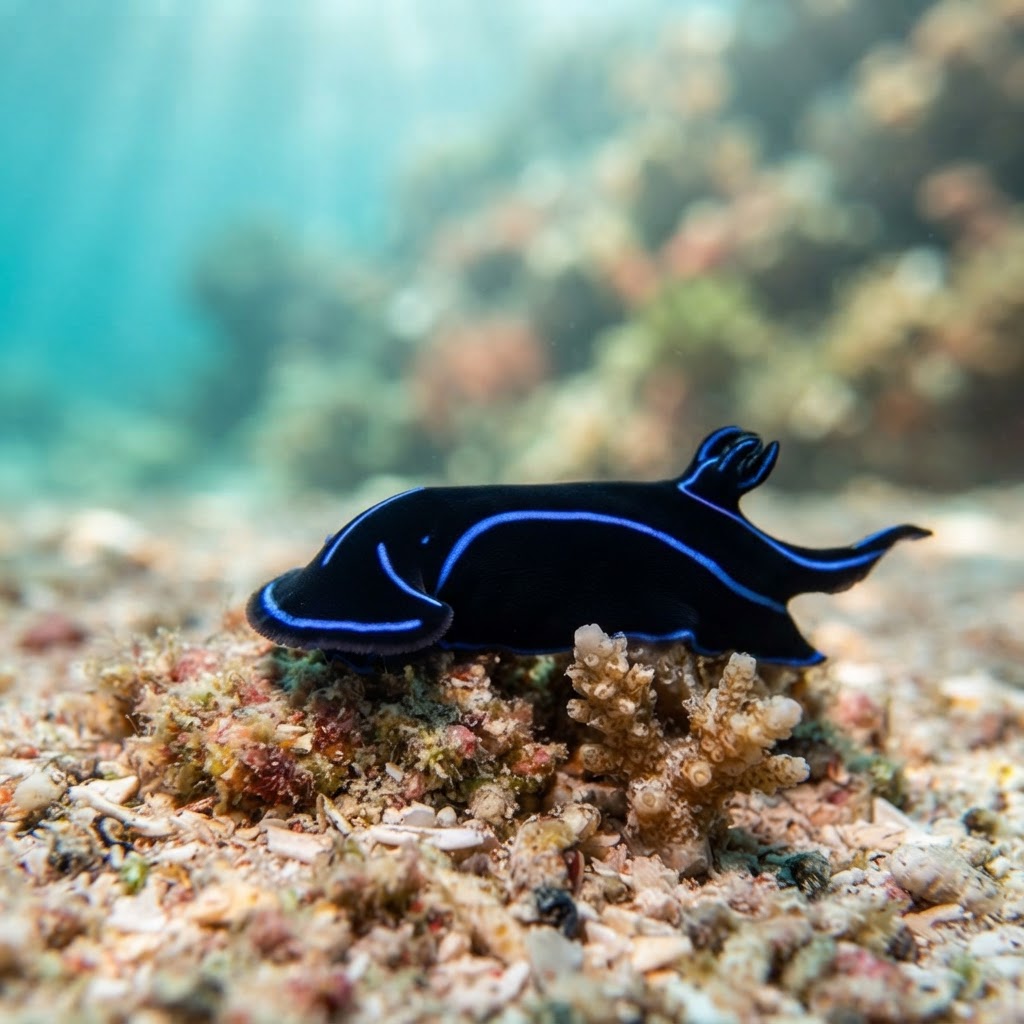
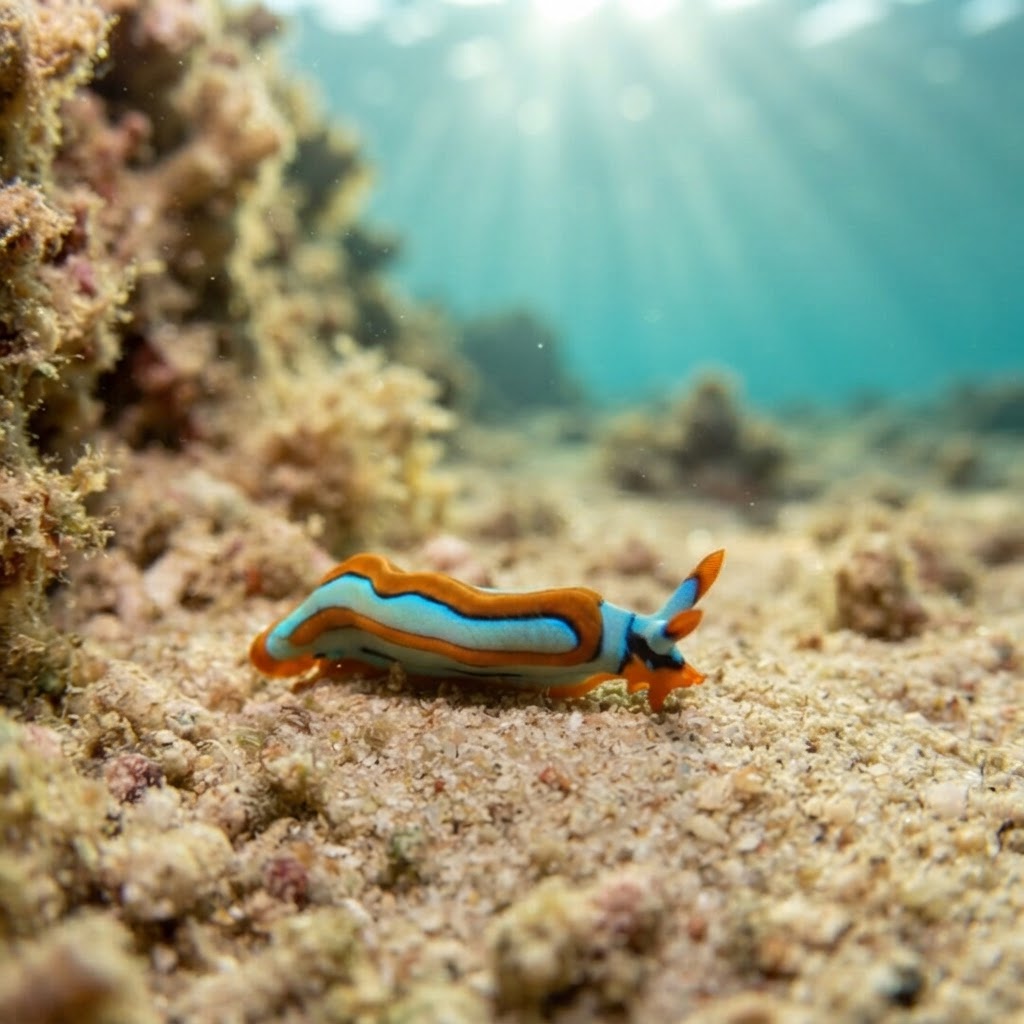
Barely a centimetre long, this sea slug carries rolled parapodia (wing-like flaps along its back) striped in electric blue and orange against a dark olive-brown body. The head bears two rhinophores (sensory horns) tipped orange, and the whole animal looks more like a sliver of neon piping than a mollusc. Its small size and bright longitudinal lines are the giveaway once you know to look for it on rubble and algae patches.
Look for it grazing slowly over algae-covered rubble and rock, usually in the shallows where sunlight feeds the algae it favours. It shows no reaction to divers beyond a slow retreat, since it has no real defence against anything bigger than the fish that ignore it anyway. Most sightings happen during the day on close macro-focused dives rather than night dives.
Like other sacoglossan slugs, it feeds on algae and can retain the algae's chloroplasts in its own tissue for a while afterwards, a trick called kleptoplasty that lets it photosynthesise borrowed sunlight for extra energy.
No clear season shows up in the sighting data, and with a comfortable range of 25.6 to 31.6C this slug is active on tropical reefs all year round. Plan around good visibility and calm conditions for macro work rather than a particular month.
Reef neighbours a diver could mistake it for. Use the identification notes above to tell them apart.
The Visayas region of the Philippines is by far the most reliable place to find this slug, with a strong scatter of sightings across its reefs and rubble slopes. Dili in Timor-Leste is a dependable secondary spot, and it also turns up on reefs in Sulawesi and Bali, Indonesia.
Mapping where Lined Thuridilla is logged…
The Visayas region of the Philippines is the most consistent place to find it, with additional sightings around Dili in Timor-Leste and on reefs in Sulawesi and Bali, Indonesia.
There's no strong seasonal pattern in the data, and it tolerates warm water from about 25.6 to 31.6C, so it's found on tropical reefs throughout the year.
Look for a tiny slug, about a centimetre long, with blue and orange stripes running along rolled wing-like flaps on its back and orange-tipped sensory horns on its head. It's usually spotted crawling slowly over algae-covered rubble.
This is a small species, reaching only around 1 cm in length, so it takes a careful eye or a macro lens to spot on the reef.
It can hold onto chloroplasts from the algae it eats and use them to photosynthesise for a time, a rare trick called kleptoplasty found in only a few slug groups.
No, it poses no risk to divers. It has no venom or sting and simply crawls away slowly if disturbed.
Site and sighting data is aggregated from diver logs, iNaturalist and GBIF. For taxonomy and conservation status:
Light-spotted Aegires
3,168 sites