Elysia ornata
Frilly, lime-green and barely 3cm long, the lettuce slug turns up on muck dives in Florida and Guadeloupe year-round in warm water.
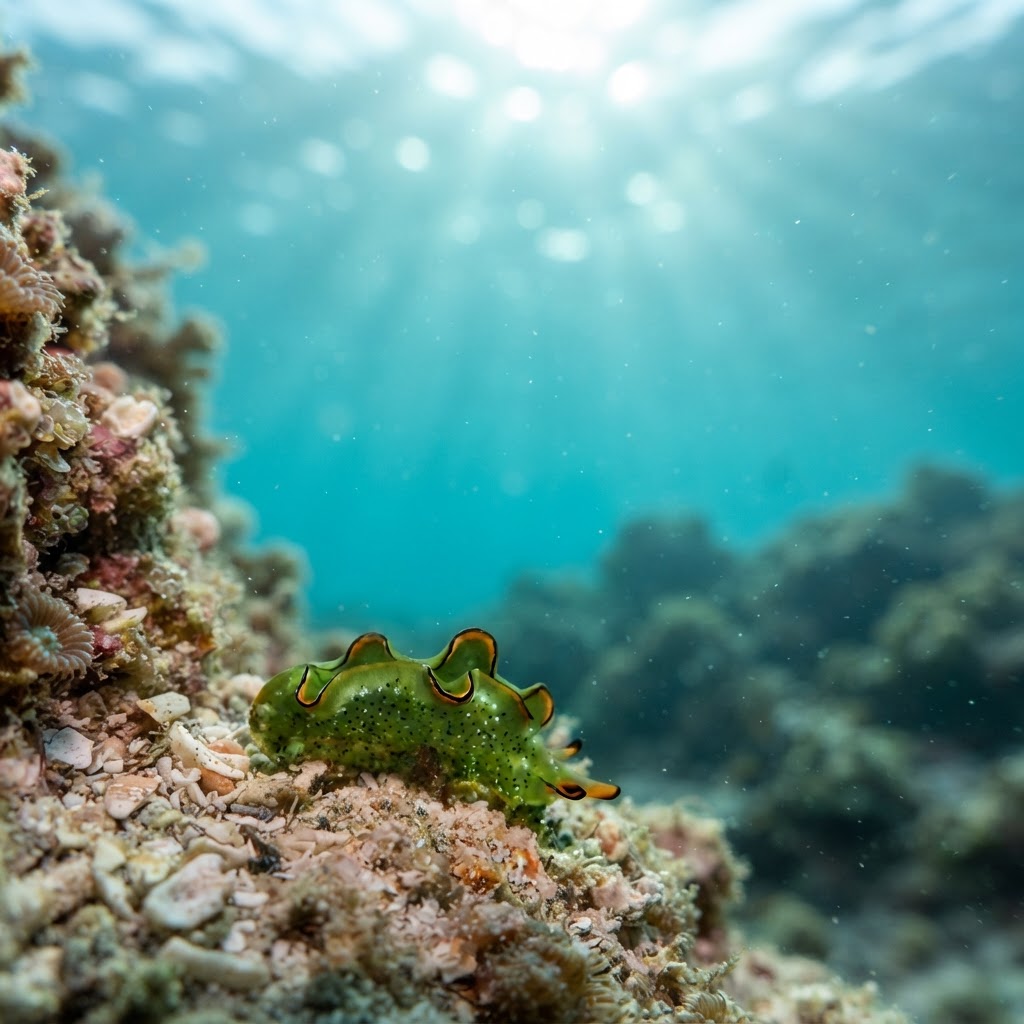
Barely bigger than a fingernail at around 3cm, this sea slug has a soft, ruffled body with wavy, leaf-like folds (parapodia) running down each side, which is exactly why it earned the name lettuce slug. Colour is typically bright green to olive, often flecked with small blue, white or orange spots along the frilly edges. Look for the pair of slender, upright rhinophores (sensory horns) on the head, which give it a snail-like silhouette despite having no visible shell.
Divers usually find this slug grazing slowly over algae-covered rubble, seagrass edges or shaded reef crevices, often on muck or macro-focused dives rather than open coral wall. It moves at an unhurried pace and pays no attention to divers, making it an easy macro subject once you spot the frilly outline against dark substrate. Most logs describe it as an uncommon find, so a slow, close look at algal patches improves your odds more than covering ground fast.
Like other members of its family, this slug feeds on algae and can retain some of the algae's chloroplasts in its own tissue, giving it a limited ability to photosynthesise while it digests, a trick called kleptoplasty.
Sightings are spread across the year with no clear seasonal spike, and its comfort range of roughly 24.6 to 30.6C means warm reef and rubble sites stay suitable in every month. Plan around water temperature at your chosen site rather than a particular season.
Reef neighbours a diver could mistake it for. Use the identification notes above to tell them apart.
Most reliably logged in Guadeloupe, with strong numbers across both Grande-Terre and Basse-Terre, and in Florida in the United States, which together account for the bulk of sightings. Smaller but consistent populations turn up on the Mediterranean coast of Israel, around Grand Cayman in the Cayman Islands, and off Sal in Cape Verde.
Mapping where Lettuce Slug is logged…
Best logged in Guadeloupe (both Grande-Terre and Basse-Terre) and in Florida, with smaller populations recorded in Israel's Mediterranean coast, Grand Cayman, and Sal in Cape Verde.
There is no strong season in the data. It tolerates water from about 24.6 to 30.6C, so it is present on warm reef and rubble sites throughout the year.
Look for a small, soft-bodied slug around 3cm long with ruffled, leaf-like green folds along its sides and slender upright rhinophores on the head. Blue, white or orange flecks along the frilly edges are a useful extra clue.
They stay small, typically around 3cm in length, so a close, slow look at algae-covered rubble is usually needed to spot one.
It can absorb chloroplasts from the algae it eats and keep them functioning in its own tissue for a while, effectively letting it photosynthesise a little between meals.
Site and sighting data is aggregated from diver logs, iNaturalist and GBIF. For taxonomy and conservation status:
Light-spotted Aegires
3,168 sites