Hypselodoris nigrostriata
Spot the Black-striped Split-tooth Dorid in Muscat or the Southern Andaman, a warm-water nudibranch found across the Indian Ocean and Gulf.
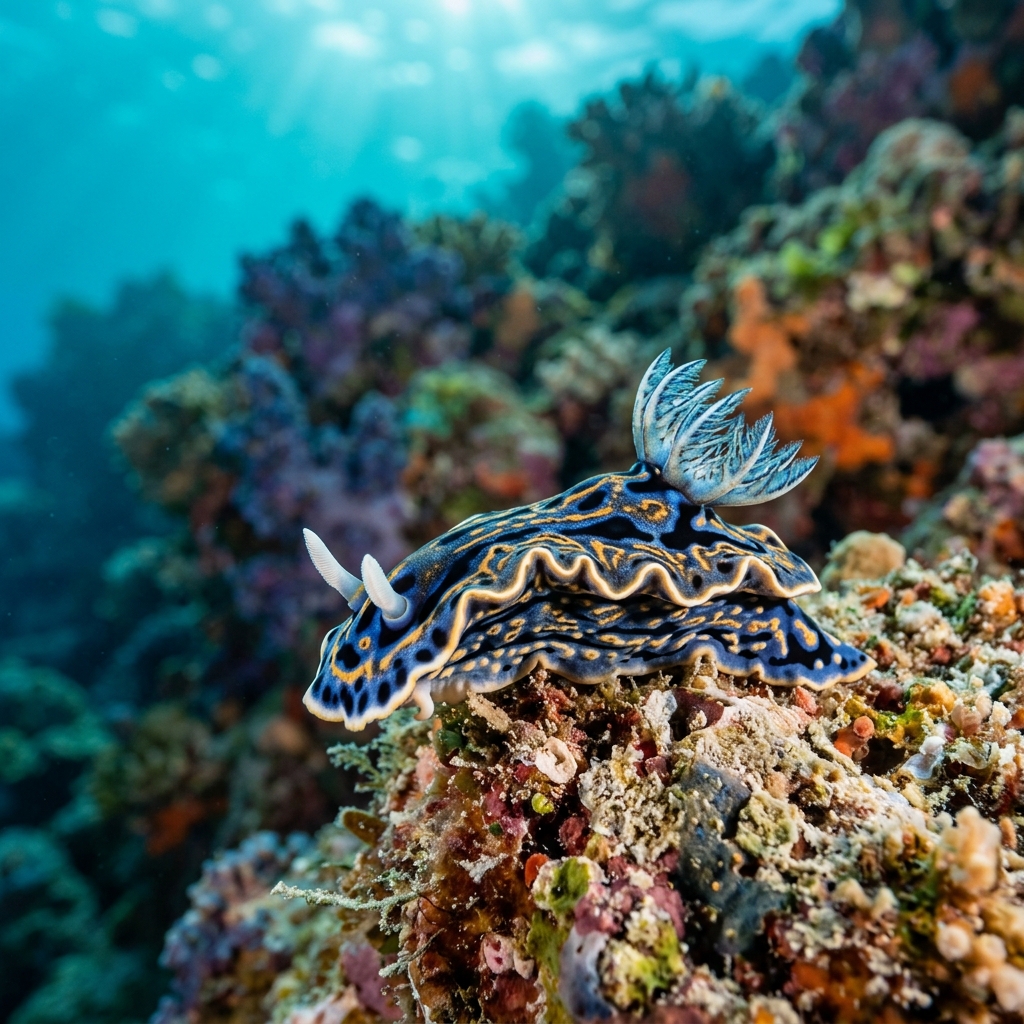
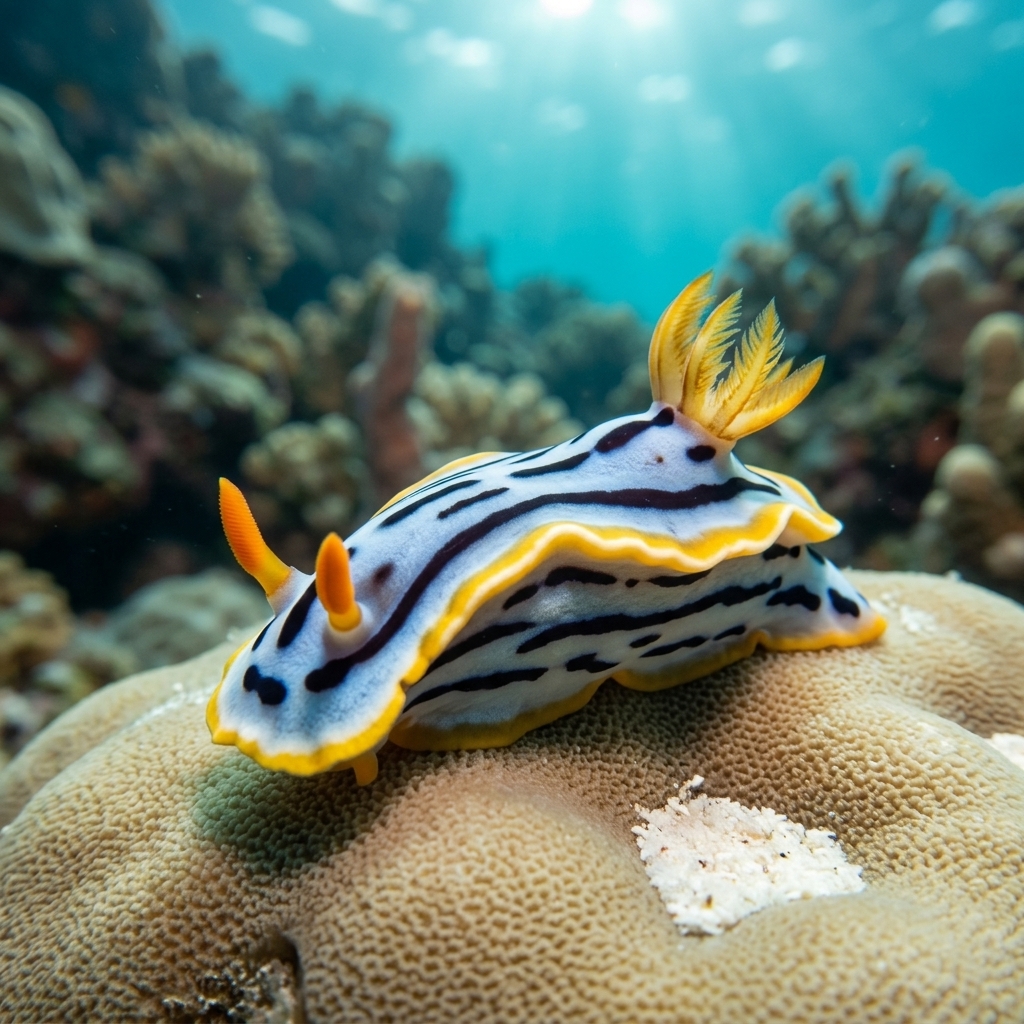
Look for a white or pale blue-white body crossed by bold, dark (near-black) longitudinal stripes running head to tail, the feature that gives it its name. The feathery gill plume (cerata cluster) at the rear and the paired rhinophores (sensory stalks) at the head are typical of the chromodorid family, and both are usually tipped or edged in colour. It is a small nudibranch, slow-moving and pressed flat against the substrate, which makes it easy to overlook against encrusting life.
Like most chromodorids, it spends its time slowly grazing across encrusting sponges and algae on the reef surface, rarely stopping. When approached by a diver it simply continues moving or stays still; it has no flight response worth mentioning. Methodical searching of rubble patches, reef walls, and the underside of ledges in the 0 to mid-depth range gives the best chance of a sighting.
Chromodorids like this one sequester toxic chemicals from the sponges they eat and store them in their skin, making them chemically defended against predators, those bold contrasting stripes are thought to serve as a warning to fish that the animal tastes bad.
No clear seasonal peak has emerged from the sighting data, so it is treated as year-round across its range. Its observed temperature window of roughly 23 to 30 °C fits the warm tropical and subtropical reefs where it is most often found.
Reef neighbours a diver could mistake it for. Use the identification notes above to tell them apart.
Most observations come from Muscat, Oman, making the reefs of the Omani coast the single most reliable area to search for this species. The Southern Andaman sites in Thailand and the dive sites around Fujairah in the United Arab Emirates are the next strongest concentrations. It has also been logged across Perhentian and Redang in Malaysia, Ponta do Ouro in Mozambique, and the Durban and North Coast region of South Africa, showing a broad Indian Ocean and Arabian Gulf spread.
Mapping where Black-striped Split-tooth Dorid is logged…
Muscat in Oman has the strongest concentration of sightings by a clear margin. Good secondary options include the Southern Andaman coast of Thailand, Fujairah in the UAE, and the Perhentian and Redang islands of Malaysia. Smaller numbers have been recorded at Ponta do Ouro in Mozambique and along the Durban and North Coast of South Africa.
There is no defined season in the sighting data, so this nudibranch is considered findable year-round across its range. It has been observed in water temperatures from about 23 °C up to 30 °C, consistent with warm tropical and subtropical reef diving throughout the year.
The key feature is the set of bold, dark longitudinal stripes running along a white or pale body from head to tail, this striped pattern is distinctive among Indian Ocean chromodorids. Look also at the coloured tips on the gill plume and rhinophores. It moves slowly across hard substrate, making a calm, close approach straightforward.
No, it poses no risk to divers whatsoever. Like other chromodorids it stores chemical deterrents in its skin as a defence against predators, but this is harmless to humans who are simply observing it.
The high-contrast stripe pattern is thought to be aposematic colouration, a visual signal warning predators that the animal is chemically defended. Chromodorids accumulate toxins from the sponges they graze on, and their vivid markings advertise that eating them is a bad idea for any fish in the area.
Site and sighting data is aggregated from diver logs, iNaturalist and GBIF. For taxonomy and conservation status:
Blue Dragon
3,163 sites