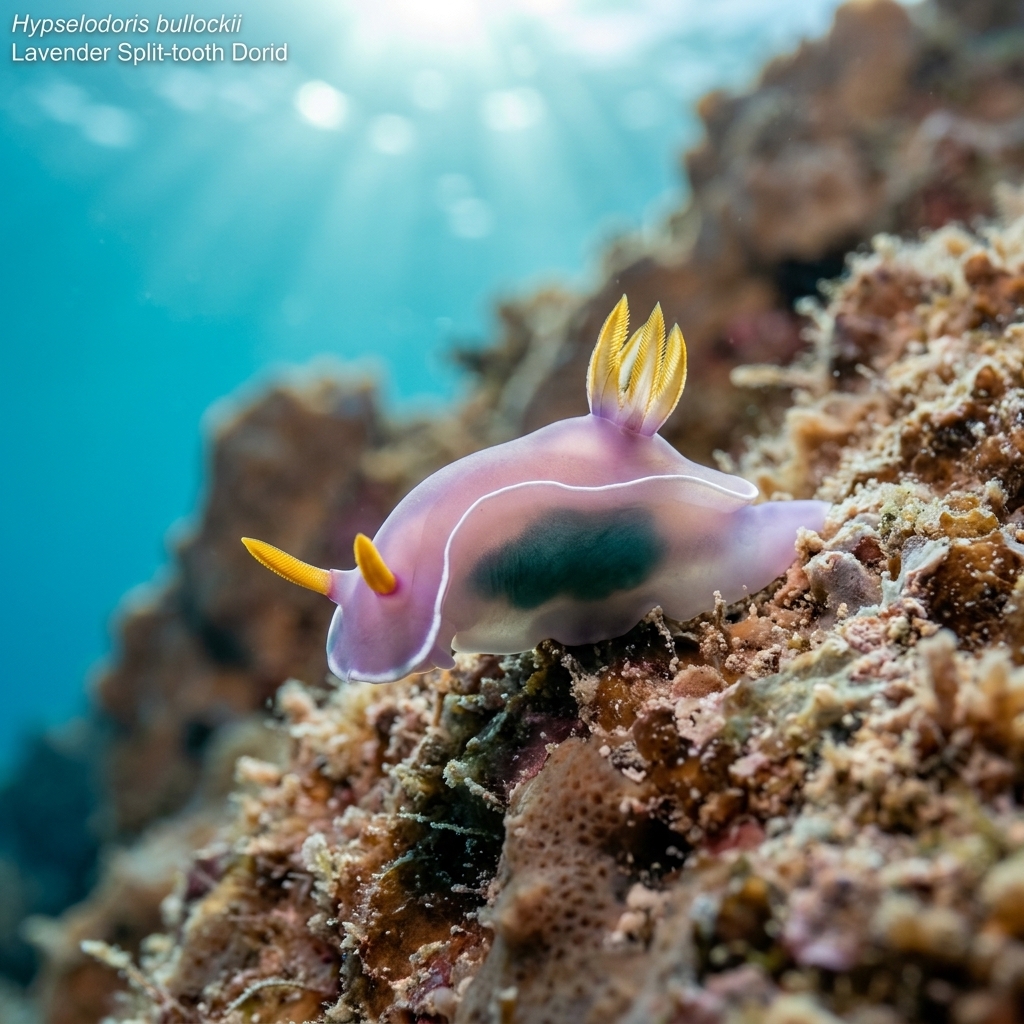
Hypselodoris bullockii
Spot the Lavender Split-tooth Dorid in warm 27-29°C waters around Pulau Tioman, Okinawa and Bali. Tips on ID, season, and best dive sites.
A small chromodorid nudibranch with a pale lavender to whitish body edged with a brighter violet or lilac margin, giving it a subtle but distinctive border. The gill plume (the feathery rosette of gills on the back) and rhinophores (horn-like sensory organs) pick up stronger purple tones. Look for the contrast between the washed-out central body and the more vivid rim, that colour split is the key field mark. It moves slowly across hard coral and rubble, so a careful eye is needed to spot it.
Like most chromodorids, this nudibranch is a slow crawler, typically seen inching across rubble, sponge, or encrusted hard coral at nudibranch-hunting depths on the reef. It tends to ignore divers entirely, which makes it straightforward to photograph once found, though finding one takes patience. Early morning and late afternoon dives, when the reef is most active, seem to produce the most encounters.
Chromodorid nudibranchs like this species sequester toxic or distasteful chemicals from the sponges they eat and store them in their mantle, making their bright colouring a warning signal to potential predators rather than mere decoration.
In the Northern Hemisphere, sightings are spread throughout the year with no concentrated peak, which fits the species' preference for warm tropical water in the 27-29°C range. In the Southern Hemisphere, sightings concentrate in the austral summer months of December through February.
Reef neighbours a diver could mistake it for. Use the identification notes above to tell them apart.
Most consistently logged across Malaysia, particularly around Pulau Tioman and the Perhentian and Redang islands, with West Sabah and Labuan also producing regular sightings. Japan's Okinawa Islands and Indonesia's Bali, Lombok, and Java region are the next strongest areas, followed by sites in the Philippines, Vietnam, and Singapore. Within that range, Malaysia accounts for by far the greatest spread of confirmed sighting locations.
Mapping where Lavender Split-tooth Dorid is logged…
The strongest concentrations of sightings come from Malaysia, especially Pulau Tioman, Perhentian and Redang, and West Sabah. Okinawa in Japan and Bali in Indonesia are also reliable areas. The Philippines, Vietnam, Singapore, and Australia round out the known range.
In the Northern Hemisphere, sightings are recorded year-round, which makes sense given the species' preference for consistently warm tropical water. If you are diving in Southern Hemisphere locations, sightings tend to peak during the local summer, December through February.
Look for a small nudibranch with a pale, washed-out lavender or whitish centre and a more vivid violet border running around the mantle edge. The gill plume and rhinophores carry stronger purple colour. That two-tone contrast between a pale body and a brighter margin is the key field mark to lock onto.
It is most often rated as uncommon at sites where it appears, with a smaller number of sites rating it rare and a handful where it is considered common. Patience and a slow, methodical approach to searching rubble and sponge-covered reef usually pays off.
Site and sighting data is aggregated from diver logs, iNaturalist and GBIF. For taxonomy and conservation status:
Light-spotted Aegires
3,168 sites