Pilumnus vespertilio
A shaggy, algae-covered crab logged most often in Okinawa's reefs and the Andaman Islands, spotted year-round in warm 24-30C water.
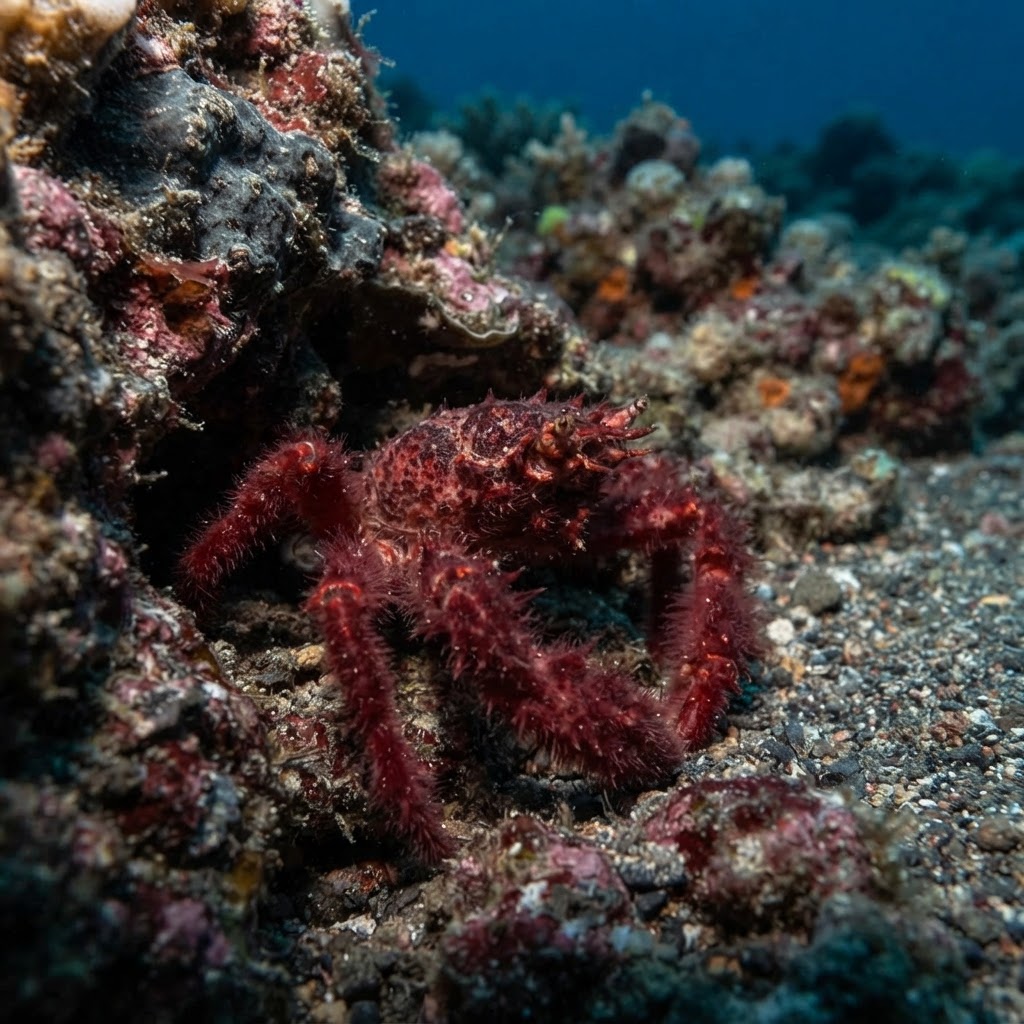
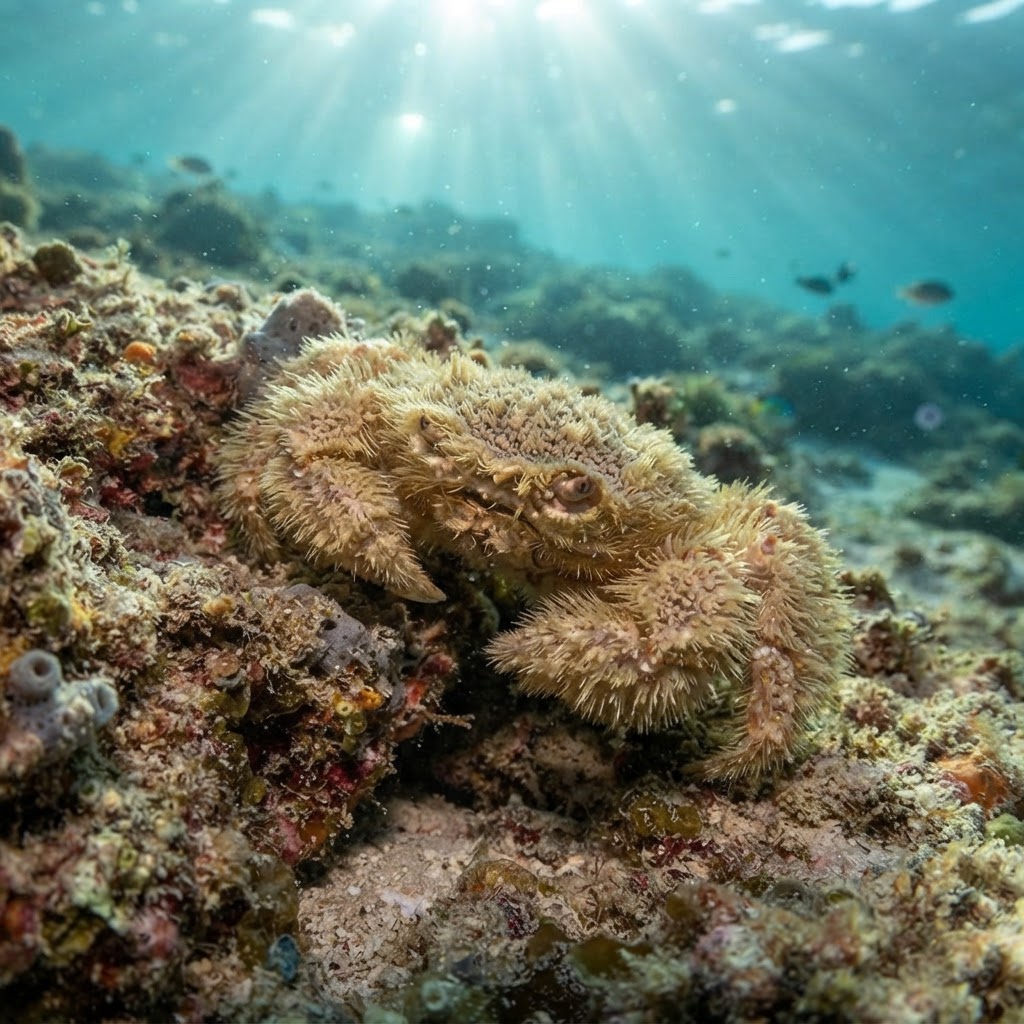
Bristly setae (hair-like filaments) cover the shell and legs, often trapping algae and debris so it looks like a small tuft of weed rather than a crab. The body is compact and rounded, usually mottled brown or reddish to blend into rubble and coral rock. Look for the fringed, hairy claws tucked close to the body, which give it away once you know what you're looking for.
Divers usually find it sitting still among coral rubble, sponges or rocky crevices, relying on its algae-covered, hairy shell to disappear into the background rather than fleeing. It's a slow, low-key subject: expect to hover and scan rather than chase, since it rarely bolts when a torch or camera gets close. Most sightings come from divers working macro sites methodically over rubble patches and reef nooks rather than open water.
The hairy covering isn't just for looks; it snags algae, sediment and debris, turning the crab into a walking piece of camouflage that can be almost invisible against weedy rubble.
No clear seasonal pattern shows up in sightings, and its comfort range of roughly 24 to 30C spans tropical reef conditions year-round, so any month works in these regions.
Reef neighbours a diver could mistake it for. Use the identification notes above to tell them apart.
Okinawa and the wider Ryukyu Islands in Japan are by far the most reliable place to find it, with a strong secondary population around the Andaman Islands in India. Smaller numbers turn up in Singapore's Southern Islands and as far as Nouméa in New Caledonia.
Mapping where Common Hairy Crab is logged…
The most consistent sightings come from Okinawa and the Ryukyu Islands in Japan, with a solid secondary population in the Andaman Islands, India. Smaller numbers are logged in Singapore's Southern Islands and Nouméa, New Caledonia.
There's no strong seasonal pattern in sightings, and it tolerates a wide 24 to 30C range, so it's seen year-round on the reefs where it occurs.
Look for a small, rounded crab covered in bristly hair-like setae that trap algae and grit, making it look like a tuft of weed on rubble or rock. Its claws are fringed with the same hairy covering, which is the key giveaway once you spot the shape.
Exact size data isn't confirmed, but like most Pilumnidae crabs it stays small, generally a few centimetres across the shell, making it a macro-photography subject rather than a big animal encounter.
No. It poses no danger to divers and is a passive, slow-moving animal best left undisturbed while you photograph it in place.
Site and sighting data is aggregated from diver logs, iNaturalist and GBIF. For taxonomy and conservation status:
European Green Crab
2,469 sites