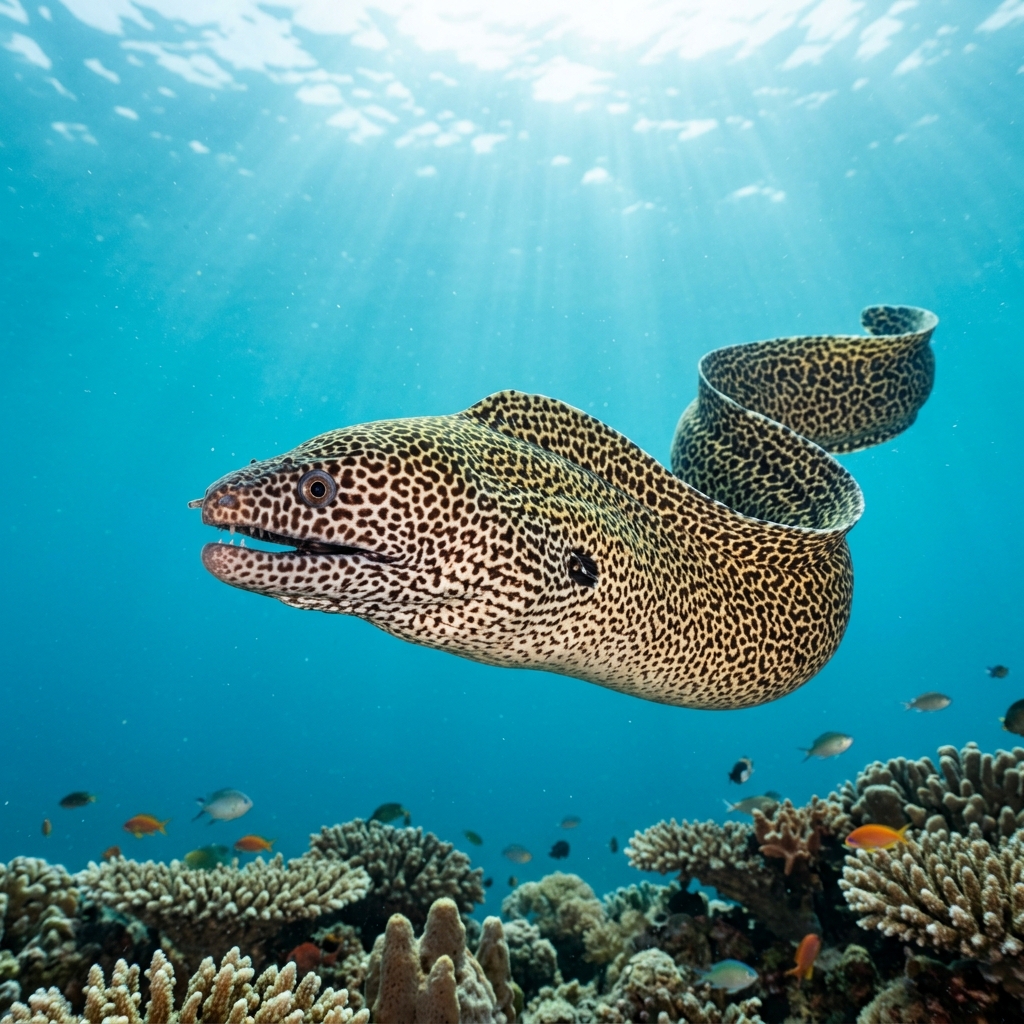
Gymnothorax favagineus
Spot the Laced Moray's bold black-and-white honeycomb pattern in the Maldives, Oman, and Seychelles. Best sightings run Sep, Mar across the Indian Ocean.
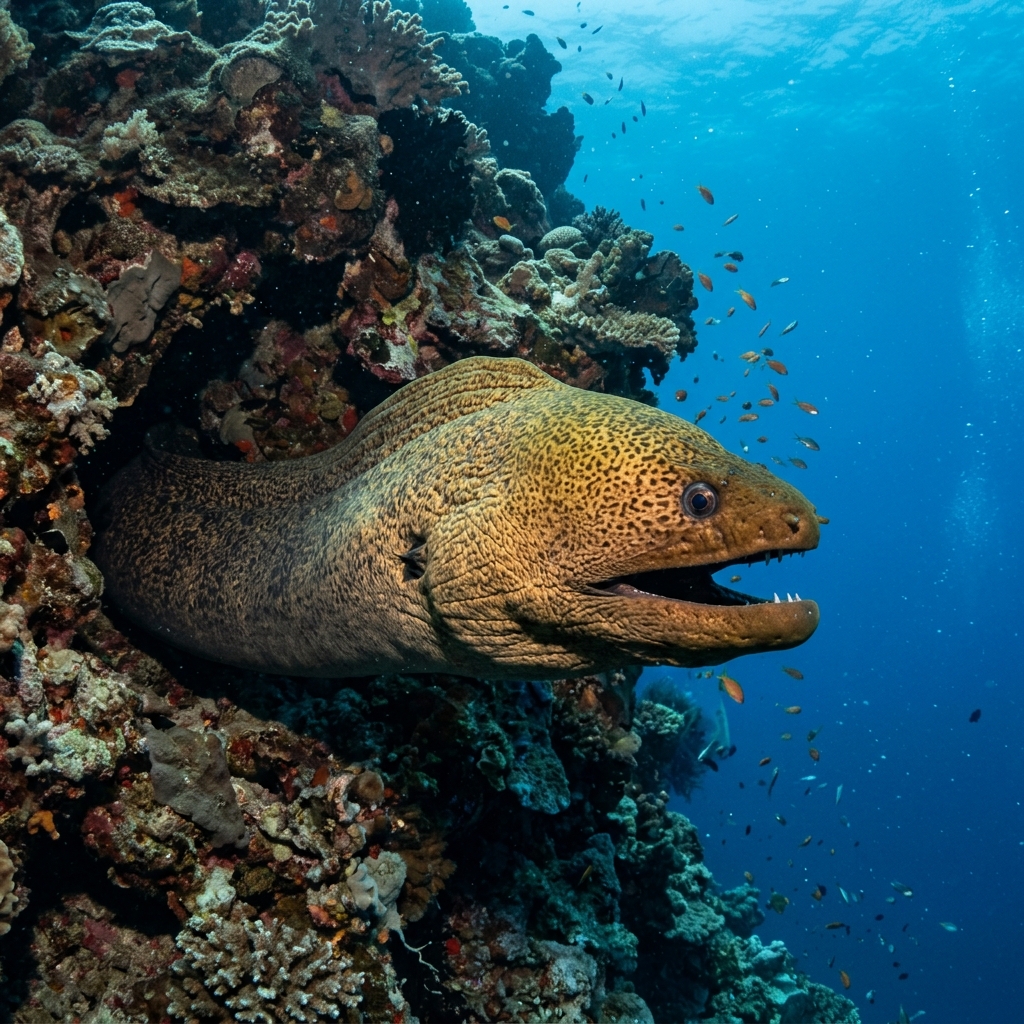
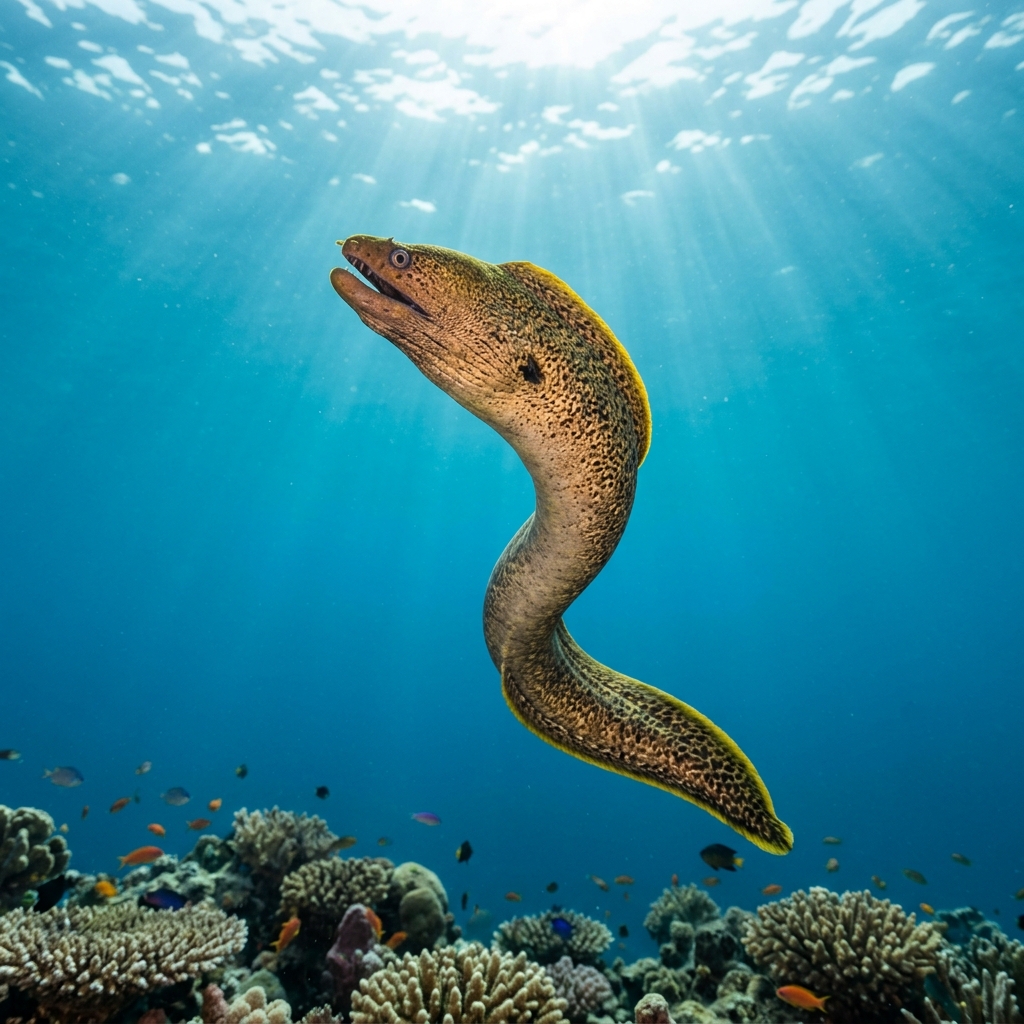
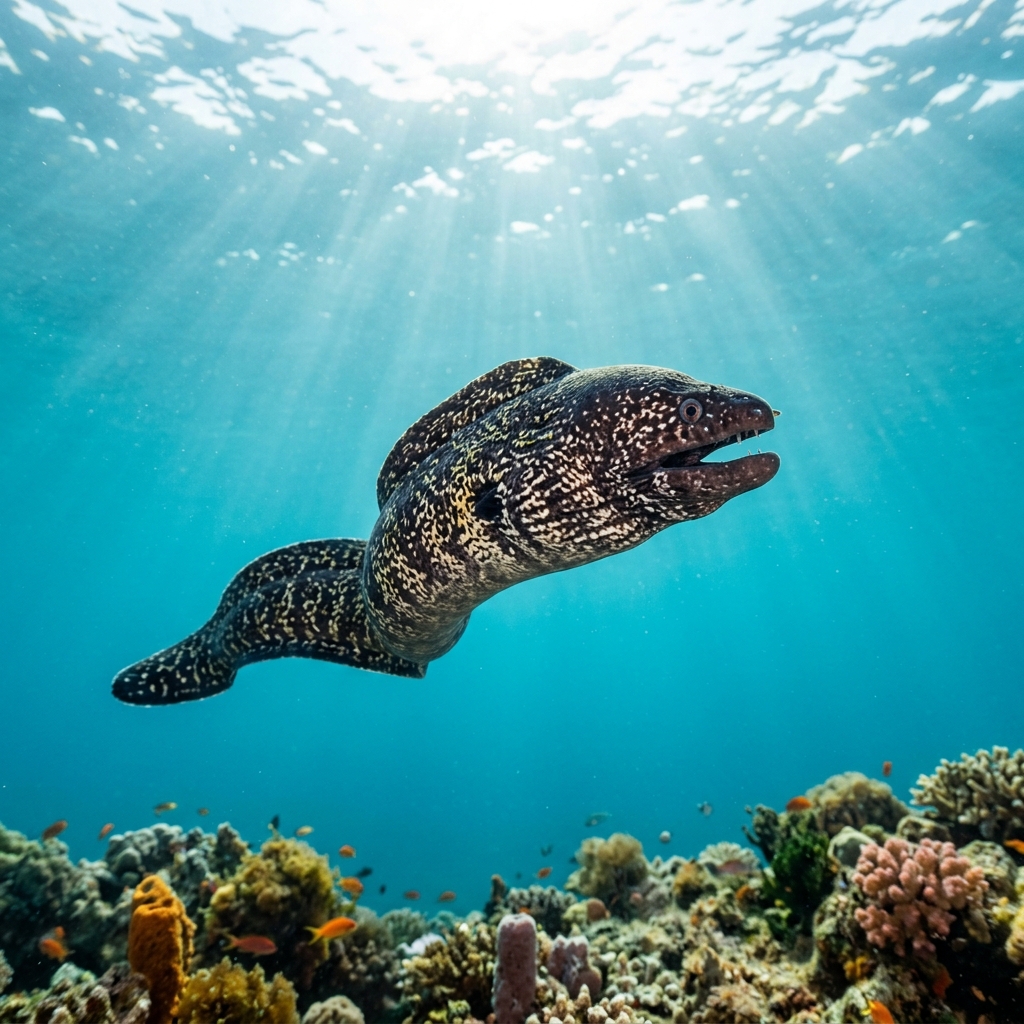
Few morays are this easy to recognise underwater: the body is covered in a striking black-and-white reticulated pattern of dark polygons on a pale background, resembling a honeycomb or lacework from any angle. The head is large and blunt, the skin pale-to-yellowish with the dark patterning intensifying towards the snout, and the interior of the mouth can look dark when the eel opens it to breathe. At full adult size this is one of the larger morays in the Indo-Pacific, and that combination of bulk and high-contrast patterning makes misidentification unlikely once you have seen the species once.
Laced morays spend most of the dive poking their heads out of reef crevices, coral bommies (large standalone coral heads), and rocky overhangs, opening and closing their mouths rhythmically to push water over their gills. They are generally unbothered by divers who keep a respectful distance, though like all large morays they will hold their ground rather than retreat. Occasional individuals are found hunting more actively along the reef bottom at dusk, when they become notably more mobile.
Morays lack pectoral fins and move by undulating their entire body, but what makes the laced moray especially interesting to watch is its two-jaw system: a second set of jaws (pharyngeal jaws) in the throat shoots forward to drag prey deeper once the main jaws have grabbed it, a mechanism unique to morays among vertebrates.
In northern hemisphere destinations such as the Maldives, Oman, and Thailand, sightings concentrate between September and March. Southern hemisphere sites like South Africa and Mozambique similarly peak from September through January.
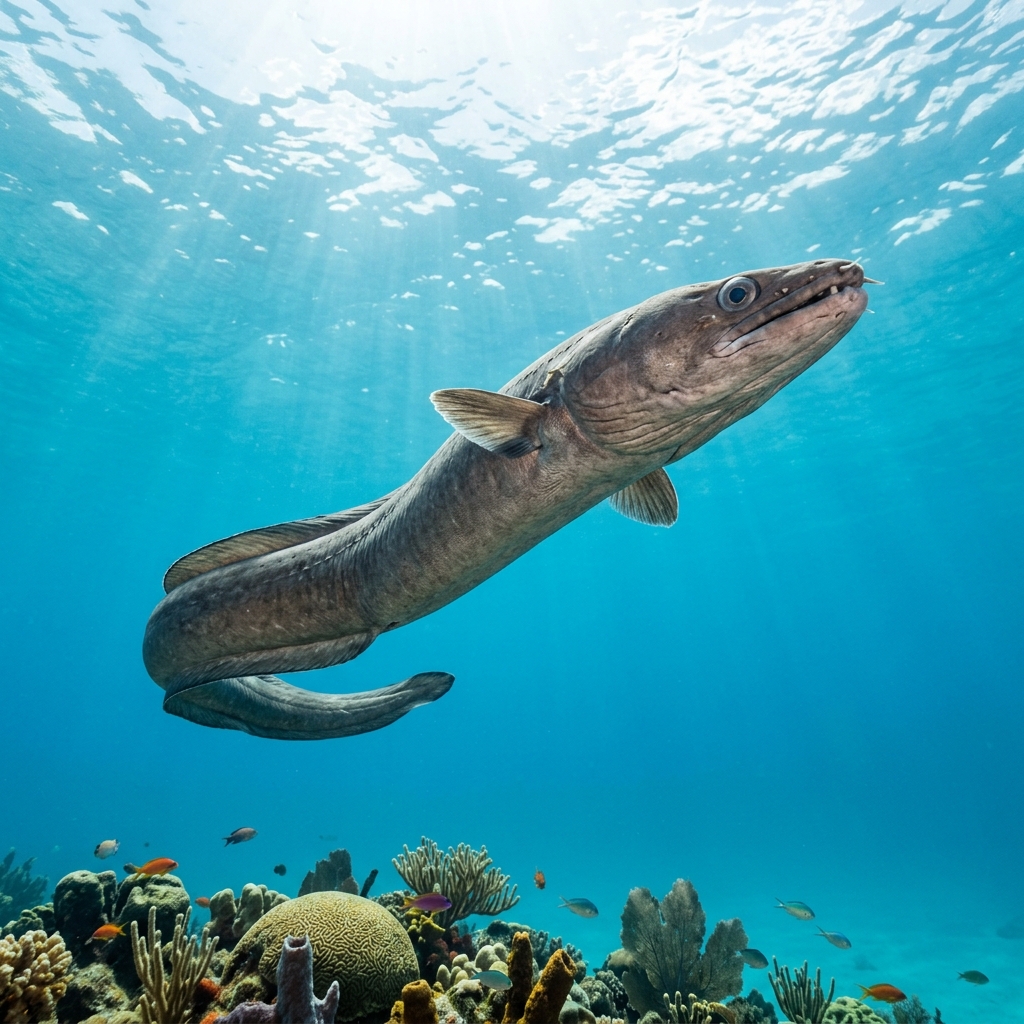
Reef neighbours a diver could mistake it for. Use the identification notes above to tell them apart.
The laced moray is most commonly logged across the Indian Ocean, with the Maldives standing out clearly as the top destination, particularly around the Male and Ari Atolls. Strong populations are also reliably encountered around Muscat in Oman, throughout Phuket and Phi Phi in Thailand, and across the Seychelles' Praslin and La Digue reefs. South Africa's Durban and North Coast, Tofo in Mozambique, and Netrani Island in India round out the hotspots, giving divers a wide spread of options from East Africa to Southeast Asia.
Mapping where Laced Moray is logged…
The laced moray is most reliably found across the Indian Ocean. The Maldives is the standout hotspot, especially around the Male and Ari Atolls. Oman's Muscat coast, Thailand's Phuket and Phi Phi reefs, the Seychelles, South Africa's Durban and North Coast, and Tofo in Mozambique are all strong options.
In northern hemisphere destinations like the Maldives, Oman, and Thailand, sightings peak between September and March. In southern hemisphere locations such as South Africa and Mozambique, the same September to January window applies.
Look for the bold black-and-white honeycomb pattern covering the entire body. No other commonly dived moray in the Indo-Pacific shares that high-contrast reticulated design. The large, blunt head and substantial body size help confirm the ID.
Laced morays are not considered dangerous to divers under normal circumstances. Like all large morays they should not be touched or hand-fed, as the teeth are sharp and a startled eel may bite defensively. Observe from a short distance and they will typically ignore you.
The laced moray is one of the larger moray species in the Indo-Pacific, with adults capable of reaching around 180 to 200 cm in length. Underwater they often appear even larger due to the bulky, muscular build of the body.
Site and sighting data is aggregated from diver logs, iNaturalist and GBIF. For taxonomy and conservation status:
Garden Eel
2,448 sites