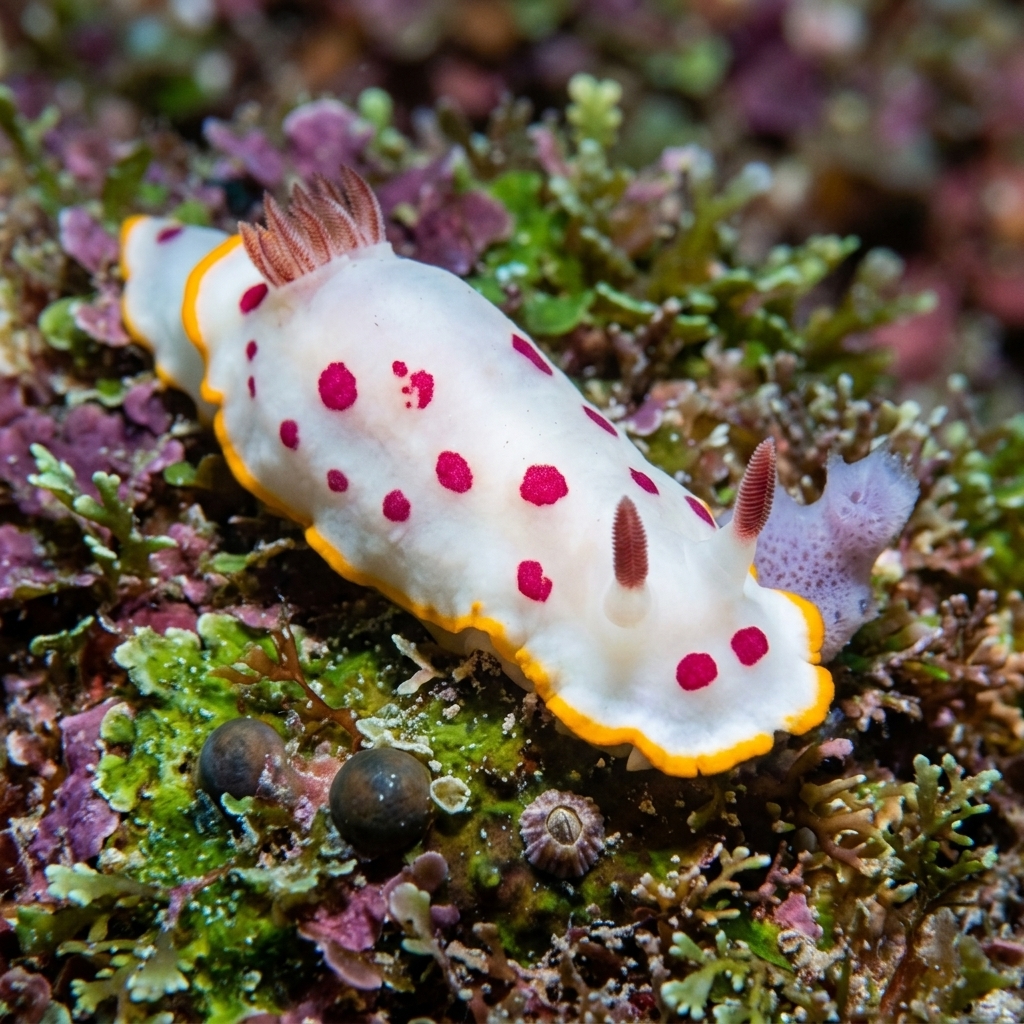
Glossodoris rufomarginata
Spot the Caramel Nudibranch on reefs from Hawaii to the Philippines. Know what to look for, when to go, and why Hawaii leads all sightings.
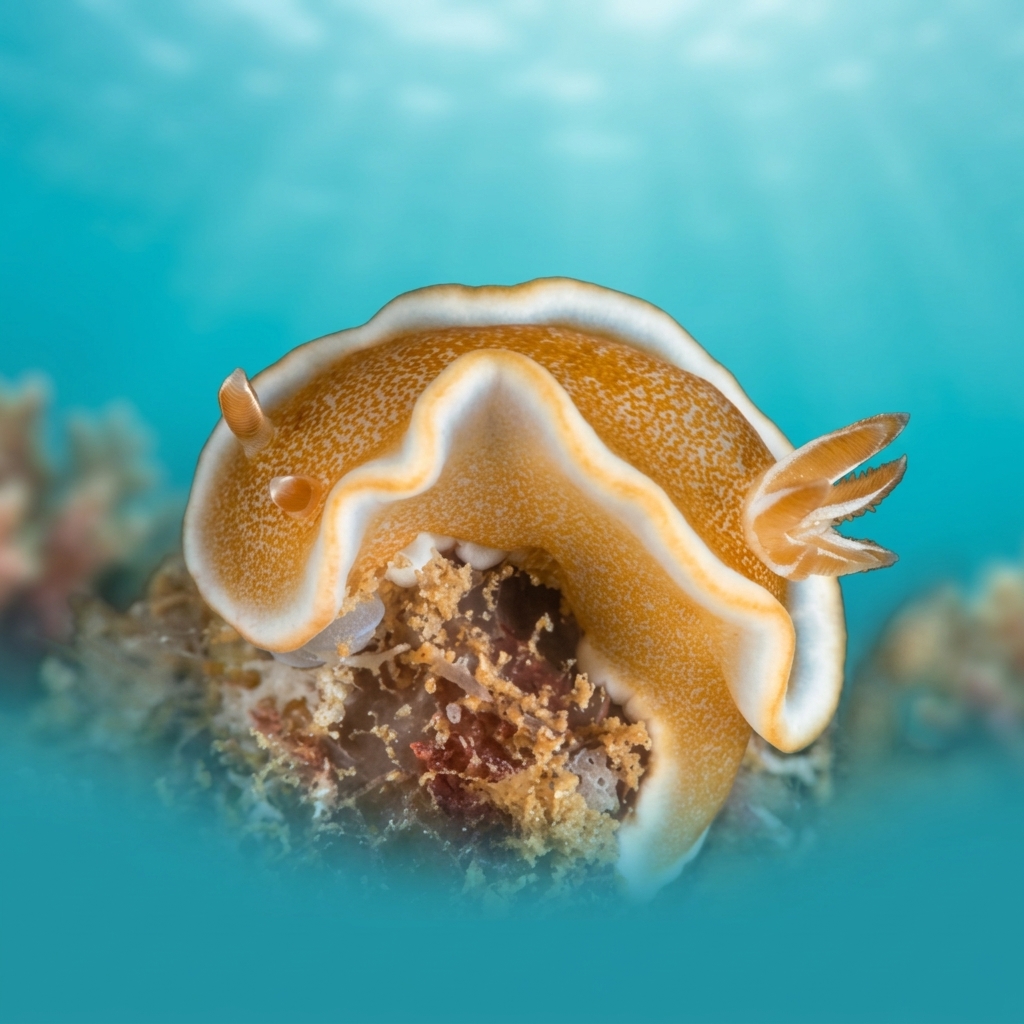
Look for a smooth, elongated dorid body in warm caramel to pale brownish-orange tones, with a distinctive reddish or orange margin running around the edge of the mantle, that border is the key field mark. The gills and rhinophores (the club-shaped sensory projections at the head) are typically darker, often brownish-red, standing out against the lighter body. Underwater it reads as a small, flat slug with clear colour zoning rather than an all-over uniform tint.
Like most chromodorids, it spends its time slowly crawling over the reef surface, typically on sponges or encrusting growth that it grazes on. It tends to ignore divers entirely and keeps moving in a steady, unhurried glide. Most sightings are on the shallower, well-lit reef structure rather than in sand or open water.
Chromodorids such as this one sequester defensive chemicals from the sponges they eat, storing toxins in their own mantle tissue, making them distasteful to most predators despite being completely soft-bodied and slow.
Northern Hemisphere sightings concentrate from May through February, suggesting a broad warm-season window rather than a tight peak. The species sits in a 24 to 29 °C temperature band, so tropical reefs within that range can hold it through most of the year.
Reef neighbours a diver could mistake it for. Use the identification notes above to tell them apart.
Hawaii accounts for more logged sightings than anywhere else, making it comfortably the best single destination worldwide. Outside Hawaii, strong secondary populations are recorded in Western Australia, the Philippines (especially Western Visayas), and Sipadan and East Sabah in Malaysia. French Polynesia (centred on Tahiti) and Sulawesi in Indonesia round out the Indo-Pacific spread.
Mapping where Caramel Nudibranch is logged…
Hawaii is by far the most reliable location, with more logged sites than all other destinations combined. Western Australia, the Philippines (Western Visayas), Sipadan in Malaysian Borneo, Tahiti, and Sulawesi also have confirmed sightings across multiple dive sites.
In the Northern Hemisphere, sightings run from May through February, covering the bulk of the year. The species favours water between 24 and 29 °C, so any dive trip to the tropical Indo-Pacific or Hawaii within that temperature window gives you a reasonable chance.
Key in on the reddish-orange margin that outlines the mantle edge, it contrasts clearly with the pale caramel body. Darker rhinophores and gill plume help confirm the ID. The overall silhouette is a flat, oval dorid with clean colour zones rather than spots or complex patterns.
It is classed as rare at the majority of sites where it has been recorded, and uncommon at most of the rest. Only a small proportion of known sites report it as common, so treat any sighting as a fortunate find rather than a guaranteed encounter.
Not at all. Like other nudibranchs they pose no threat to divers. They are slow-moving, small, and entirely uninterested in anything larger than a sponge. Simply avoid touching or disturbing them.
Site and sighting data is aggregated from diver logs, iNaturalist and GBIF. For taxonomy and conservation status:
Light-spotted Aegires
3,168 sites