Meiacanthus atrodorsalis
Small yellow-and-blue blenny found on reefs across the Visayas, Guam and Vanuatu, year-round in 26-29C water.
Safety warning
Carries a venomous bite delivered through grooved fangs on the lower jaw, used defensively if it is cornered or handled rather than as an unprovoked attack on divers. The bite is not considered dangerous to humans beyond localised pain and swelling, so the simple approach is to look without touching or trying to coax it out of its burrow.
If you're bitten
Venomous bite (mild)General first-aid guidance, not a substitute for professional medical care. In an emergency, call your local emergency number.
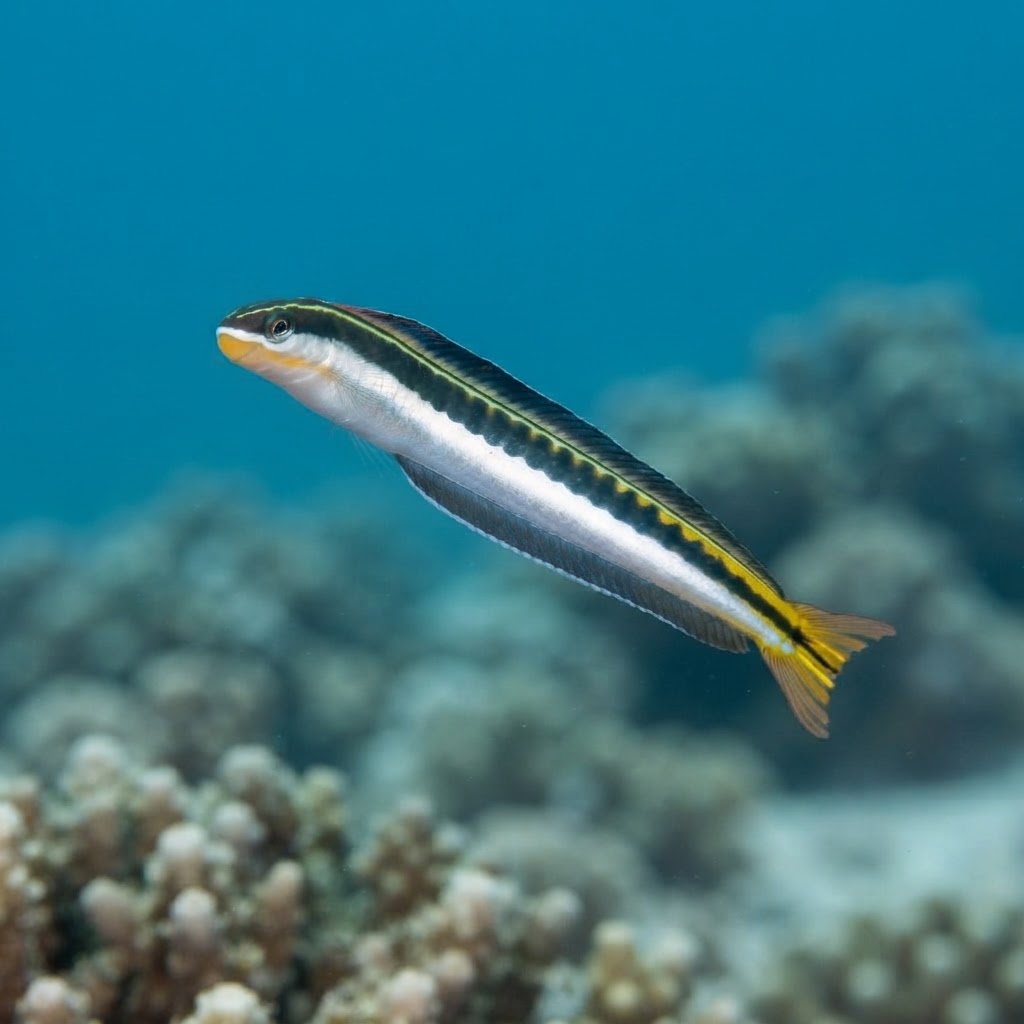
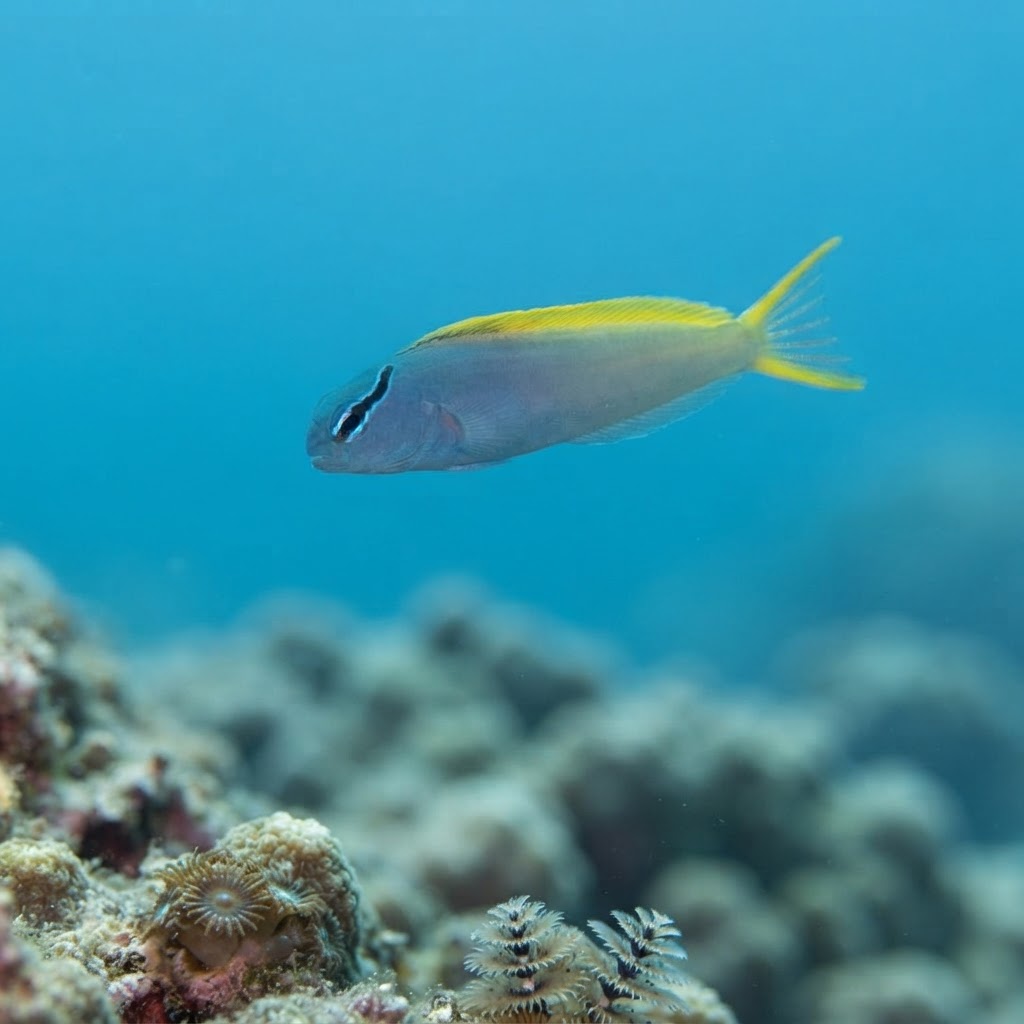
A slender, eel-like little fish around 7 cm long, usually seen with its head poking out of a burrow or perched on rubble. Colouration runs from pale blue-grey at the head fading to bright yellow toward the tail, with a dark stripe running along the upper body through the eye and a forked tail that gives the species its name. Look for the way it rests propped on its pelvic fins rather than swimming freely, often near a small hole it can dart back into.
Spend most dives spotting this one hovering just above a burrow entrance or perched on dead coral and rubble in shallower reef sections, rarely straying far from cover. It holds its ground fairly well for a fish this size, more likely to retreat a few centimetres into its hole than bolt, which makes it a manageable macro subject if you approach slowly. Most sightings come from casual daytime reef dives rather than night dives, and it is logged as uncommon at the great majority of sites, so it takes a bit of patient scanning of rubble patches rather than open water.
Its fangs deliver a venom that behavioural studies suggest functions more as a deterrent against predators than as a hunting tool, and its yellow-and-blue pattern is mimicked by several unrelated fish species trying to borrow that protection.
No clear seasonal pattern shows in the sightings data, and with a comfortable range of 25.6 to 29.3C this is a year-round reef resident across its Indo-Pacific range. Plan around good visibility and calm conditions at your chosen site rather than a particular month.
Reef neighbours a diver could mistake it for. Use the identification notes above to tell them apart.
Most reliably logged across the Visayas in the Philippines, which accounts for the bulk of recorded sightings, with strong secondary populations around Apra Harbor in Guam and Efate in Vanuatu. It also turns up consistently at Saipan in the Northern Mariana Islands, in Sulawesi, Indonesia, around Dili in Timor-Leste, and off Nouméa in New Caledonia and Queensland, Australia.
Mapping where Forktail Blenny is logged…
Best logged in the Visayas region of the Philippines, with reliable sightings also around Apra Harbor in Guam, Efate in Vanuatu, and Saipan in the Northern Mariana Islands. It also appears in Sulawesi, Indonesia and around Dili in Timor-Leste.
Sightings show no strong seasonal pattern, and warm reef temperatures of 25.6 to 29.3C mean it is present year-round. Any time you can dive its range is fair game.
They have venomous fangs used defensively, not for hunting divers, and bites only happen if one is handled or cornered. Localised pain is the typical result, so simply avoid touching it.
Look for a slim 7 cm fish with a blue-grey head fading into yellow toward a forked tail, plus a dark stripe running through the eye along the back. It usually rests propped near a burrow entrance rather than swimming in open water.
They max out around 7 cm, making them a small, easy-to-overlook reef fish best spotted with a careful eye on rubble and burrow entrances.
Its venomous bite is thought to work mainly as an anti-predator defence, and the blue-and-yellow warning colouration is copied by several unrelated fish species that mimic it to gain the same protection without the venom.
Site and sighting data is aggregated from diver logs, iNaturalist and GBIF. For taxonomy and conservation status:
Rusty Blenny
2,605 sites