Amphinomidae spp.
Fireworms turn up year-round from Florida to the Mediterranean. Learn to spot their white bristles before you accidentally touch one.
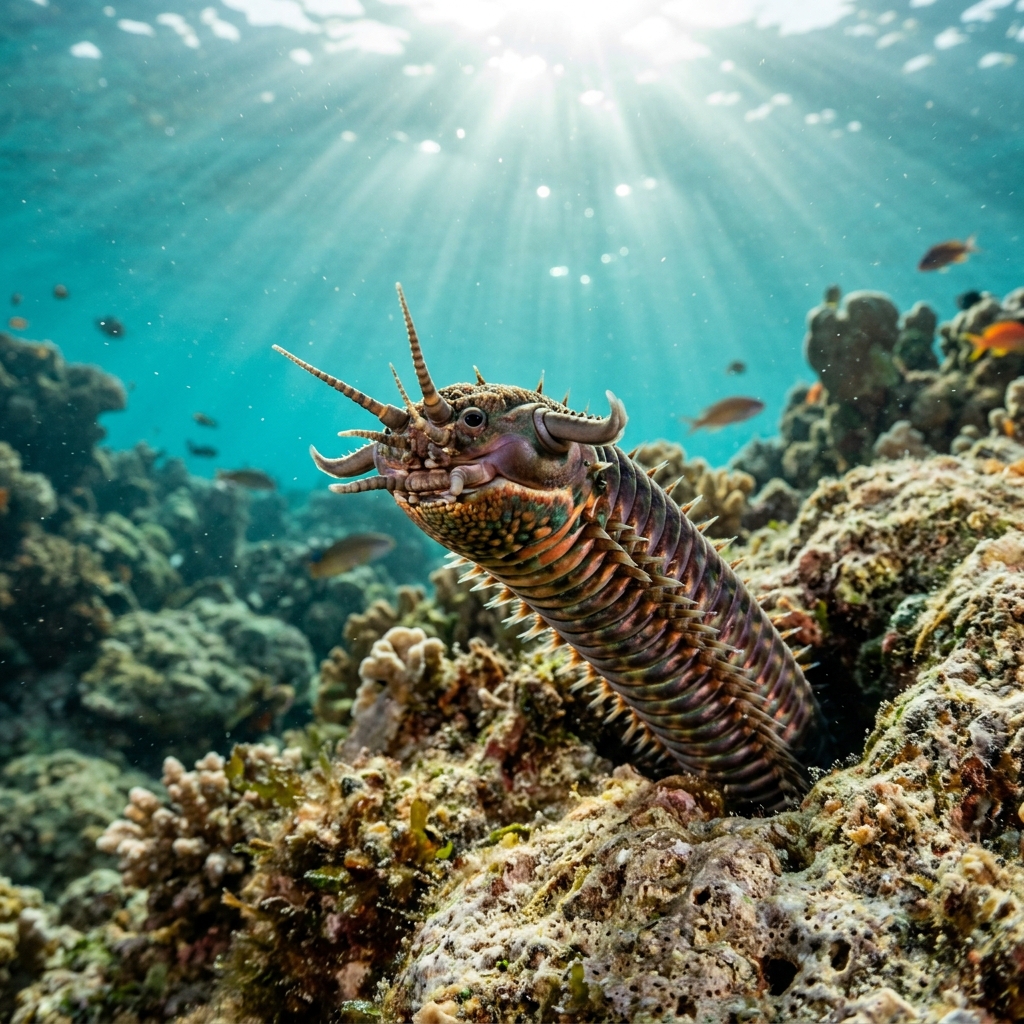
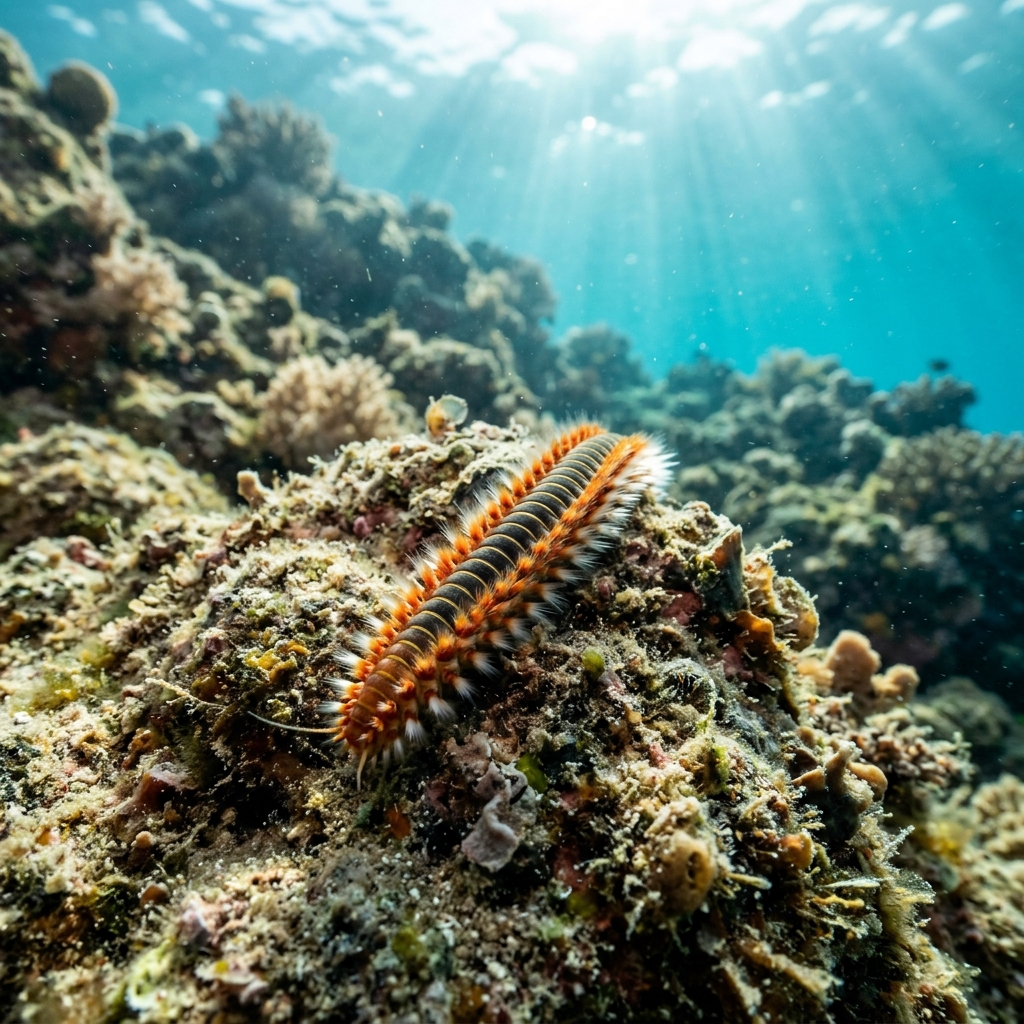
Fireworms are flattened, segmented worms with a distinctly bristly silhouette: each body segment carries tufts of bright white or cream chaetae (hollow bristles) that fan outward like a fringe. Body colour typically runs from pale cream to orange or reddish-brown along the centre, making the white bristle rows stand out sharply against darker reef surfaces. They range from a few centimetres to well over ten centimetres long depending on the species, and move with a slow, deliberate crawl. The combination of bright white bristle rows on a warm-toned worm body is the key underwater identifier for the family.
When you encounter a fireworm, it is usually moving slowly across hard substrate or rubble, grazing on encrusting organisms, or occasionally on coral tissue. They tend to ignore divers entirely and continue crawling at their unhurried pace rather than retreating into crevices. Look along the base of the reef, on rubble patches, and under ledge edges, particularly during daylight hours when they are active foragers.
Those white bristles are not decorative: they are hollow and detach on contact, embedding in skin and causing a burning, itching irritation that can last hours. Always keep hands clear, and never brush against them, even accidentally.
Fireworms are present year-round at sites where they occur, with no concentrated season recorded. The observed temperature range runs from around 6 to 23 °C, meaning they are well suited to both cool temperate and warm subtropical waters across the calendar.
Reef neighbours a diver could mistake it for. Use the identification notes above to tell them apart.
Fireworms are most commonly logged across the United States, Greece, Italy, the Canary Islands, and Turkey, with strong records throughout the Mediterranean basin. In the Americas, Florida and the Yucatán Peninsula stand out as reliable areas, along with Roatán in Honduras. The family also turns up regularly in the UK and Canada, so temperate divers should not discount local sites.
Mapping where Fireworm is logged…
Fireworms are logged across an enormous range of sites worldwide. The Mediterranean is a stronghold, particularly Greece, Italy, and Turkey, along with the Canary Islands. In the Atlantic, Florida, the Yucatán Peninsula, and Roatán are reliable. Temperate divers in the UK and Canada encounter them too.
Fireworms show no concentrated season and are recorded year-round at sites where they live. Their tolerance for water temperatures as low as around 6 °C means even cool-water winter dives in temperate regions can turn up a sighting.
Fireworms are not aggressive and will not chase or bite you. However, their white bristles break off and embed in skin on contact, causing a persistent burning and itching sensation. Simply avoid touching them and you will have no problem. If bristles do get in your skin, remove them with tape or tweezers rather than rubbing.
Look for a segmented worm with a warm orange or reddish-brown body lined on both sides by prominent tufts of white bristles. The bristle fringe is the clincher; no other common reef worm has quite that combination of colouration and dense white bristle rows. The wonder-worm is the most likely lookalike, but lacks the same vivid white bristle tufts.
Size varies across the family, but most individuals divers encounter range from a few centimetres to around 15 to 20 cm in length. Larger specimens can look surprisingly substantial crawling across the reef.
Fireworms are opportunistic predators and scavengers. They graze on encrusting organisms, soft corals, and anemones, and will feed on dead or weakened invertebrates. On coral reefs they are occasionally observed preying on coral tissue, which is one reason they attract attention from researchers studying reef health.
Site and sighting data is aggregated from diver logs, iNaturalist and GBIF. For taxonomy and conservation status:
Christmas Tree Worm
2,154 sites