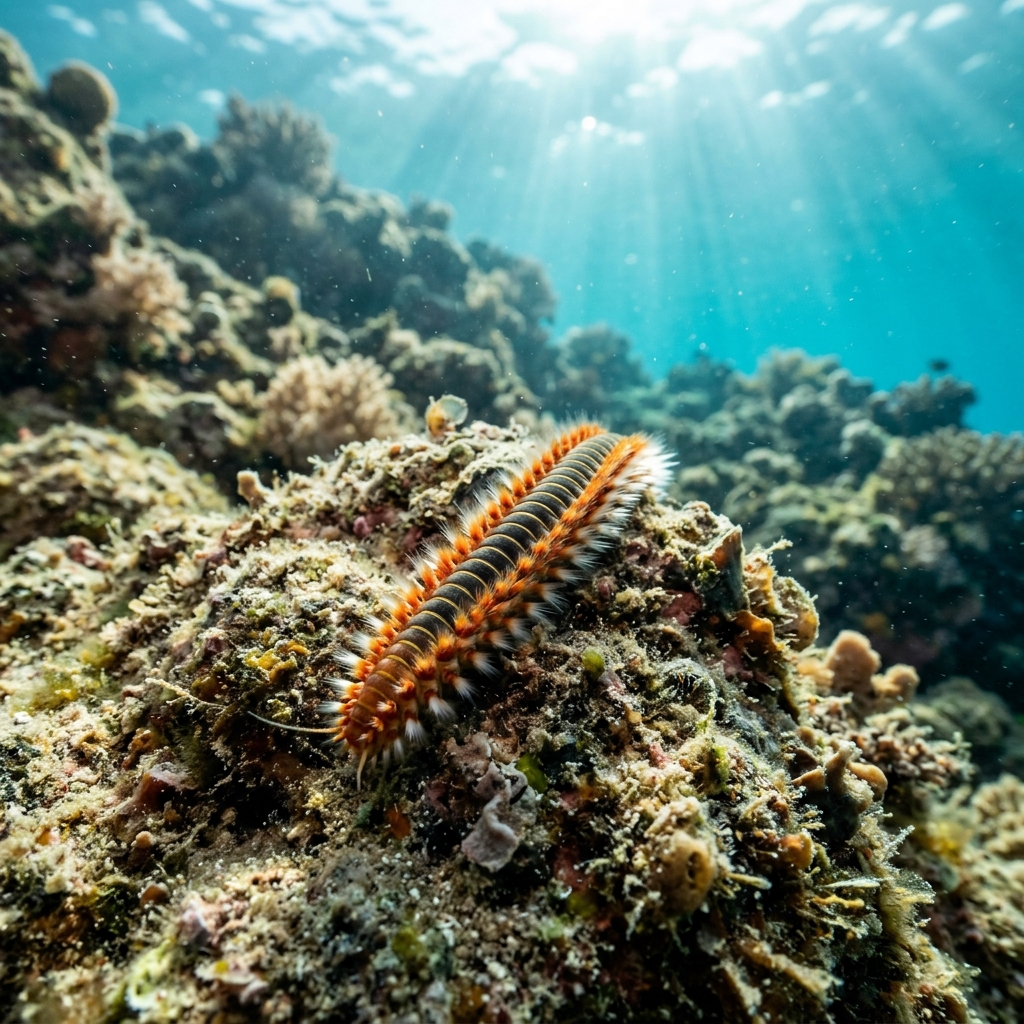
Polycladida spp.
Spot flatworms from the Philippines to the French Riviera year-round. ID tips, top dive regions, and what to look for on the reef.
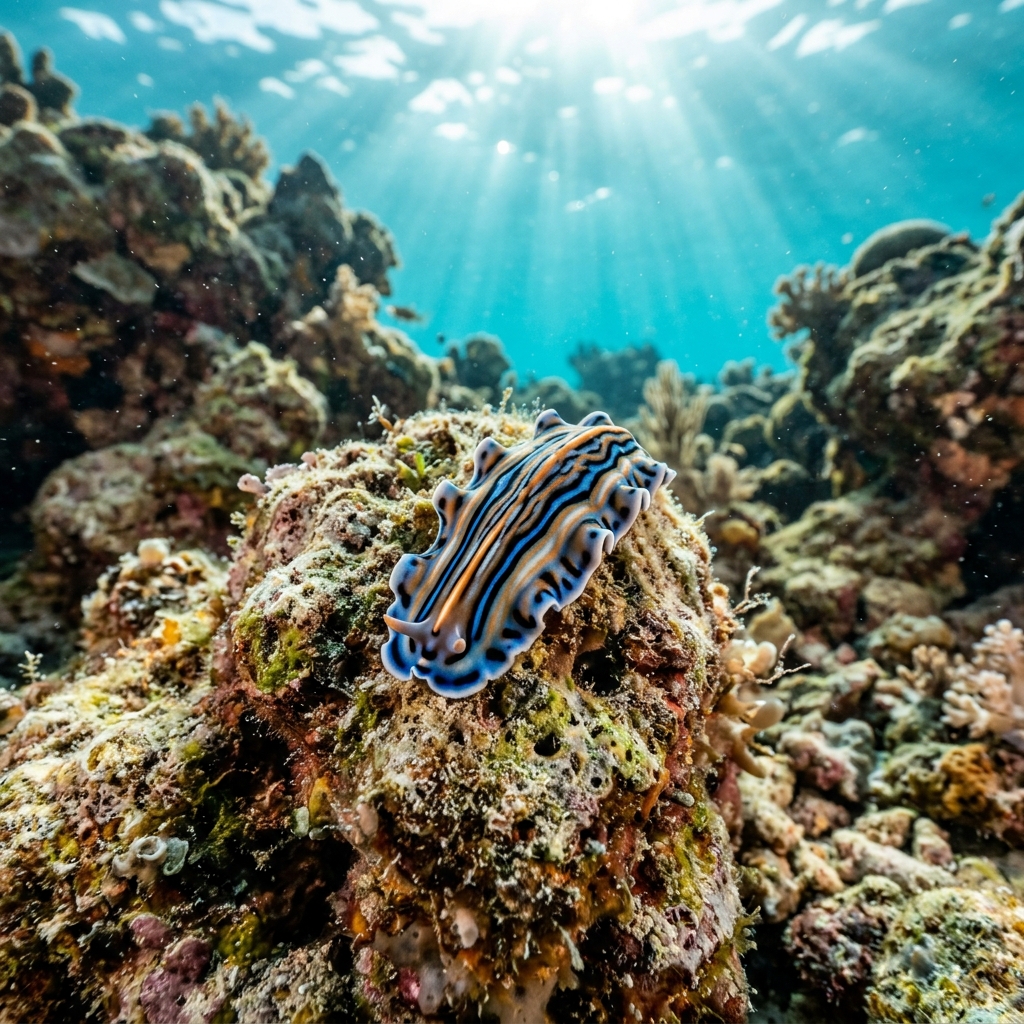
Polyclad flatworms are paper-thin, leaf-shaped invertebrates that glide smoothly across the reef as though they have no skeleton at all, because they don't. They range from a centimetre to several centimetres across, and many species wear bold warning colours: bright orange, yellow, white, black, or electric blue, often in contrasting bands or margins. Unlike nudibranchs, they have no visible gills or rhinophores (the sensory horns nudibranchs carry on their heads), giving them a smooth, uninterrupted silhouette. The combination of extreme flatness, fluid gliding motion, and vivid patterning is the quickest ID cue underwater.
Most sightings are of individuals gliding slowly across hard coral, rubble, or rock in the open, often in relatively shallow water where light is good. They move by beating thousands of tiny cilia on their underside, producing an almost hypnotic rippling motion with no visible effort. They tend to ignore divers entirely, continuing to patrol the reef surface, which makes them cooperative subjects for close-up photography.
Many polyclad flatworms are mimics: their vivid colour patterns closely copy toxic nudibranchs, and predators that have learned to avoid the real thing also leave the flatworm alone, a neat example of Batesian mimicry (where a harmless species imitates a harmful one) that plays out right in front of you on the reef.
Flatworms are present year-round in both hemispheres with no concentrated season, which matches their wide temperature tolerance of roughly 10 to 28 °C, they turn up on everything from British kelp beds to warm Philippine coral gardens.
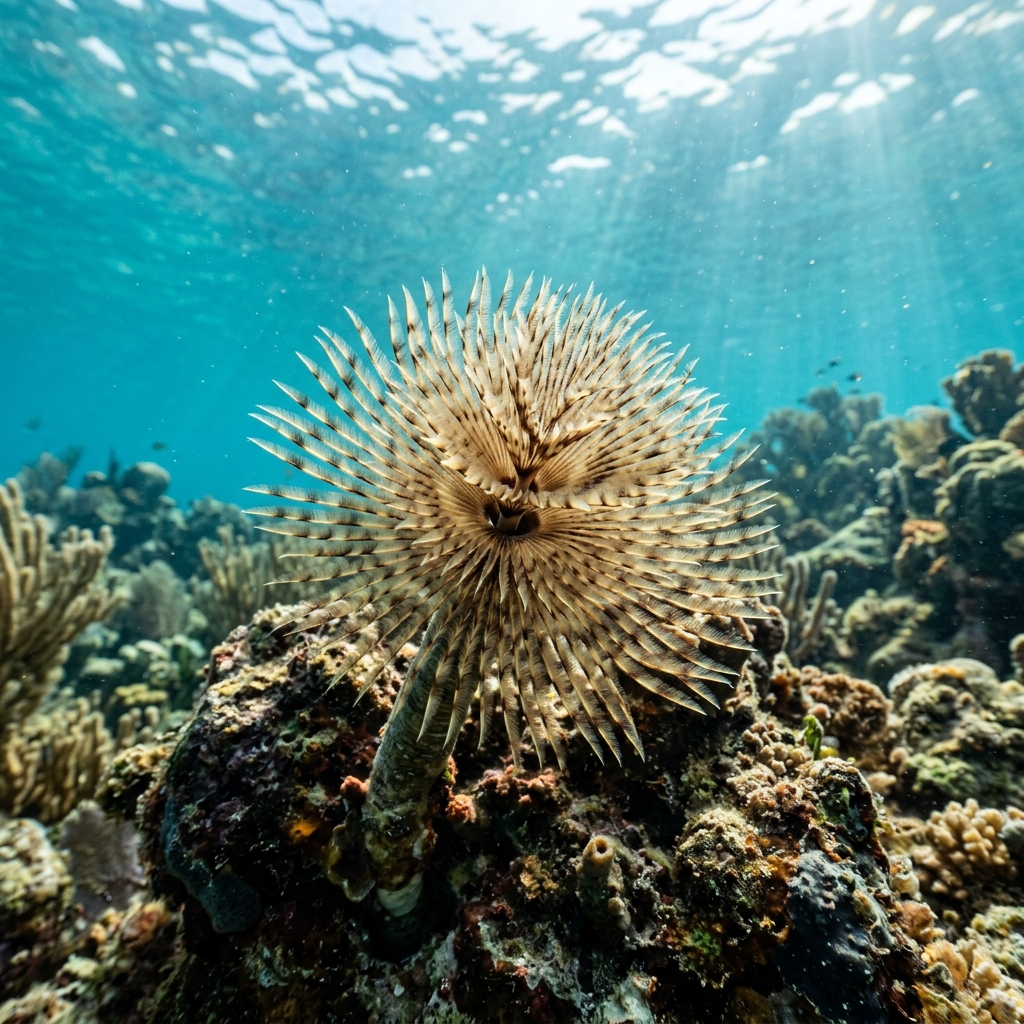
Reef neighbours a diver could mistake it for. Use the identification notes above to tell them apart.
Flatworms are logged across a remarkably broad range, with the strongest coverage in the Philippines, particularly the Visayas and Luzon regions, and in Indonesia. In Europe, the French Riviera, Costa Brava, and the UK coastline all produce regular sightings, showing the group is as comfortable in cooler temperate waters as on tropical reefs. Australia's Queensland sites and the southeastern United States round out the places where divers most reliably encounter them.
Mapping where Flatworm is logged…
Flatworms are logged at dive sites across a huge number of countries worldwide. The Philippines, Indonesia, France, Spain, Australia, and the United States are among the most productive, with the Visayas, French Riviera, Costa Brava, and Queensland all standing out as regions where divers report them regularly.
There is no peak season, flatworms are present year-round in both the northern and southern hemispheres. Their tolerance for water temperatures from around 10 °C up to nearly 29 °C means they inhabit temperate and tropical reefs alike, so the best time to look is simply whenever you are in the water.
Look for an extremely thin, leaf-shaped body gliding smoothly across the reef with no fins, limbs, or visible gills. Most species are colourful, bold oranges, whites, blacks, or blues, and the complete absence of rhinophores (the horn-like projections nudibranchs have) is a reliable separator from similar-looking slugs.
Most polyclad flatworms divers encounter range from about 1 cm to a few centimetres in length, though some larger species can reach 5 to 8 cm. Their extreme thinness means even the bigger ones can be easy to overlook unless their colours catch your eye.
No, flatworms pose no danger to divers. They are small, slow-moving animals that have no mechanism to harm a person. Some species may carry chemical defences that deter fish predators, but these are harmless to humans unless ingested, which is not a concern during diving.
Site and sighting data is aggregated from diver logs, iNaturalist and GBIF. For taxonomy and conservation status:
Christmas Tree Worm
2,154 sites