Echidna catenata
Chain moray sightings are most common in the Yucatán Peninsula, Grenada, and Roatán. Present year-round in warm Caribbean waters from 26-29 °C.
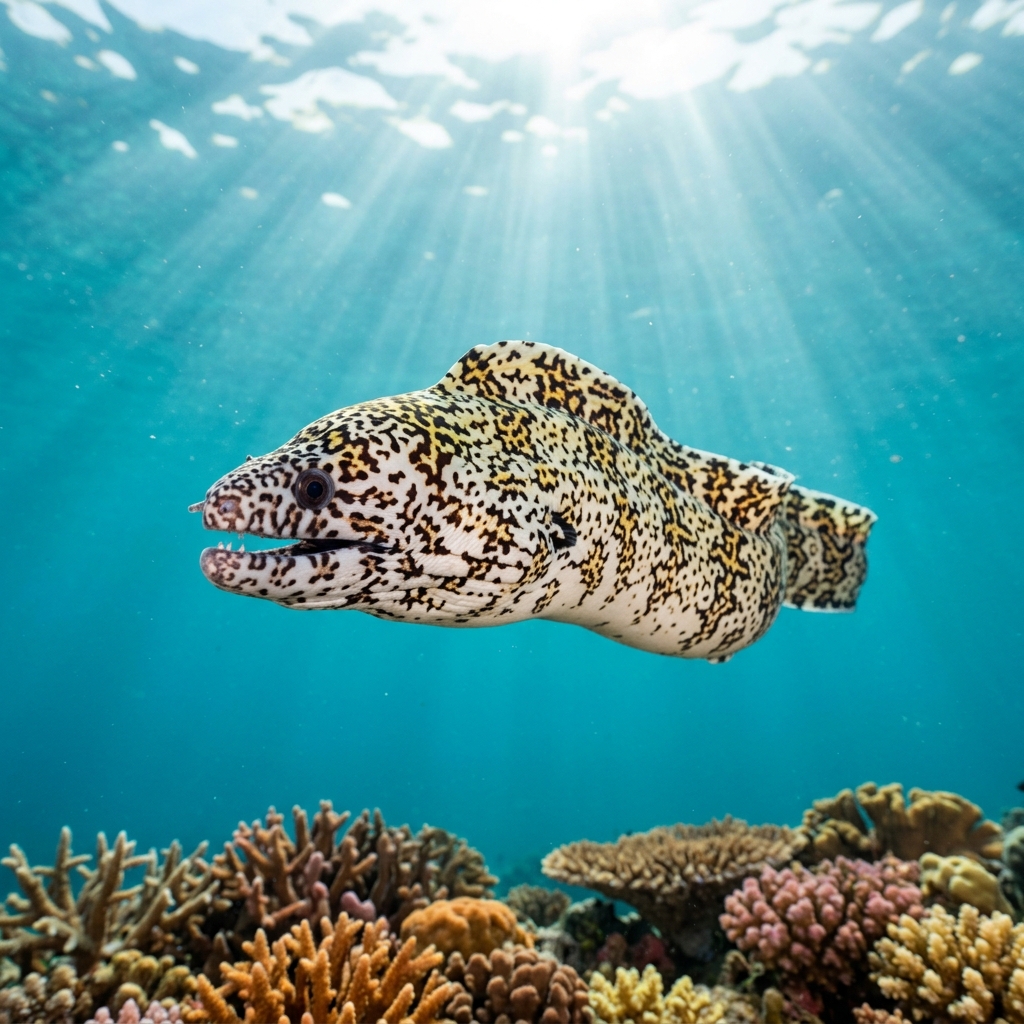
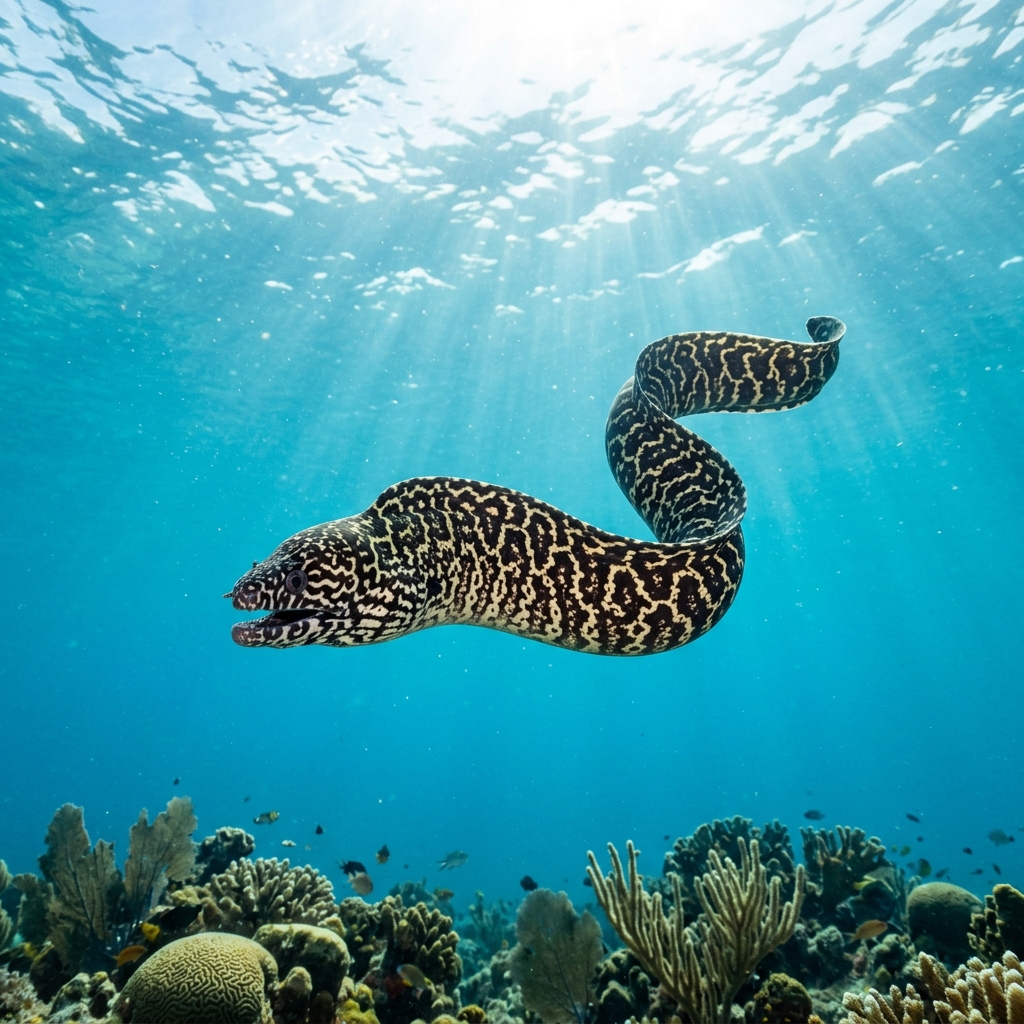
That chain-link or lattice pattern is the key: a dark brown to black body overlaid with irregular yellow or pale rings that interlock like links of a chain, giving this moray a look unlike any other Caribbean eel. It is a moderately sized moray, typically tucked into reef crevices with just the head and anterior body visible. The head is relatively blunt compared to many morays, and the teeth are rounded and pebble-like rather than fang-like, a useful clue when it opens its mouth to breathe. Juveniles tend to show higher contrast, with brighter yellow rings on a near-black ground.
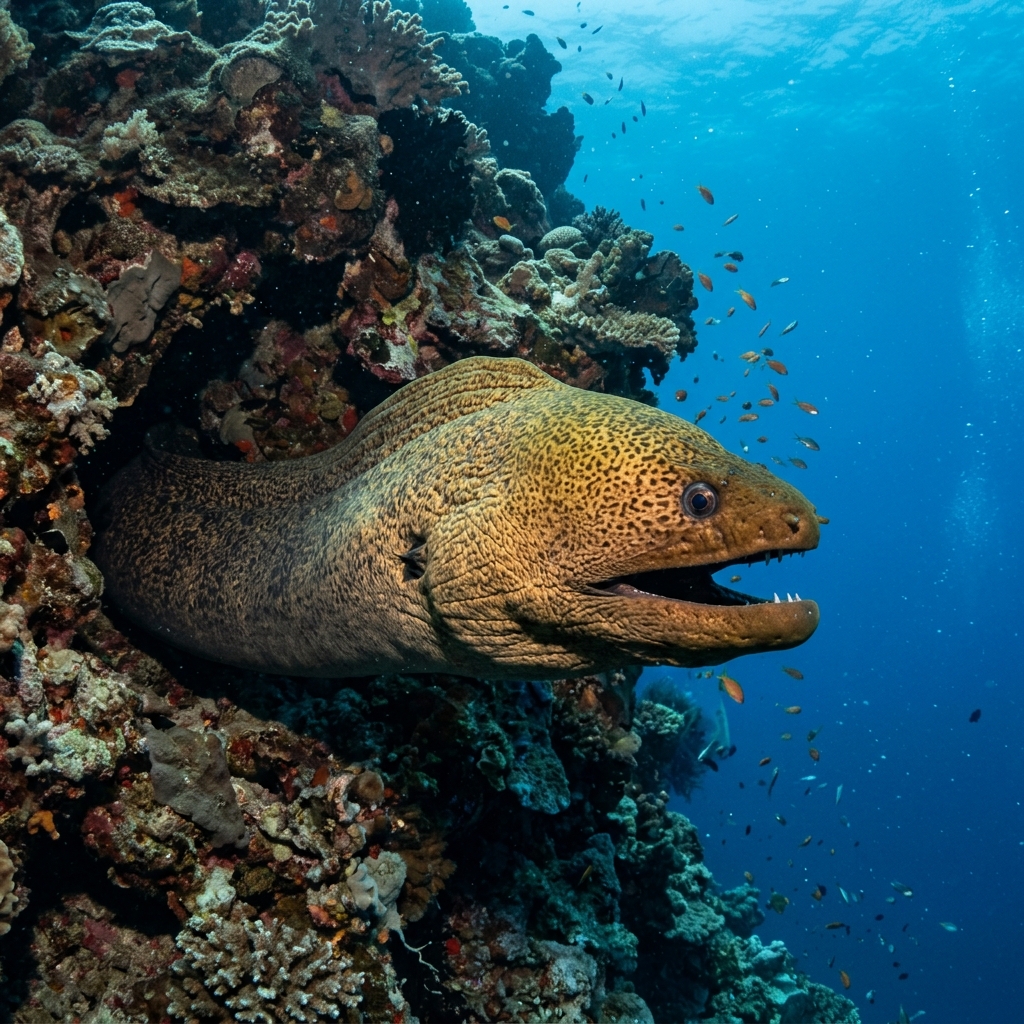
Expect to find chain morays wedged into rubble, under coral ledges, or inside cavities in the reef, usually with the head protruding and the mouth opening and closing rhythmically as they ventilate their gills. They are generally tolerant of calm divers and will hold position if you approach slowly without blocking their escape route. Unlike the large predatory morays that hunt fish, chain morays specialise in hunting crustaceans, and you may catch one actively foraging across the reef at dusk.
Chain morays are unusual among morays in that their teeth are blunt and molar-like rather than sharp, an adaptation for cracking open the hard shells of crabs and other crustaceans rather than gripping fish prey.
Chain morays are present year-round; seasonality data shows no concentrated peak season. Their observed water-temperature niche of roughly 26.5 to 29 °C matches the stable warm conditions found on Caribbean reefs throughout the year, so there is no wrong month to look for one.
Reef neighbours a diver could mistake it for. Use the identification notes above to tell them apart.
Chain morays are most consistently logged across the wider Caribbean, with the strongest sighting records in the Yucatán Peninsula in Mexico, Grenada Island, and Roatán in Honduras. Bonaire, Curaçao, the Cayman Islands, Aruba, and the Caribbean coast of Colombia all hold solid populations, making this effectively a pan-Caribbean species for divers to search out.
Mapping where Chain Moray is logged…
Chain morays are a Caribbean species logged at sites across Mexico, Grenada, Honduras, Bonaire, Curaçao, the Cayman Islands, Aruba, and Colombia. The Yucatán Peninsula, Grenada Island, and Roatán in Honduras are among the best-represented regions in diver records.
Chain morays are present year-round on Caribbean reefs. They favour stable warm water around 26.5 to 29 °C, which most Caribbean destinations maintain throughout the year, so there is no single peak season to target.
Look for the chain-link or lattice pattern: irregular yellow or pale rings interlocking across a dark brown to black body. No other Caribbean moray shares this exact pattern. The blunt, rounded snout also sets it apart from the more pointed heads of species like the spotted or green moray.
Chain morays are a mid-sized moray, typically reaching around 70 cm in length, though some individuals can approach 90 cm. Underwater they often appear shorter because much of the body remains hidden inside the reef.
Chain morays are specialist crustacean feeders. Their teeth are blunt and rounded rather than fang-like, designed for crushing crab and shrimp shells rather than gripping fish. This makes them one of the few morays you might observe actively hunting across rubble or hard substrate rather than simply ambushing prey from a hole.
Site and sighting data is aggregated from diver logs, iNaturalist and GBIF. For taxonomy and conservation status:
Garden Eel
2,448 sites