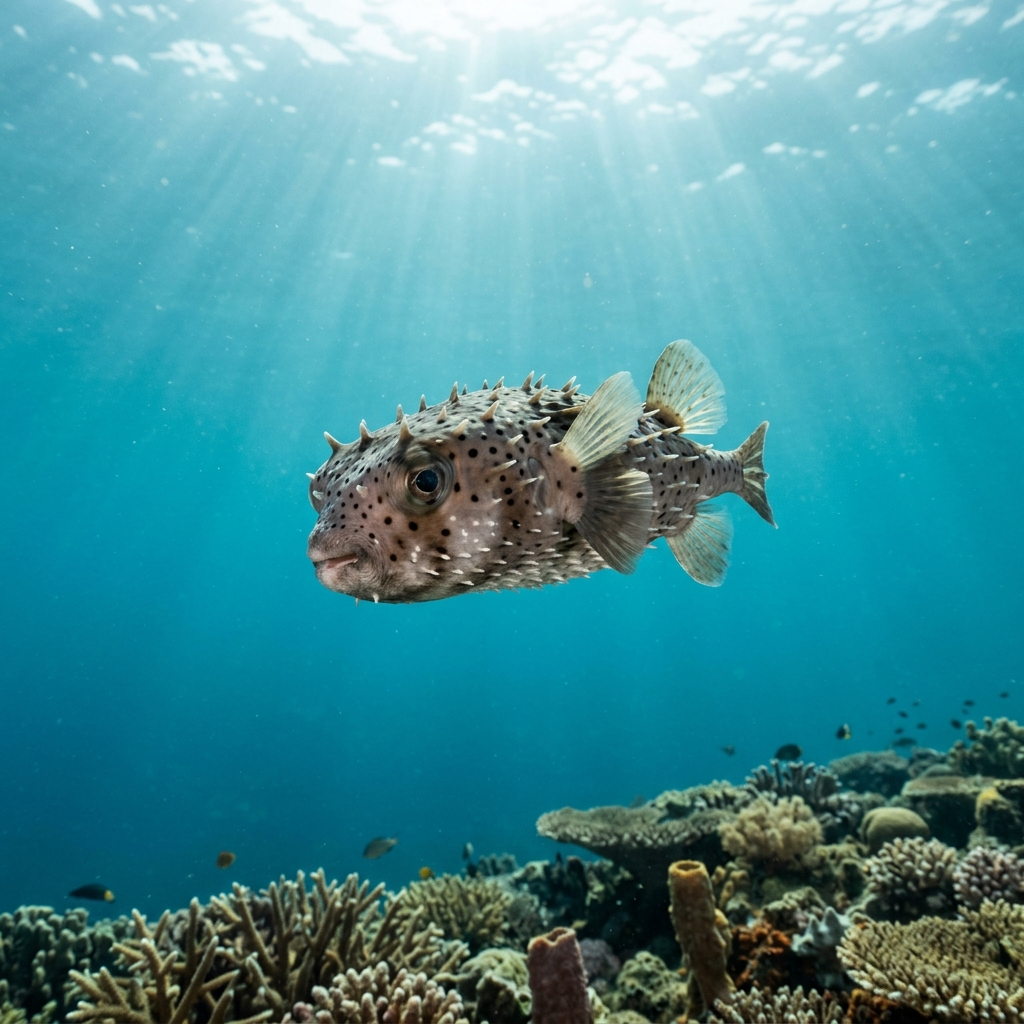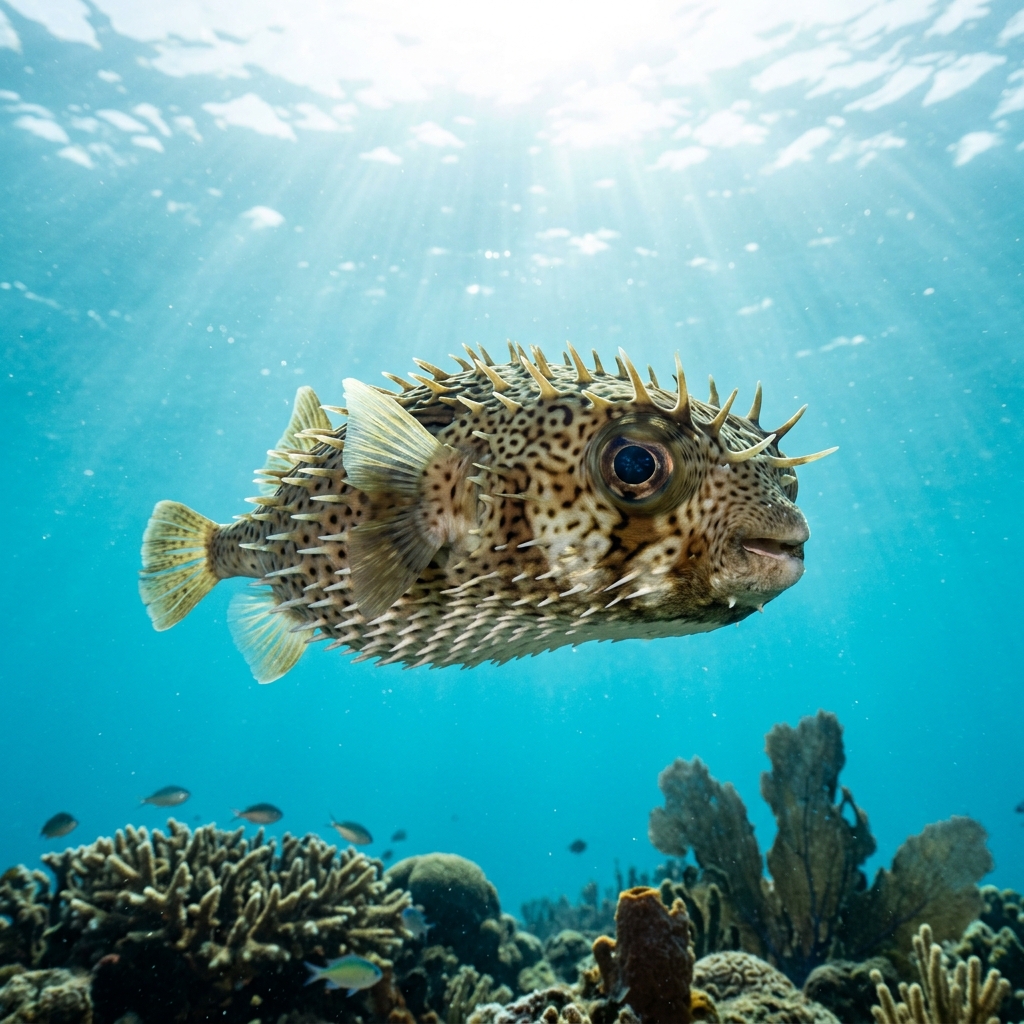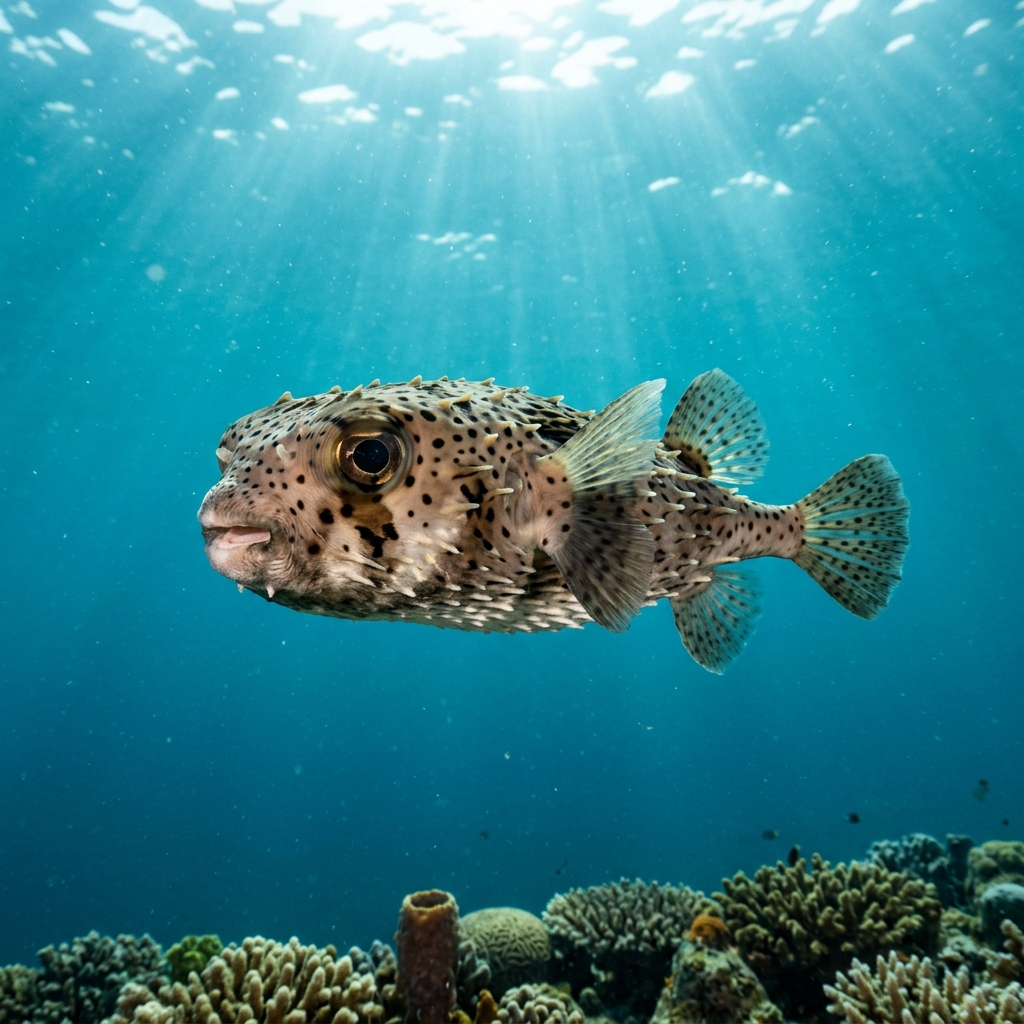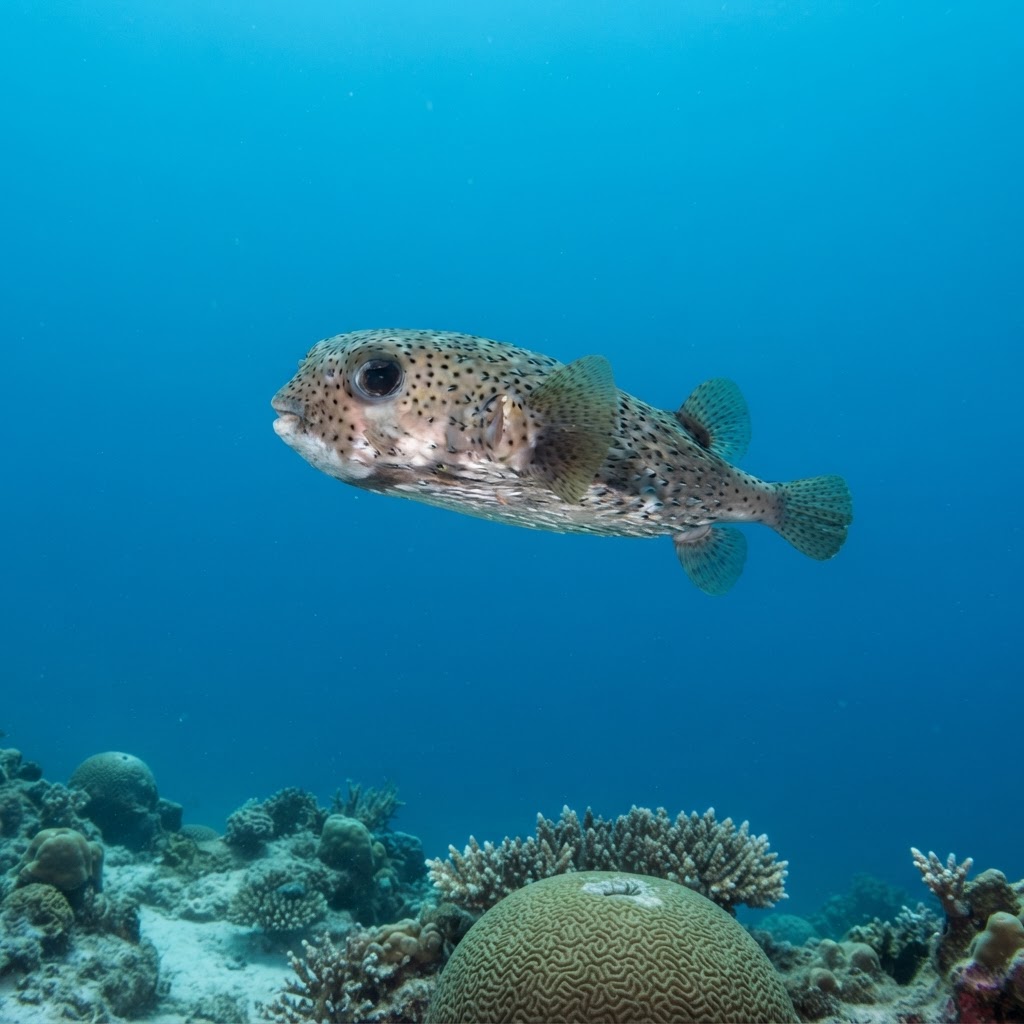
Cyclichthys orbicularis
Spot Birdbeak Burrfish in Sharm el Sheikh, Muscat, and the Philippines. Know when and where to find this round, spiny fish on Red Sea and Indo-Pacific reefs.
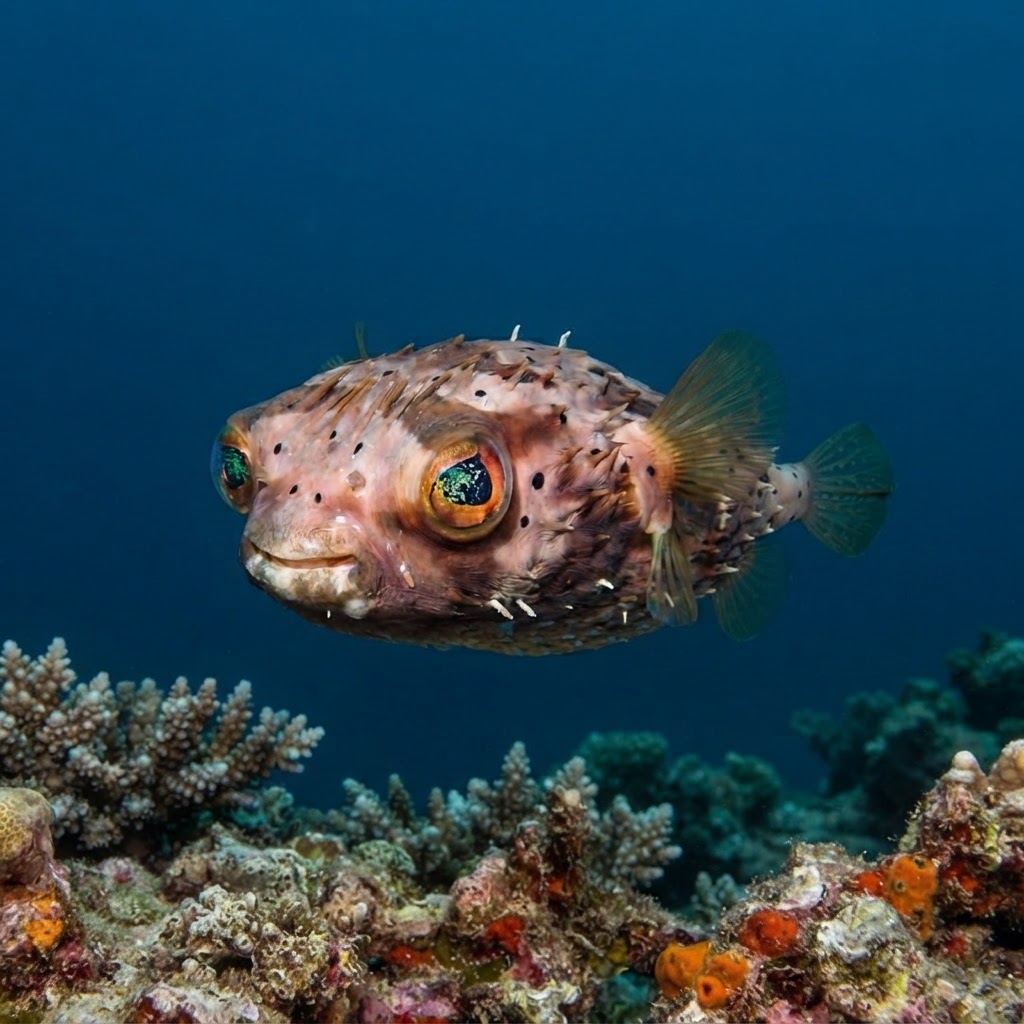
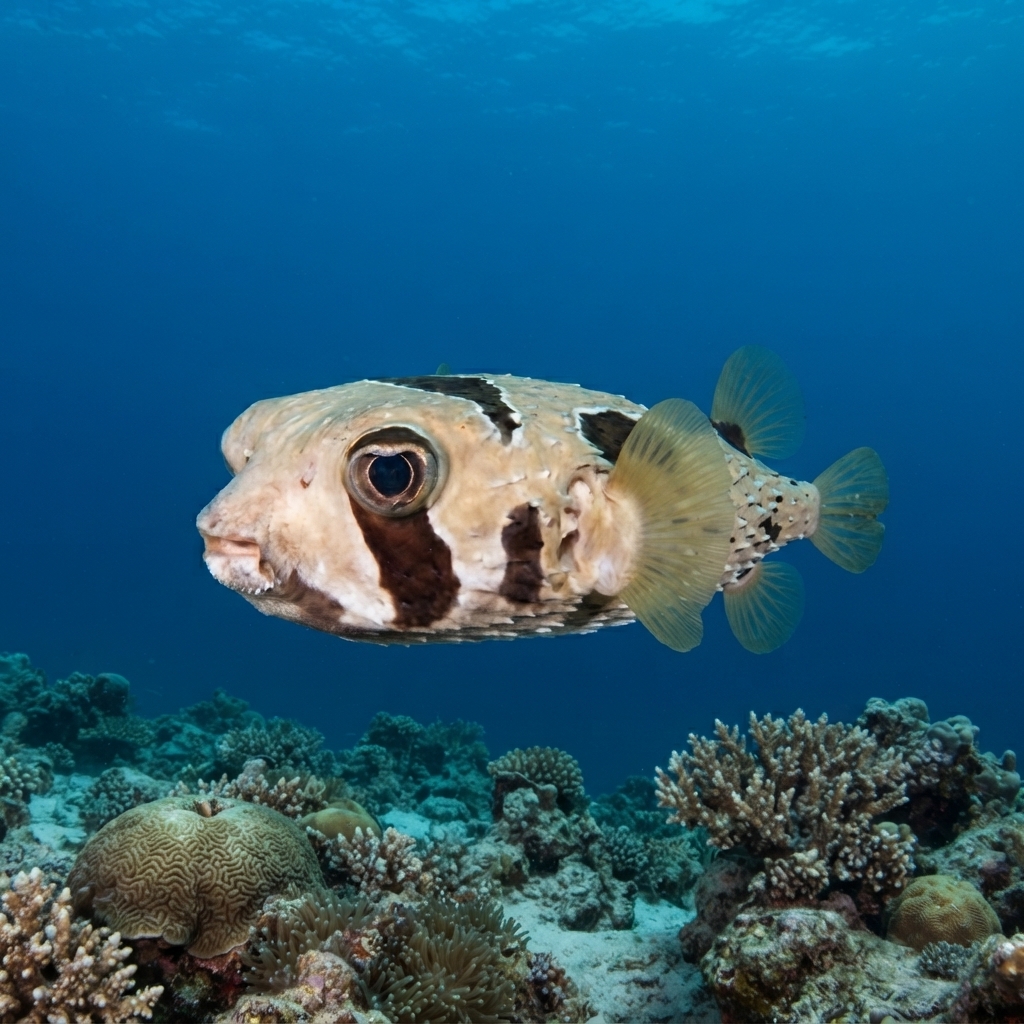
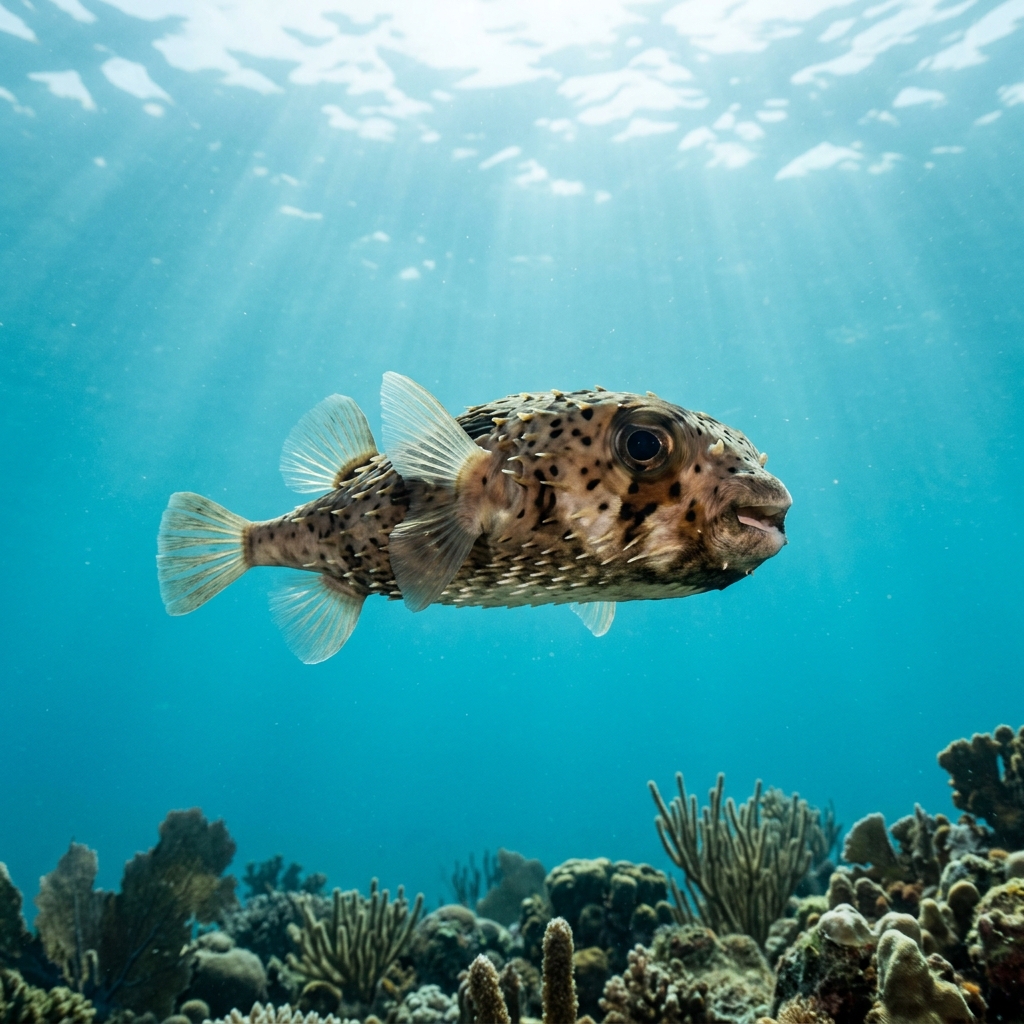
A compact, almost spherical body covered in short, fixed spines (which do not erect like those of a porcupinefish) immediately sets this species apart from most reef fish. The skin is pale to yellowish-tan with scattered dark spots or blotches, and the fused beak-like teeth that give the fish its name are clearly visible even from a short distance. It rarely exceeds about 15 cm in the water, making it noticeably smaller than common porcupinefish. Look for the blunt, rounded head and small fins to confirm the ID.
Birdbeak burrfish are most often found resting or moving slowly close to the reef substrate, tucked into coral rubble or among rocks rather than out in open water. They tend to hold their position when a diver approaches, relying on their spines as passive defence rather than fleeing, which makes close observation straightforward. Encounters are typically solitary, and the fish is most active at night, so twilight and night dives raise your chances considerably.
Unlike porcupinefish, the spines of burrfish are always erect and fused to the body rather than raised only as a threat response. This means the fish is permanently armed without needing to inflate, and it cannot puff up its body to the same dramatic degree.
In the northern hemisphere, sightings concentrate from August through April, broadly overlapping with the cooler end of tropical water temperatures (observed range 23 to 29 °C). Summer months in the northern hemisphere see a dip in records, so autumn through early spring is the most productive window in Egypt, Oman, and Jordan.
Reef neighbours a diver could mistake it for. Use the identification notes above to tell them apart.
Most consistently logged in Egypt, particularly around Sharm el Sheikh and Safaga, which together account for a large share of all records. The Red Sea coast of Oman around Muscat is another strong bet, and the species turns up regularly across the Philippines and Malaysian Borneo. Jordan's Aqaba and Kenya's coast round out the range for divers working the western Indian Ocean.
Mapping where Birdbeak Burrfish is logged…
The strongest sighting records come from Sharm el Sheikh and Safaga in Egypt, Muscat in Oman, and coastal sites across the Philippines and Malaysian Borneo. It is also reliably logged in Aqaba (Jordan), along Israel's Red Sea coast, and in Kenya, making the Red Sea and western Indian Ocean the core range for divers targeting this species.
In northern hemisphere destinations like Egypt, Oman, and Jordan, sightings are most frequent from August through April. The summer gap in records may reflect reduced diver effort as much as fish behaviour, but autumn to early spring is your most reliable window. The species tolerates water temperatures from about 23 to 29 °C.
Look for a small, near-spherical fish with short, permanently erect spines and a blunt beak formed by fused teeth. The body is pale tan with dark spotting. The key difference from a porcupinefish is that the spines are always raised and the body does not inflate dramatically. Burrfish are also noticeably smaller and rounder than most porcupinefish species.
No. Birdbeak Burrfish pose no threat to divers. They are slow-moving and docile, and while their spines are sharp, a relaxed, non-touching approach means there is no risk of contact. Simply observe from a respectful distance and they will usually stay put.
No. The Birdbeak Burrfish is currently assessed as Least Concern on the IUCN Red List, meaning it faces no elevated extinction risk at present. It is spread across a wide range of Indo-Pacific and Red Sea reefs.
Site and sighting data is aggregated from diver logs, iNaturalist and GBIF. For taxonomy and conservation status:
Long-spine Porcupinefish
1,222 sites