Rachycentridae spp.
Cobia are logged across warm tropical waters, most commonly in San Andrés & Providencia. Spot them in 23-29 °C seas year-round.
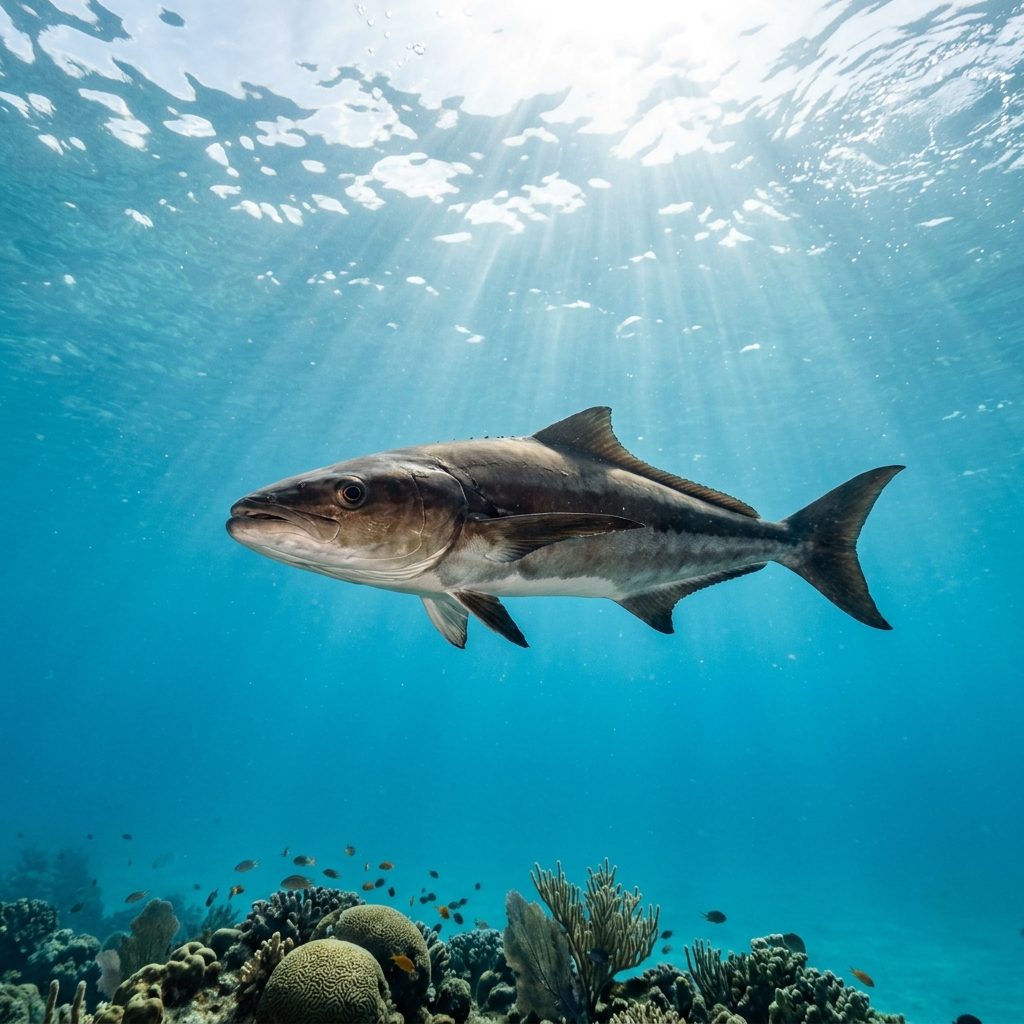
A large, torpedo-shaped fish with a broad, flattened head and a distinctive long lower jaw that juts forward slightly, giving it a slightly shark-like profile from the side. Adults are plain dark brown above, fading to pale on the belly, often with a subtle lighter lateral stripe running from snout to tail. Juveniles are unmistakable, wearing bold alternating black and white horizontal stripes along the full body length. In open water, the elongated body, pointed pectoral fins, and that flat head are the quickest giveaways.
Cobia are typically encountered as solitary individuals or in loose groups cruising in open water or just above the reef, often moving at a steady, unhurried pace. They have a well-known habit of shadowing larger animals, including rays, sharks, and even dive boats, apparently using them as cover while hunting. Divers generally find them tolerant of a calm approach, though they will peel away if spooked.
Cobia are the sole species in their entire family, Rachycentridae, making every sighting a meeting with an evolutionary one-of-a-kind. No close relatives exist anywhere in the ocean.
There is not enough seasonal data to point to a peak month, so treat cobia as a year-round possibility wherever you find warm water. The observed temperature range of roughly 23 to 29 °C fits tropical and subtropical reef conditions throughout the year.
Reef neighbours a diver could mistake it for. Use the identification notes above to tell them apart.
By far the strongest sighting record sits in San Andrés & Providencia, Colombia, making this the go-to destination for a cobia encounter. Smaller but consistent records come from Florida and the Southeast United States, New South Wales in Australia, and Mafia Island in Tanzania. Portugal has a solitary observation rounding out the spread.
Mapping where Cobia is logged…
Cobia are most commonly logged in San Andrés & Providencia, Colombia, which accounts for the majority of all recorded sightings. Other reliable regions include Florida and the Southeast United States, New South Wales in Australia, and Mafia Island in Tanzania. A sighting has also been recorded in Portugal.
No clear seasonal peak has emerged from the available data, so cobia should be treated as a year-round possibility. They appear most consistently in water between 23 and 29 °C, which covers tropical and warm subtropical reef conditions throughout all seasons.
Look for a large, dark brown fish with a noticeably flat, broad head and a jutting lower jaw that gives it a shark-like silhouette. A faint pale lateral stripe runs the length of the body. Juveniles are completely different, showing bold black and white horizontal stripes across the whole body.
Cobia are sizeable pelagic (open-water) fish. Adults regularly exceed one metre in length and can approach two metres, making them hard to miss in open water. Their bulk and elongated shape contribute to that unmistakable torpedo profile.
No, cobia are not considered dangerous to divers. They are generally curious and tolerant around people in the water, though like any large fish they should be given space and not harassed.
Cobia have a well-documented habit of shadowing larger animals, including stingrays, sharks, and even turtles. This behaviour is thought to help them ambush small fish and crustaceans disturbed or flushed out by the larger animal's movements, essentially using them as a living feeding aid.
Site and sighting data is aggregated from diver logs, iNaturalist and GBIF. For taxonomy and conservation status:
Butterfish
1,423 sites