Megalops atlanticus
Atlantic Tarpon are most reliably seen in Florida and the Yucatán Peninsula. Know when to go, what to look for, and how common sightings really are.
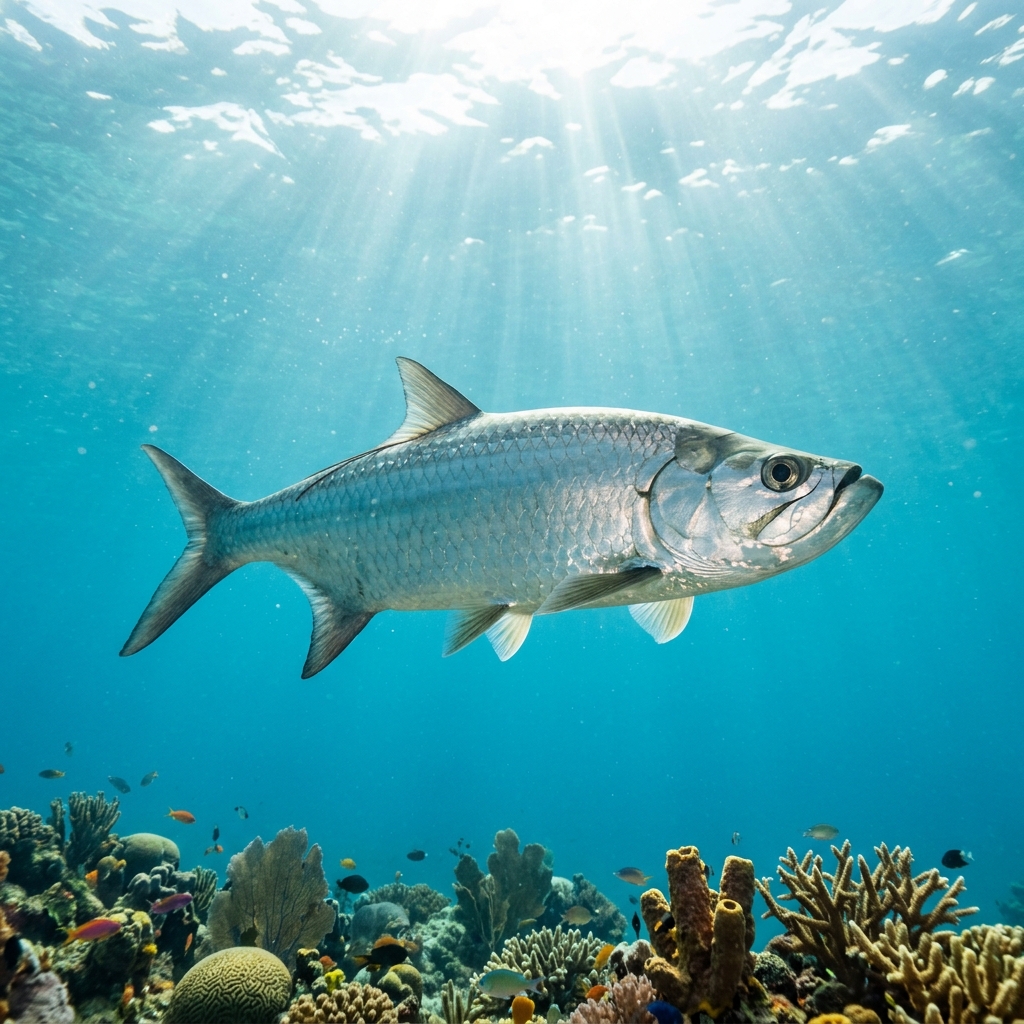
Few fish announce themselves quite like a tarpon: a large, torpedo-shaped body covered in enormous, plate-like silver scales that catch the light from a distance. The back is dark blue-green to olive, contrasting sharply with the bright silver flanks. Look for the upturned lower jaw, a distinctly large mouth that opens wide, and a single dorsal fin whose last ray extends into a long filament trailing behind. In the water they often move in loose groups, and their size alone sets them apart from most reef fish.
Tarpon are often spotted cruising slowly in mid-water or just above the bottom, sometimes in loose aggregations of a dozen or more fish moving in the same direction. They are generally relaxed around divers and will often hold their position or circle back out of curiosity rather than bolting. Near dawn or dusk they may be seen rolling at the surface, gulping air into their modified swim bladder, which functions as a primitive lung.
Tarpon can breathe air directly by rolling at the surface and gulping, using a lung-like swim bladder. This adaptation lets them survive in low-oxygen environments such as mangrove channels and warm shallow lagoons that most large fish cannot tolerate, and it is one reason they turn up in such a wide variety of dive conditions.
In the Northern Hemisphere, sightings concentrate from November through September, suggesting a broad season that covers most of the year. The observed water-temperature range of roughly 20 to 28 °C aligns with warm tropical and subtropical conditions, so diving in peak summer months in Florida or the Caribbean offers the most consistent encounters.
Atlantic Tarpon are most commonly logged across the western Atlantic, with Florida and the broader southeast United States the top region by a wide margin. Strong populations also bring reliable sightings across the Yucatán Peninsula in Mexico, Grand Cayman, Roatán in Honduras, and into Bonaire, the Bahamas, and Cuba. Belize and Brazil round out the range, showing that this is a species well spread across Caribbean and tropical Atlantic dive destinations.
Mapping where Atlantic Tarpon is logged…
The strongest diver sightings come from Florida and the southeast United States, followed by the Yucatán Peninsula, Grand Cayman, Roatán in Honduras, and Bonaire. Cuba, the Bahamas, Belize, and northeast Brazil also feature them regularly. The species spans a large chunk of the tropical and subtropical western Atlantic.
Northern Hemisphere sightings are recorded from November through September, making encounters possible for most of the year. Summer months tend to be most productive in Florida, while the Caribbean sees them throughout its warm season. The species favours water temperatures between roughly 20 and 28 °C.
Look for a very large silver fish with oversized plate-like scales, a dark blue-green back, and a long trailing filament at the end of the dorsal fin. The upturned mouth is distinctive. Their size and bright mirror-like flanks make them hard to confuse with anything else on a Caribbean or Florida reef.
Atlantic Tarpon are one of the largest fish divers regularly encounter in Atlantic and Caribbean waters. Adults commonly exceed 1.5 metres and can surpass 2 metres in length, with weights reaching well over 100 kg in older individuals. In the water their sheer bulk is immediately apparent.
Yes. Tarpon have a modified swim bladder that works similarly to a primitive lung, allowing them to gulp air at the surface. You can sometimes watch them roll and surface in shallow water. This ability lets them thrive in warm, low-oxygen environments like mangrove channels where other large fish cannot survive.
Atlantic Tarpon are currently listed as Vulnerable by the IUCN, meaning the population faces real pressure. Key threats include habitat loss in the mangrove nursery areas where juveniles develop. Divers can help by not harassing aggregations and supporting conservation of coastal mangrove habitats across their range.
The Atlantic Tarpon is listed as vulnerable by the IUCN. Observe from a distance, avoid touching or feeding it, and report sightings to local marine research organisations.
Atlantic Tarpon are currently assessed as Vulnerable on the IUCN Red List. Divers should avoid chasing or crowding them, particularly in known aggregation areas, and support local regulations that protect their critical nursery habitats in mangroves and estuaries.
Site and sighting data is aggregated from diver logs, iNaturalist and GBIF. For taxonomy and conservation status:
Ocean Sunfish
1,394 sites