Mola mola
Spot ocean sunfish in the Mediterranean from July onward, Attica, Central Dalmatia, and Aegean Turkey are your best bets in cooler 5-20 °C waters.
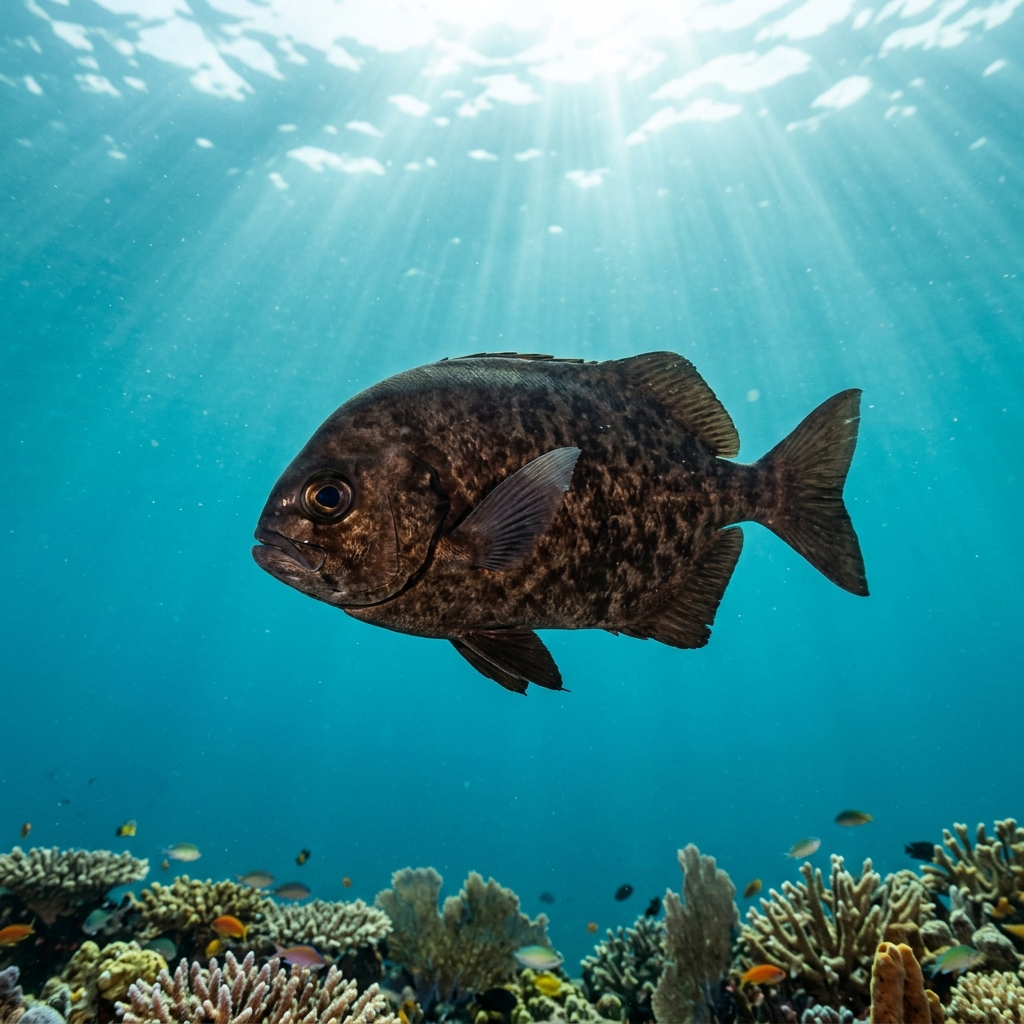
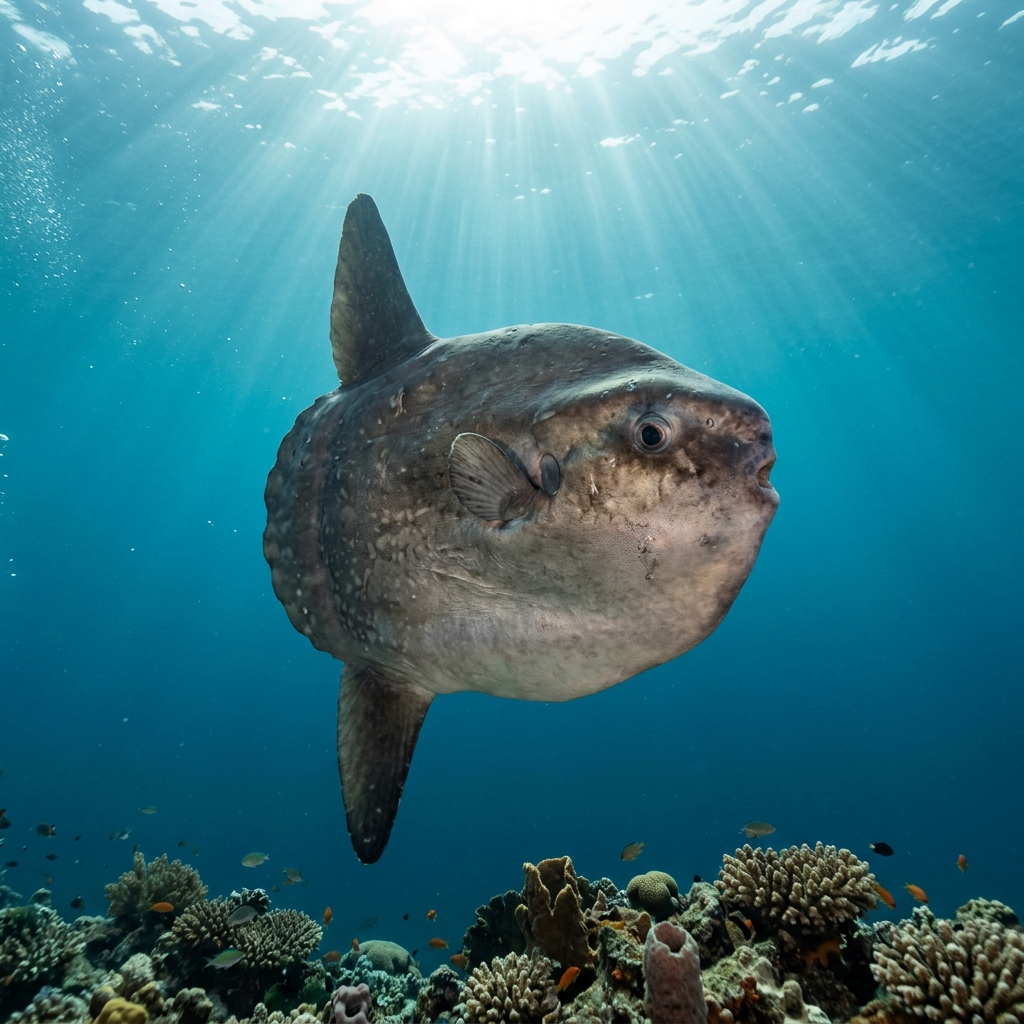
Nothing else in the ocean looks quite like this animal: a massive silvery-grey disc, often taller than it is long, that appears to be all head with the tail sawn off. Adults average over two metres across and move by sculling their tall dorsal and anal fins in slow, hypnotic sweeps. The skin is rough and leathery, often a pale blue-grey above fading to silvery white below, and the body is so laterally compressed (flattened side to side) it can vanish when facing you head-on. Juveniles look completely different, see below.
Divers most often encounter an ocean sunfish slowly sculling at or near the surface, sometimes lying on its side, a basking posture that helps it warm up after deep foraging dives that can exceed 200 metres. It is generally indifferent to divers, continuing its unhurried patrol rather than fleeing, though large individuals can spook if approached too aggressively. Occasionally one will hover near a cleaning station, holding still while wrasse pick parasites from its rough skin.
Despite its enormous size, the ocean sunfish begins life as a tiny egg barely 1.5 mm wide, and a single female can carry more eggs than almost any other vertebrate on the planet, estimates run into the hundreds of millions.
In the Northern Hemisphere, sightings concentrate from July through January, peaking in the warmer months when the sunfish move closer to the surface in the Mediterranean and northeastern Atlantic. The species tolerates a wide temperature band down to around 5 °C, so encounters in cooler northern waters are possible well into autumn and winter.
Most sightings are logged across the Mediterranean and northeastern Atlantic, with Greece, Italy, Croatia, Spain, and France leading the tally. The richest regional concentrations sit around Attica in Greece, Central Dalmatia in Croatia, the Aegean Coast of Turkey, and Sardinia and Tuscany in Italy. Outside Europe, the Pacific and northeast coasts of the United States also produce regular records.
Mapping where Ocean Sunfish is logged…
The Mediterranean is the most reliable region, particularly around Attica in Greece, Central Dalmatia in Croatia, the Aegean Coast of Turkey, and the waters off Sardinia and Tuscany in Italy. The Pacific and northeast coasts of the United States also produce regular sightings.
In the Northern Hemisphere, sightings cluster between July and January. Summer and early autumn are prime in the Mediterranean, when sunfish move to shallower, warmer surface waters. They can still turn up later in autumn and winter, especially in the cooler northeastern Atlantic.
The shape is unmistakable: a huge silvery disc that looks like a giant head with no proper tail, propelled by tall, sweeping dorsal and anal fins. The rough, grey-silver skin and the sheer scale, adults regularly exceed two metres, rule out almost everything else a diver is likely to see.
Adults average around 233 cm across and are among the heaviest bony fish on Earth, with large individuals exceeding 1,000 kg. In the water they appear even bigger because the tall dorsal and anal fins add considerably to their overall height.
No. Ocean sunfish pose no threat to divers. They are slow-moving, non-aggressive, and generally indifferent to human presence. The only practical concern is their sheer bulk, give a large individual reasonable space simply because of its size.
They are currently classified as Vulnerable by the IUCN. The main pressure is accidental capture in drift nets and longlines rather than direct targeting. Their slow reproduction and late maturity mean populations recover slowly from losses.
The Ocean Sunfish is listed as vulnerable by the IUCN. Observe from a distance, avoid touching or feeding it, and report sightings to local marine research organisations.
The ocean sunfish is listed as Vulnerable on the IUCN Red List, largely due to bycatch in drift-net and longline fisheries. If you encounter one, keep a respectful distance and avoid blocking its path, passive observation is the best a diver can offer.
Site and sighting data is aggregated from diver logs, iNaturalist and GBIF. For taxonomy and conservation status:
Butterfish
1,423 sites