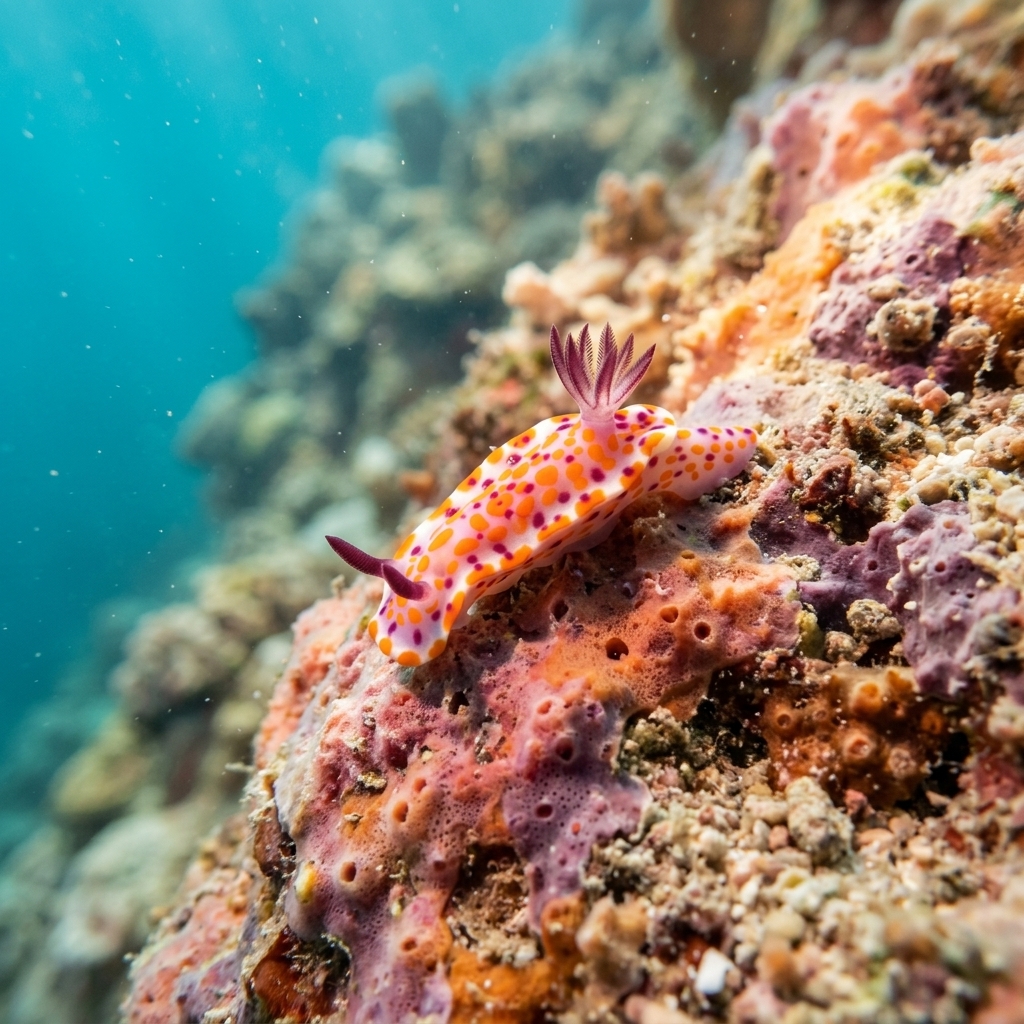
Ceratosoma amoenum
Spot the Clown Doris along Australia's New South Wales coast and New Zealand's Northland. Best sightings run September to April in cool 15-21°C waters.
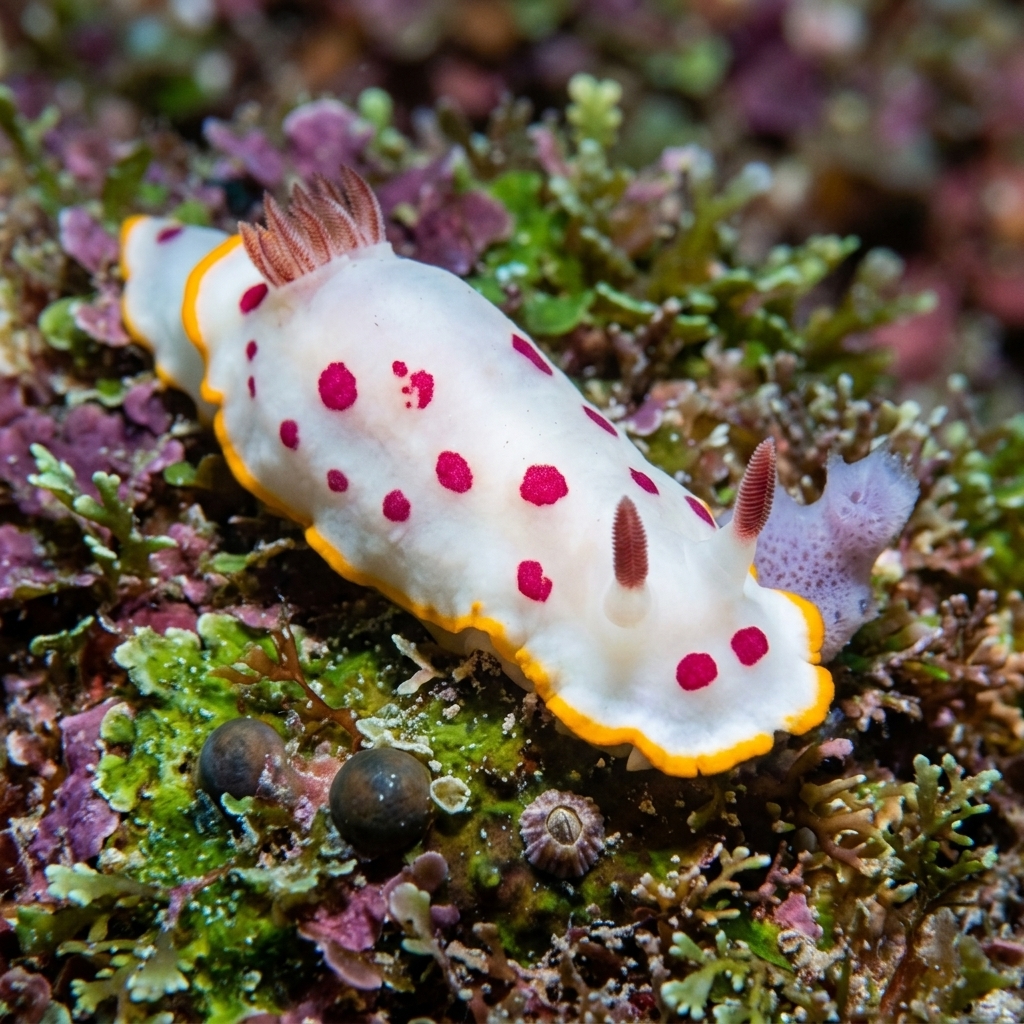
Bold, contrasting colours are the key to spotting this nudibranch, with a white or cream body patterned with bright orange or red blotches and purple-tipped cerata (the finger-like projections along the back). The body is relatively elongated and soft, sitting flat against the reef as it moves. Look for the distinctive purple or violet edging on its gills and rhinophores (the club-shaped sensory horns at the front), which give it a clown-like, flamboyant appearance even in murky water.
Clown Doris are passive and pay little attention to divers, carrying on with slow, deliberate foraging along rocky and reef surfaces during daylight hours. You will typically find one moving steadily across sponge or bryozoan growth, which is likely its prey. Approach slowly and low to avoid disturbing the substrate around it.
Like many chromodorids, Clown Doris is thought to sequester toxic or distasteful compounds from the sponges it feeds on, and its vivid colouring is widely interpreted as a warning to predators, a strategy known as aposematism.
Sightings concentrate between September and April across the Southern Hemisphere range, covering the spring-through-autumn window when water temperatures sit in the 15 to 21°C band that suits this species best.
Reef neighbours a diver could mistake it for. Use the identification notes above to tell them apart.
Most commonly logged in Australia, with New South Wales leading by a wide margin, followed by Victoria, South Australia, and Tasmania. New Zealand is the other confirmed country, with strong records across Northland, Auckland, and the Coromandel and Bay of Plenty coastlines.
Mapping where Clown Doris is logged…
The species is most reliably found along the New South Wales coast of Australia, with further records from Victoria, South Australia, Tasmania, and Western Australia. In New Zealand, Northland, Auckland, and the Coromandel and Bay of Plenty are the top areas. Rocky reef dives in cooler southern waters give you the best chance.
Across its Australian and New Zealand range, sightings peak between September and April. This spring-to-autumn window aligns with the water temperatures, roughly 15 to 21°C, that the species appears to prefer.
Look for a white or cream body with bold orange or red blotches and purple-tipped cerata along the back. The gills and rhinophores typically show violet or purple edging. That combination of warm and cool colours on a slow-moving nudibranch is a strong field indicator.
No. Clown Doris poses no threat to divers whatsoever. Like other nudibranchs, it is completely passive. The vivid colours are a warning to predators, not a signal relevant to people. Simply avoid touching it or disturbing the reef around it.
The striking pattern is believed to serve as a warning to predators, a strategy called aposematism. Many chromodorid nudibranchs accumulate distasteful or toxic chemicals from the sponges they eat and advertise this through bright colours, making them a meal most fish learn to avoid.
Site and sighting data is aggregated from diver logs, iNaturalist and GBIF. For taxonomy and conservation status:
Light-spotted Aegires
3,168 sites