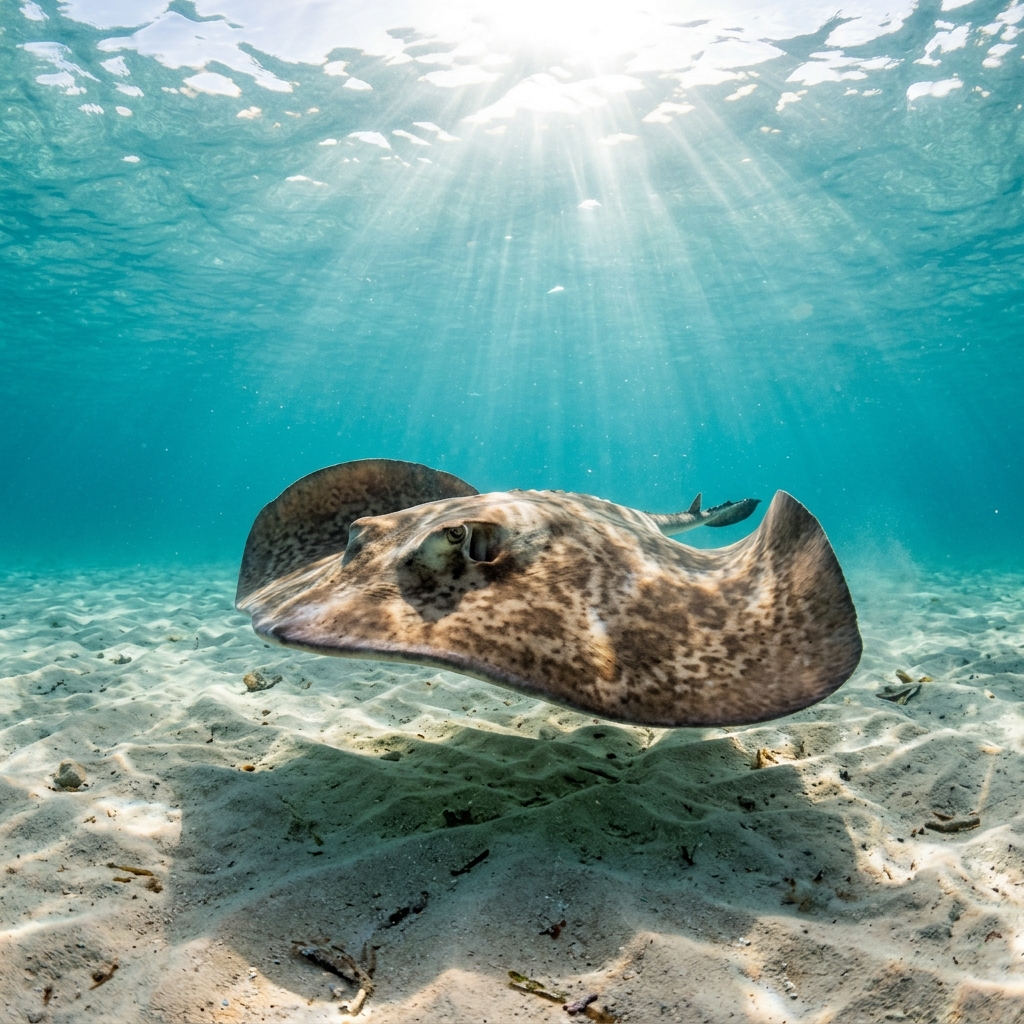
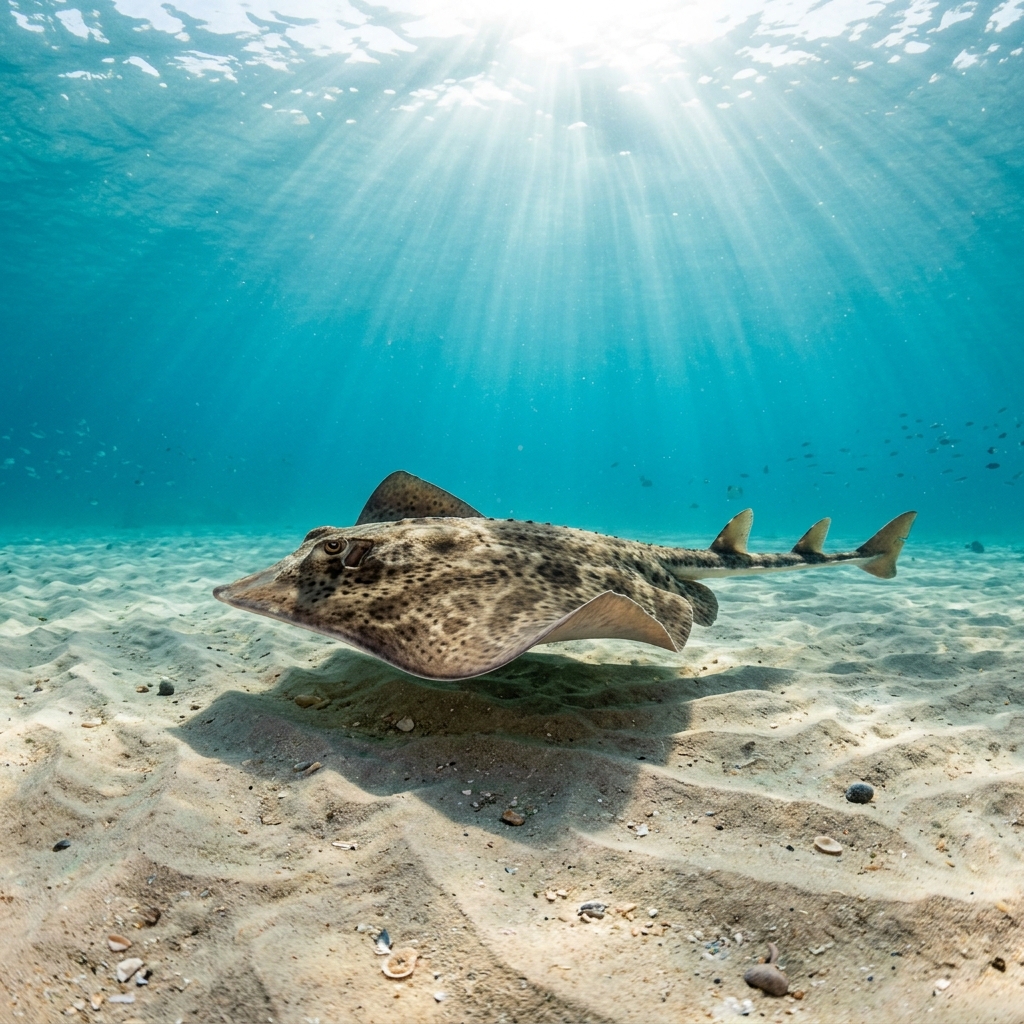
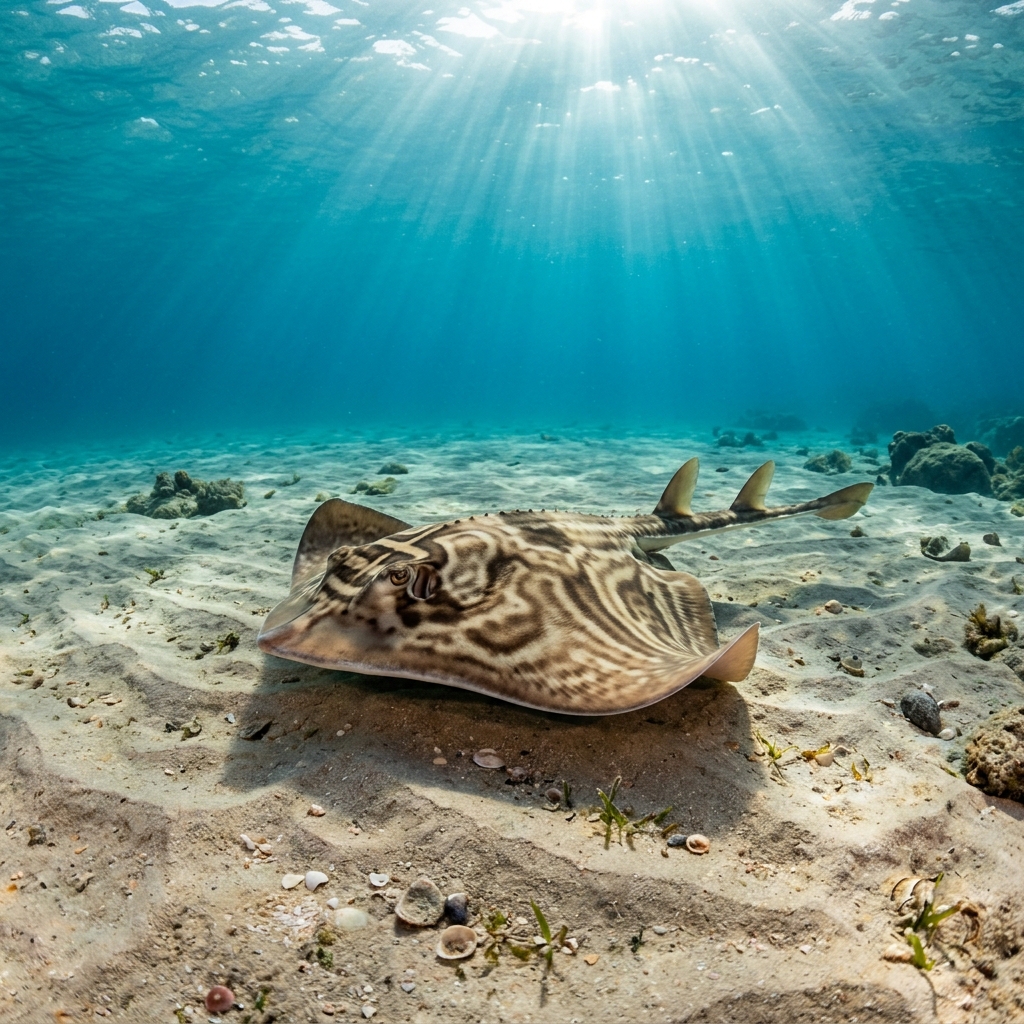
Gymnura marmorata
A diamond-shaped ray gliding over sand in waters from 17.7 to 28.8 C, seen year-round along the California and Mexican Pacific coast.
Safety warning
The tail spine can deliver a painful sting if the ray is stepped on or handled, so keep a careful eye on where you place hands and fins over sandy bottoms. Give a resting ray space and let it move off on its own rather than trying to touch or corner it.
If you're stung
Venomous tail barbGeneral first-aid guidance, not a substitute for professional medical care. In an emergency, call your local emergency number.
Look for a very wide, diamond-shaped disc that is much broader than it is long, with a short whip-like tail lacking the long tail seen on other rays. Colouring is mottled brown, grey or olive with darker blotches that camouflage it against sand, and the pectoral fins (side wings) taper to pointed tips at each corner. At around 70 cm across, it moves with a smooth, undulating wing-beat rather than a swim, often lifting off the bottom only when approached.
Most sightings are of a ray lying half-buried or resting flat on sand, using its mottled pattern to disappear against the bottom until a diver is nearly on top of it. When disturbed it lifts off in a slow, graceful glide low over the sand before settling again a short distance away, and it generally shows little interest in divers who keep a respectful distance.
Its short tail carries one or more venomous spines near the base, a defensive feature it relies on instead of speed when threatened.
Sightings are recorded across the year with no strong seasonal gap, and the wide temperature niche (17.7 to 28.8 C) means it tolerates both cooler winter water and warm summer shallows, so there is no single best month to target it.
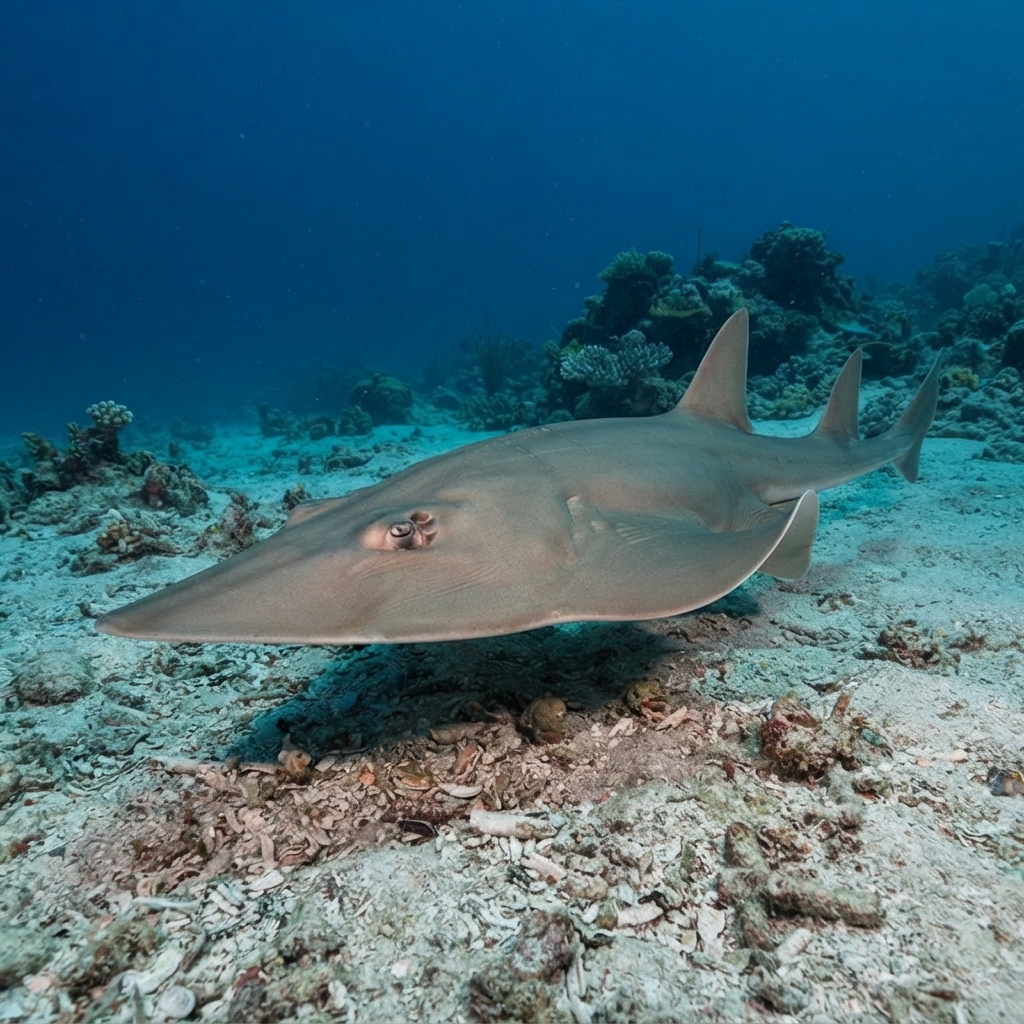
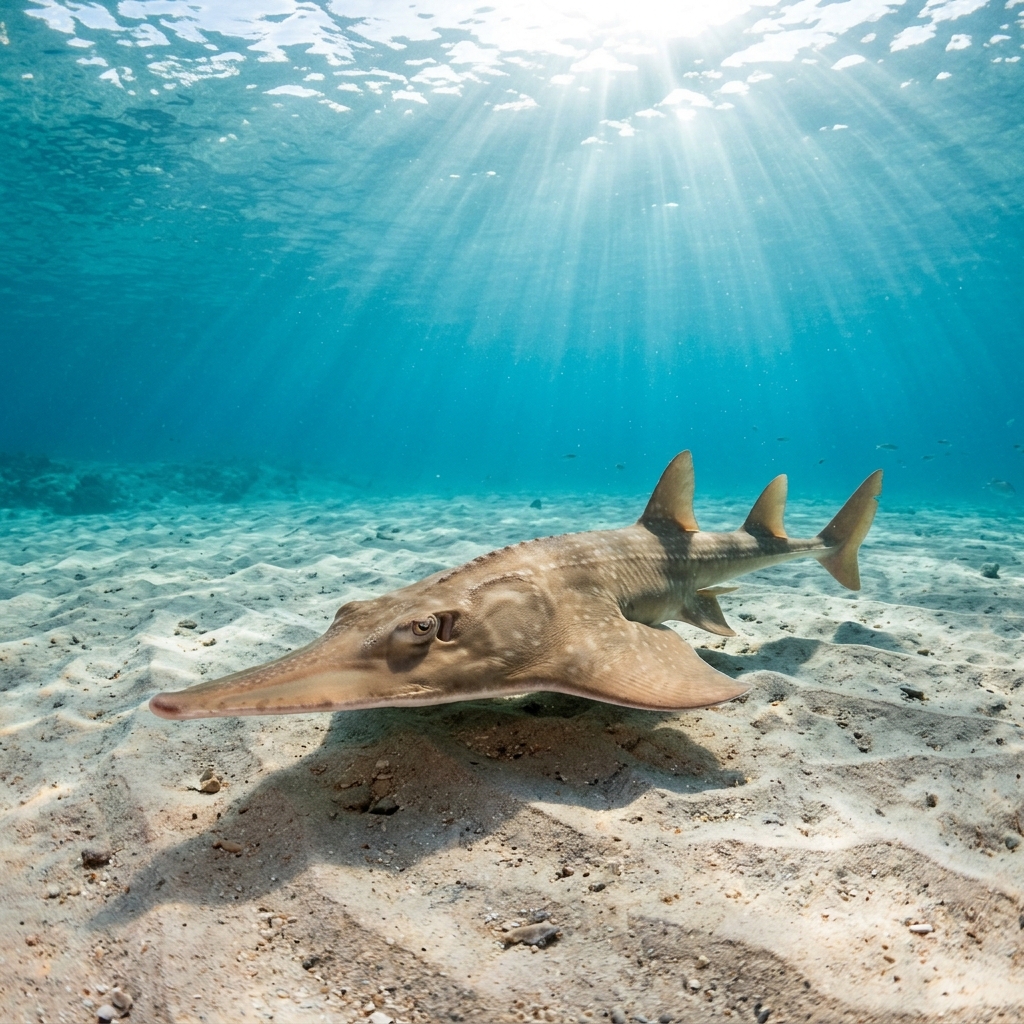
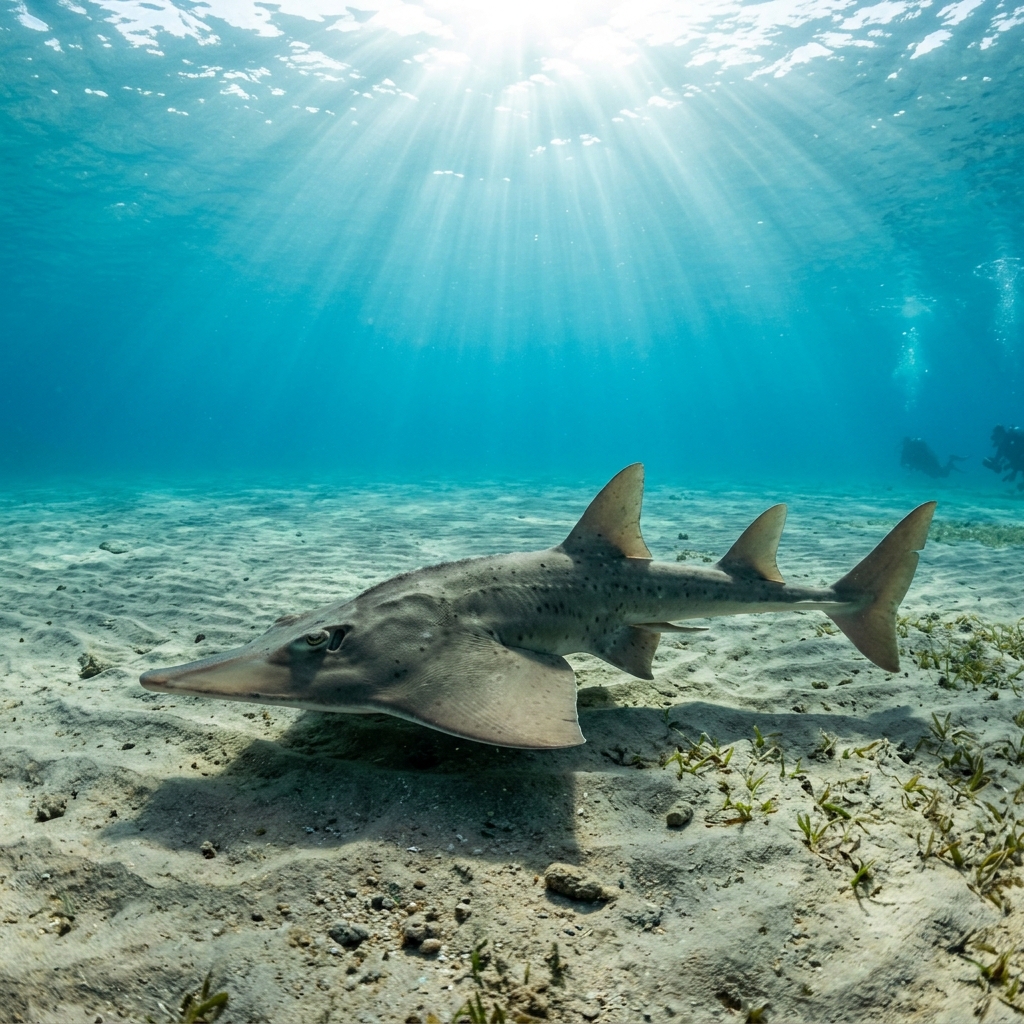
Reef neighbours a diver could mistake it for. Use the identification notes above to tell them apart.
Logged along the Pacific coast of California and down into Mexican waters, this ray favours sandy bays, estuary mouths and open sandy patches near reef edges rather than hard structure. It is a species divers and snorkellers in these temperate-to-warm-temperate coastal waters should watch for over open sand rather than on rocky reef.
Mapping where California Butterfly Ray is logged…
It is found along the Pacific coast of California down into Mexican coastal waters, usually over open sandy bottoms near bays and estuary mouths rather than on rocky reef.
There is no strong seasonal pattern in sightings, and it tolerates a wide temperature range from about 17.7 to 28.8 C, so it can turn up on sandy dive sites at any time of year.
They carry a venomous spine near the base of the tail that can cause a painful sting if trodden on, but they are not aggressive and pose little risk if you avoid stepping on or handling them.
Check for a very wide, diamond-shaped body far broader than long, mottled brown or olive camouflage colouring, pointed wingtips, and a short stubby tail rather than a long whip tail.
They typically reach around 70 cm across the disc, making them a modest-sized ray usually spotted resting flat against sand.
Its disc is unusually wide relative to its body length compared with most rays, and its tail is short rather than long, carrying a defensive venomous spine near the base instead of relying on a long whip tail.
Site and sighting data is aggregated from diver logs, iNaturalist and GBIF. For taxonomy and conservation status:
Halavi Guitarfish
412 sites