Ercolania boodleae
A pinhead-sized sea slug logged mostly around Victoria, Australia, in cool 14.6-20.6C water. Here's what to look for and where.
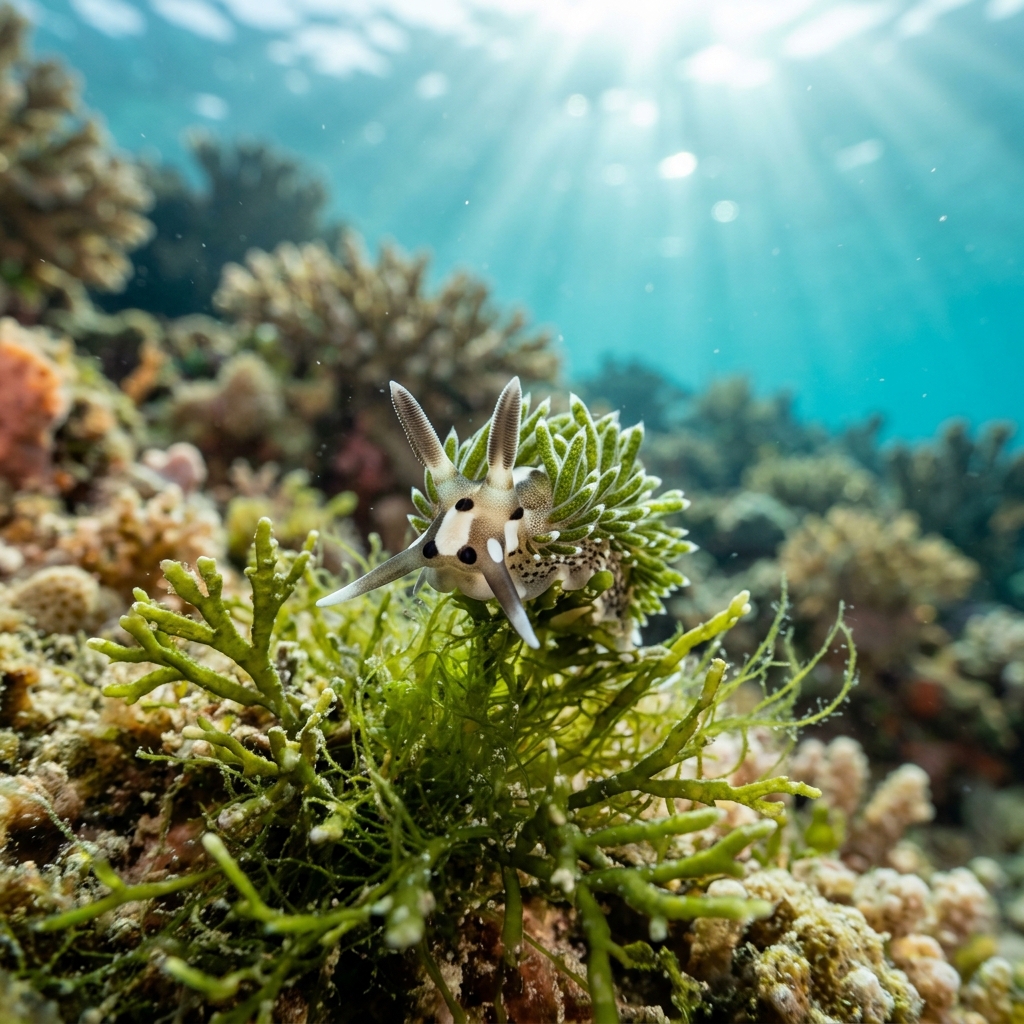
At around 1 cm long, this is a spot-it-if-you're-lucky slug rather than a swim-past sighting, so slow down and scan algae mats rather than open reef. Body colour tends to blend with the green Boodlea algae it lives on and feeds on, giving it a mottled, translucent-green look with small dark or pale cerata (the finger-like projections along its back) that help break up its outline. There's no strong pattern or bright colour flash to key on, so most divers find it by first spotting the algae clump, then looking closely for movement.
Divers find it sitting still or grazing slowly on strands of Boodlea algae, which it also uses for camouflage, so it's easiest to spot by scanning algae clumps closely rather than expecting it to move into view. It shows no reaction to divers beyond the usual slow slug retreat if disturbed, and most sightings happen on shallower temperate reef and rubble patches where its host algae grows thick.
Like other sacoglossan slugs in its family, it likely feeds by piercing algal cells and can retain functioning chloroplasts from its food for a time, a trick called kleptoplasty that lets some relatives photosynthesise briefly using stolen plant machinery.
There isn't enough logged data to show a clear season, and the water-temperature range recorded (14.6 to 20.6C) spans Victoria's cooler and milder months alike, so treat this as a year-round find rather than a seasonal one.
Reef neighbours a diver could mistake it for. Use the identification notes above to tell them apart.
Logged almost exclusively in Australia, with Victoria the clear stronghold and a smaller scatter of sightings in New South Wales. Within Victoria it turns up across a good number of individual sites, so it's more a case of checking algae-covered reef and rubble at temperate dive sites than chasing one famous location.
Mapping where Boodlea Sapsucker is logged…
Almost all logged sightings are from Australia, with Victoria by far the strongest area and a smaller number of records from New South Wales. Look for it on temperate reef sites with algae growth rather than tropical coral reef.
There's no clear seasonal pattern in the sightings, and it's been recorded across a wide temperature range from 14.6 to 20.6C, so it's best treated as a year-round possibility in Victorian waters.
It's a tiny slug, about 1 cm long, coloured to blend with the green Boodlea algae it lives on. Look for small cerata along its back and check algae clumps closely rather than expecting it to stand out on open reef.
Around 1 cm at full size, making it one of the smaller sea slugs divers try to spot, best found with a slow careful look through algae rather than a casual swim-by.
It's part of a slug family known for kleptoplasty, where some species keep stolen chloroplasts from their algal food alive and working inside their own tissue for a while after feeding.
No. It's a harmless, pinhead-sized algae grazer with no sting or bite risk to divers.
Site and sighting data is aggregated from diver logs, iNaturalist and GBIF. For taxonomy and conservation status:
Light-spotted Aegires
3,168 sites