Chelidonichthys kumu
Winged, walking fish on the sand in New Zealand and South Africa, uncommon but unmistakable once you know its spread pectoral fins.
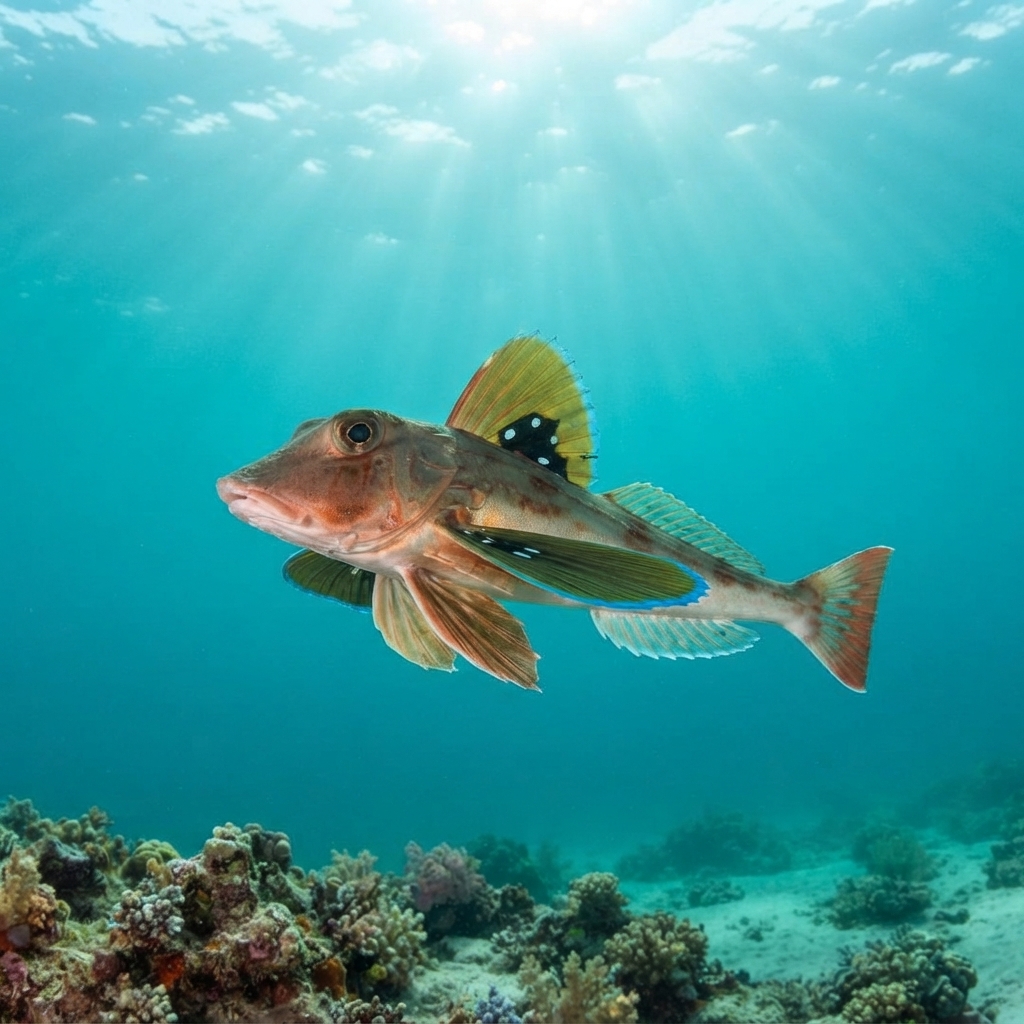
Look for an armoured, almost boxy head tapering to a slimmer tapered body, with large fan-like pectoral fins edged in electric blue that flare open like wings when the fish moves off the bottom. At rest those fins fold down and the fish blends into sand or rubble, showing mostly reddish-brown mottled colour along the back. Bluefin Gurnard grow to around 42cm, and the lower rays of the pectoral fin are modified into separate finger-like feelers it uses to probe the substrate as it moves.
Divers most often find Bluefin Gurnard resting or slowly walking across sand and rubble on their finger-like pectoral rays, using them to feel out crustaceans and other prey buried just under the surface. When approached it tends to hold still or shuffle off a short distance rather than bolt, and if it does swim it flashes those blue-edged pectoral fins open in a brief, showy glide before settling back down. It's logged as uncommon at most sites, so a close look at open sandy patches near reef edges is usually the best strategy.
Those separated lower pectoral fin rays work like fingers, letting the fish tap and probe the sand for buried prey rather than relying on sight alone to find a meal.
Sightings don't show a clear seasonal spike, so treat this as a year-round encounter at sites where it's known to occur. It's been recorded across a wide temperature range from 13.3 to 25.0C, which fits its temperate distribution and explains why it isn't tied to a narrow warm-water window.
Reef neighbours a diver could mistake it for. Use the identification notes above to tell them apart.
This is a temperate bottom-dweller, most reliably logged along the North Island of New Zealand and the Western Cape of South Africa, with sites in both countries contributing roughly equally to sightings. It favours sand, rubble and mixed reef edges rather than hard coral structure, so look down rather than out on the reef.
Mapping where Bluefin Gurnard is logged…
It's most consistently logged along the North Island of New Zealand and the Western Cape of South Africa, usually on sand or rubble patches near reef structure rather than on the reef itself.
There's no strong seasonal pattern in the sightings, so it's treated as a year-round species at the sites where it occurs, consistent with the wide 13.3 to 25.0C range it's been recorded in.
Check for a bony, armoured head, mottled reddish-brown body up to about 42cm, and large pectoral fins edged in blue that flare open like wings when it swims. At rest it looks fairly plain and can be easy to overlook on sand.
They typically reach around 42cm in length, making them a solid, noticeable presence on sand and rubble bottoms once spotted.
The lowest rays of its pectoral fins are separated into finger-like feelers that it uses to probe sand and rubble for hidden crustaceans, effectively letting it feel for prey rather than just hunting by sight.
No, they're considered harmless to divers and typically react to a close approach by shuffling off rather than showing any defensive behaviour.
Site and sighting data is aggregated from diver logs, iNaturalist and GBIF. For taxonomy and conservation status:
Soldierfish
3,612 sites