Dendrodoris nigra
A small dark nudibranch that turns up uncommon and rare on dives in New South Wales and Ponta do Ouro year-round, in 18 to 28C water.
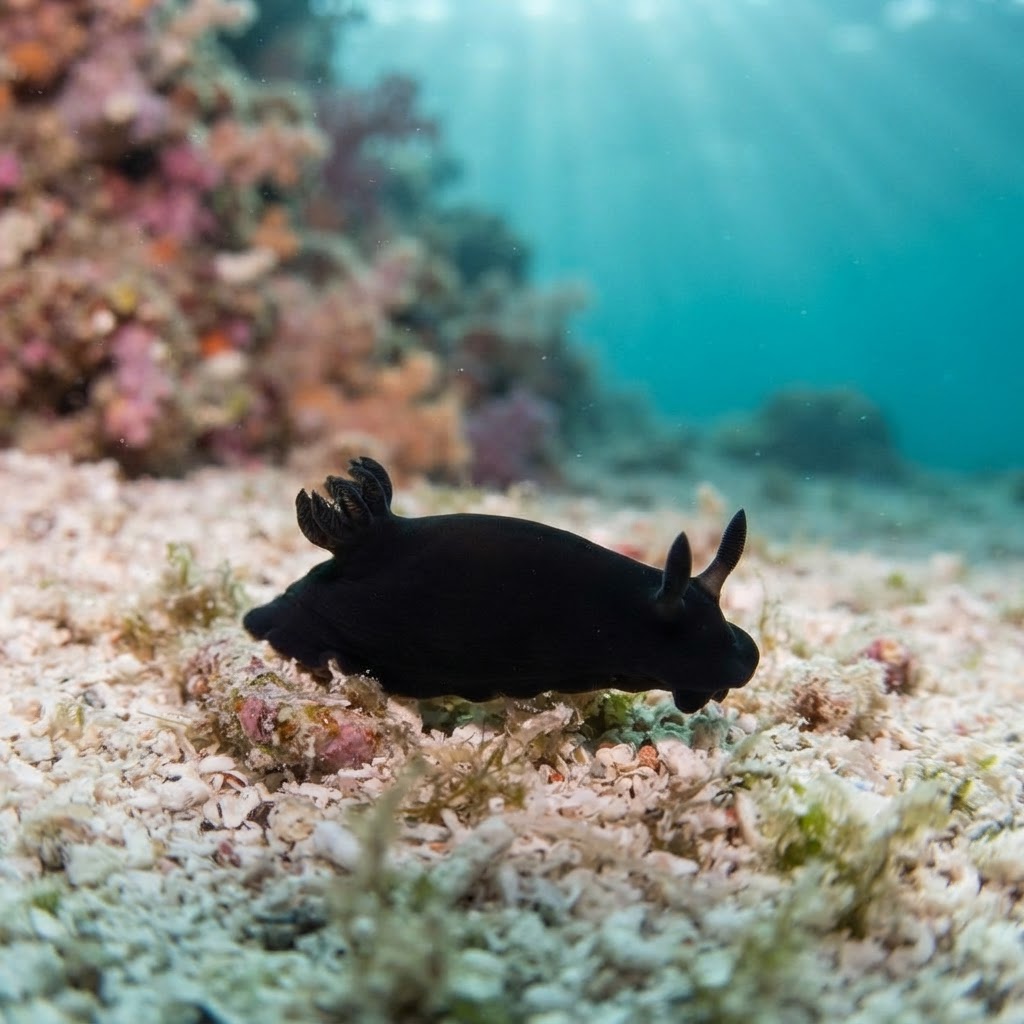
A squat, oval-bodied nudibranch around 5 cm long with a smooth, velvety-looking dark brown to black body that can show faint speckling. It lacks the bright contrast colours of many reef nudibranchs, so it reads as a dark, unremarkable lump on rock or rubble until you look closely and spot the two rhinophores (small sensory horns) at the front and the feathery gill cluster at the rear. There is no obvious size or colour split between individuals reported.
Divers find it moving slowly across rock, rubble, and low reef structure while grazing, usually not bothered by torch light or a close look. It is a benthic (bottom-dwelling) species, so check ledges, crevices, and the reef floor rather than open water, and it shows up at both day and night dives without a strong preference for either.
Like other dorid nudibranchs, it relies on chemical defences from its diet rather than speed or camouflage colour to deter predators, which is why it can sit exposed on open rock without much concern for passing fish.
No clear seasonal pattern shows up in the sighting data, and its comfortable range of 18 to 28C spans both temperate and tropical reef conditions, so it is realistically a year-round find wherever it occurs.
Reef neighbours a diver could mistake it for. Use the identification notes above to tell them apart.
Most reliably logged in New South Wales and Queensland, Australia, which together account for the bulk of sightings, with a solid secondary population around Ponta do Ouro, Mozambique. Smaller but consistent numbers turn up in North Island, New Zealand, Xiaoliuqiu in Taiwan, and KwaZulu-Natal in South Africa, with single records from Reunion, Okinawa, and New Caledonia.
Mapping where Black Dendrodoris is logged…
New South Wales and Queensland in Australia are the most consistent spots, with a strong secondary population around Ponta do Ouro in Mozambique. It also turns up around North Island, New Zealand, and Xiaoliuqiu, Taiwan.
There's no strong seasonal signal in the sighting data, so it's best treated as a year-round species. Its 18 to 28C temperature range covers both cooler temperate sites and warmer tropical reefs.
Look for a small, dark brown to black nudibranch around 5 cm long with a smooth velvety body and no bright colour patches. Confirm the ID by checking for a feathery gill tuft at the rear and two small horn-like rhinophores up front.
Around 5 cm long at full size, making it a small find that's easy to swim past on a reef unless you're scanning rubble and rock closely.
No. It poses no threat to divers and can be observed closely without any risk, though as with all nudibranchs it's best not to touch it.
It's logged as uncommon at most sites where it's found and rare at others, so it's a find worth noting rather than an everyday sighting.
Site and sighting data is aggregated from diver logs, iNaturalist and GBIF. For taxonomy and conservation status:
Light-spotted Aegires
3,168 sites