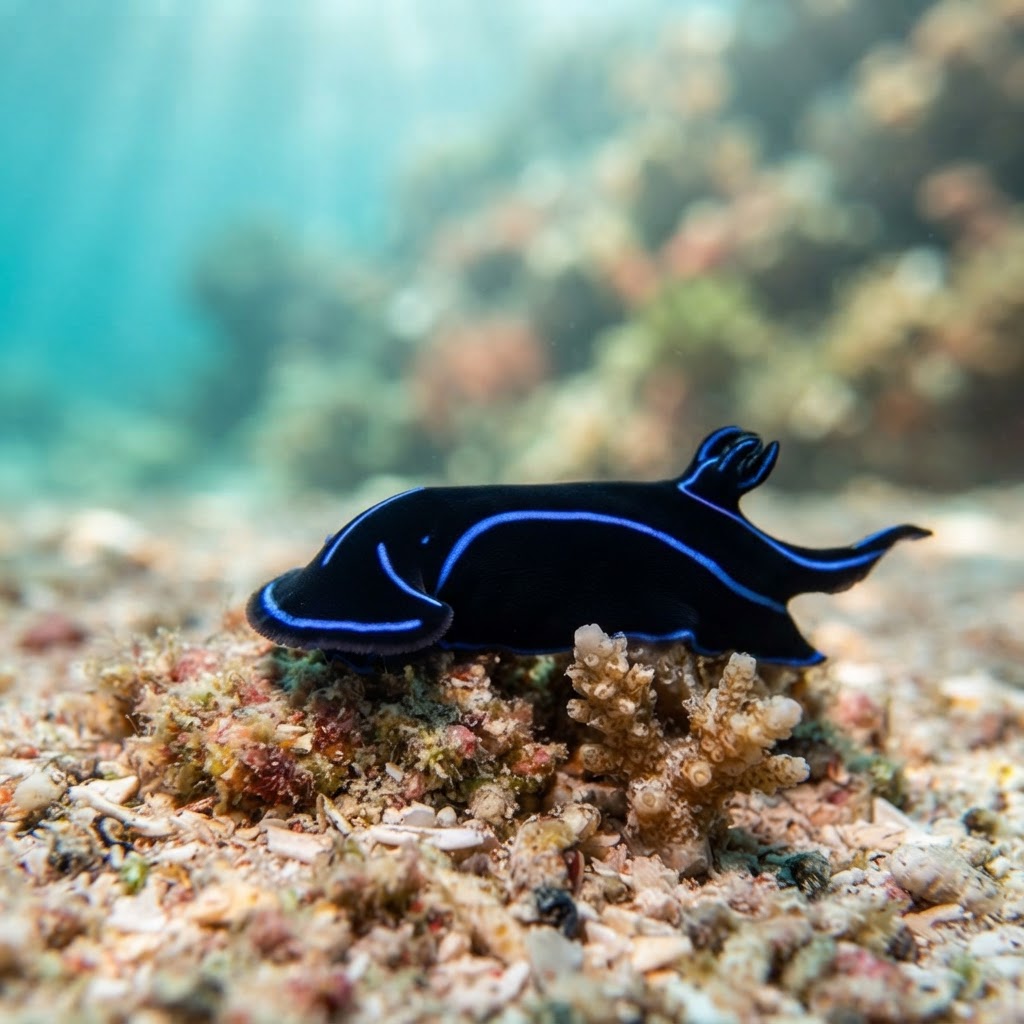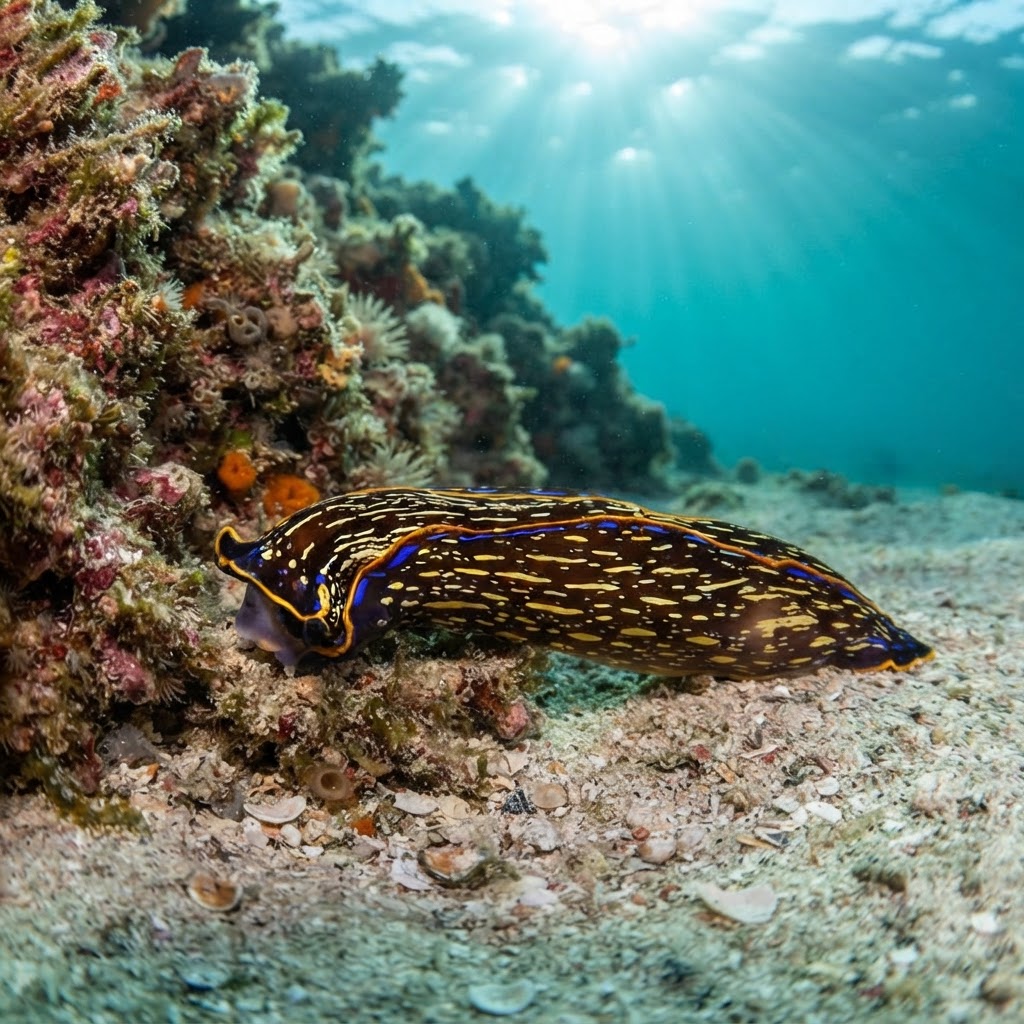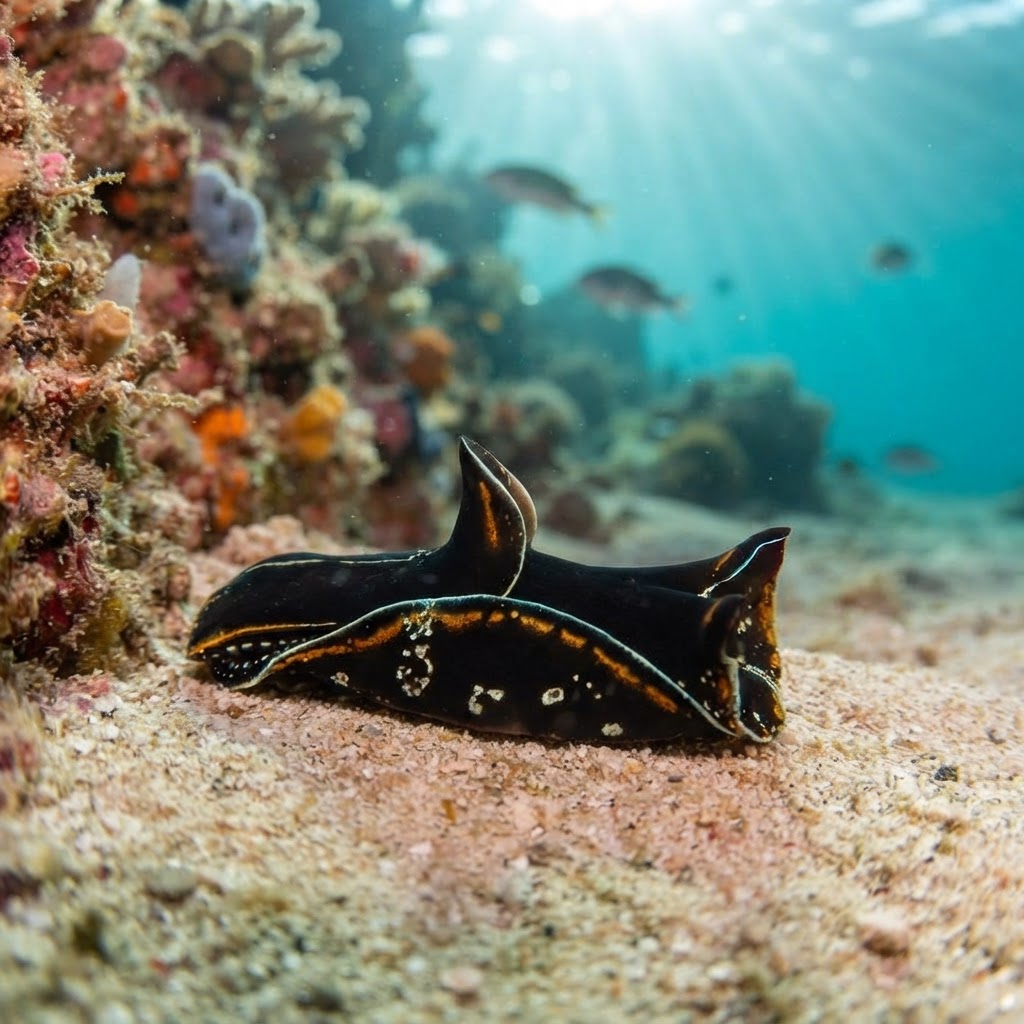
Philinopsis speciosa
A muted headshield slug most reliably spotted on night dives off Malaysia's east coast and Luzon, year-round in warm water.
Look for a soft, elongated body with broad, wing-like flaps (parapodia) running along the sides that it can fold up over its back like a cloak. Colouring runs mottled brown to olive with fine speckling, helping it blend into sand and rubble rather than stand out. There's no shell visible on the outside, and the head end carries a rounded shield rather than obvious tentacles, which is the quickest way to separate it from true nudibranchs at a glance.
Divers typically find it moving slowly across sand, silt or rubble patches at night or during dusk dives, when many aglajids become active hunters. It shows little reaction to a light or a diver hovering close, relying on its drab colouring rather than flight to avoid attention. Expect it low on the substrate rather than up in the water column or on hard coral.
Aglajids like this one are predators, gliding over sand to hunt smaller slugs and worms rather than grazing algae or sponges the way many nudibranchs do.
Sightings show no detected seasonal pattern, and the observed water temperature range of 19.3 to 29.7C spans both tropical and subtropical dive seasons, so it's fair to treat this as a year-round find wherever it's logged.
Reef neighbours a diver could mistake it for. Use the identification notes above to tell them apart.
Most reliably logged along Peninsular Malaysia's east coast and in Luzon in the Philippines, with a further stronghold in New South Wales, Australia. Divers also find it consistently in Hawaii, Timor-Leste's Dili coast, Kenting in Taiwan and Central Japan, so it's a wide Indo-Pacific presence rather than a single hotspot species.
Mapping where Beautiful Swallowtail is logged…
It's most commonly logged along Malaysia's east coast and around Luzon in the Philippines, with additional sightings in New South Wales, Hawaii, Timor-Leste, Taiwan and Japan. It turns up across a wide stretch of the Indo-Pacific rather than one single site.
There's no clear seasonal pattern in the sighting data, and it's been recorded across a wide temperature range from about 19 to nearly 30C, so it can be found year-round wherever it occurs.
Check for a soft-bodied slug with broad side flaps it can fold over its back, mottled brown-to-olive colouring, and no visible external shell. It lacks the branching gills or obvious rhinophores seen on many nudibranchs, favouring sand and rubble over coral.
No, it poses no danger to divers. It's a slow-moving benthic slug with no venom or defensive sting relevant to humans.
As a member of the aglajid family, it hunts other small slugs and worms across sand and rubble rather than grazing algae or sponges like many reef nudibranchs.
Site and sighting data is aggregated from diver logs, iNaturalist and GBIF. For taxonomy and conservation status:
Light-spotted Aegires
3,168 sites