Armina scotti
Uncommon striped nudibranch logged mostly at Koh Tao, Thailand, in warm 26-32C water on tropical reef and rubble.
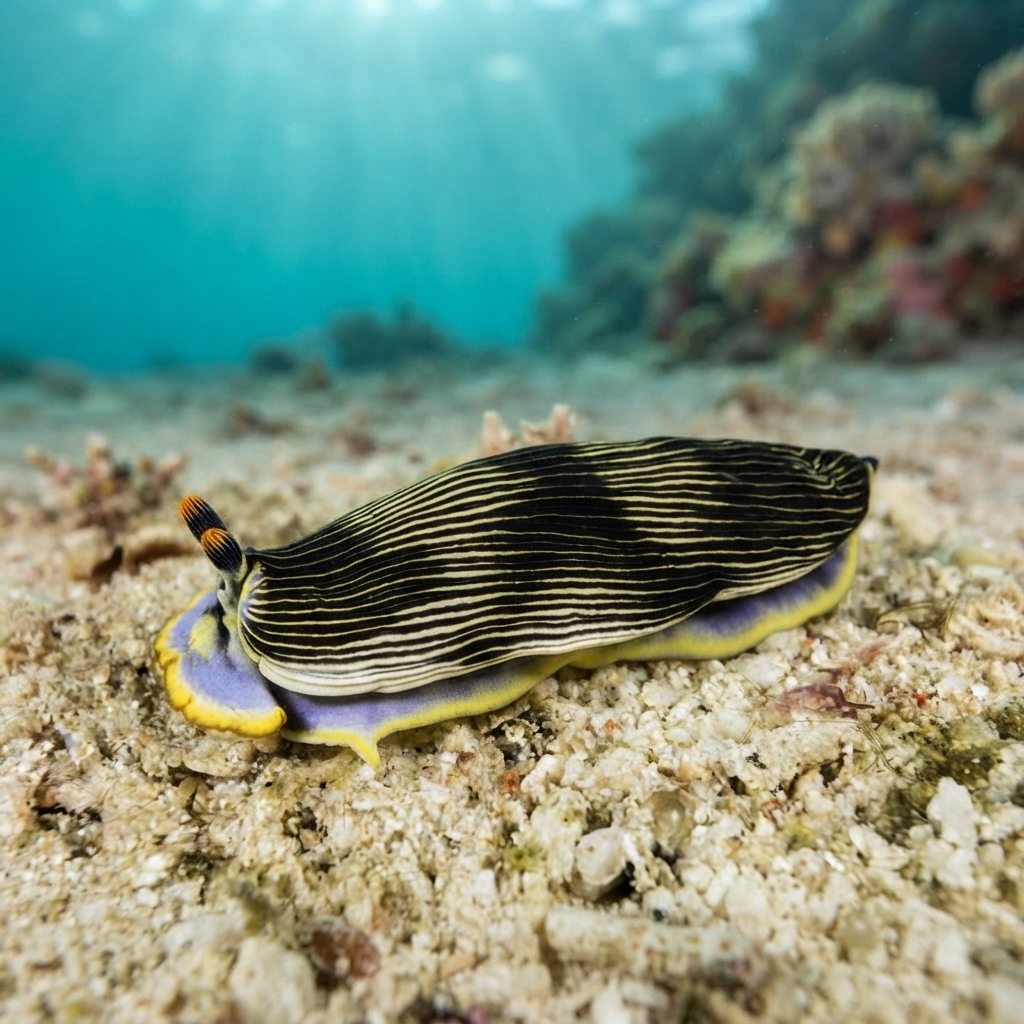
Elongated slug-like body with fine longitudinal ridges running its length, usually a muted grey to brown with pale striping along the back. Small for a nudibranch, it sits low and close to the substrate rather than perched up on a sponge like many of its relatives. No obvious rhinophores or gill plume standing tall off the back, which helps separate it from the showier chromodorids divers usually spot first.
Divers typically find it moving slowly over sand, rubble, or low reef structure rather than climbing exposed coral, often half-buried or tucked against the substrate. It shows no reaction to divers beyond its usual unhurried crawl, so a slow eye on the bottom during a muck or rubble dive is what turns one up. Like most nudibranchs it's more active and visible on night dives when it emerges to feed.
Arminidae species are known for burrowing into soft sediment, which is why this one is easy to miss during the day and shows up more often on close, deliberate substrate searches.
Sightings don't show a clear seasonal pattern, and with a comfortable range of roughly 25.6 to 31.6C it's consistent with warm tropical reefs being diveable year-round. Treat it as a possible find on any dive in its range rather than something tied to a particular month.
Reef neighbours a diver could mistake it for. Use the identification notes above to tell them apart.
Most consistently logged around Koh Tao in Thailand, which accounts for the bulk of recorded sightings, with additional records from Luzon in the Philippines, Dili in Timor-Leste, and Nusa Tenggara in Indonesia. It turns up across a spread of Southeast Asian and Coral Triangle dive regions rather than being tied to one specific reef type.
Mapping where Armina scotti is logged…
It's most reliably reported around Koh Tao in Thailand, with further sightings in Luzon in the Philippines, Dili in Timor-Leste, and Nusa Tenggara in Indonesia. It's an uncommon find at all of these sites, so treat any sighting as a bonus rather than a guarantee.
There's no detected seasonal pattern in the sightings, and its observed temperature range of about 25.6 to 31.6C fits warm tropical reefs year-round. It's worth looking for on any dive in its range rather than planning around a specific month.
Look for a slim, ridged, grey-brown body lying low against sand or rubble rather than perched on a sponge. It lacks the tall, colourful rhinophores and gill tuft of many reef nudibranchs, giving it a plainer, more understated look.
No, it poses no danger to divers. Like most nudibranchs it's harmless to touch, though it's best left undisturbed for its own sake.
Exact size data isn't recorded for this species, but as a member of Arminidae it fits the small, slender profile typical of the family, generally a few centimetres in length when spotted on a dive.
It spends much of its time burrowed into sand or rubble rather than sitting exposed on the reef, a common Arminidae trait that makes it far easier to overlook than brighter, more visible nudibranchs.
Site and sighting data is aggregated from diver logs, iNaturalist and GBIF. For taxonomy and conservation status:
Nudibranch
3,168 sites