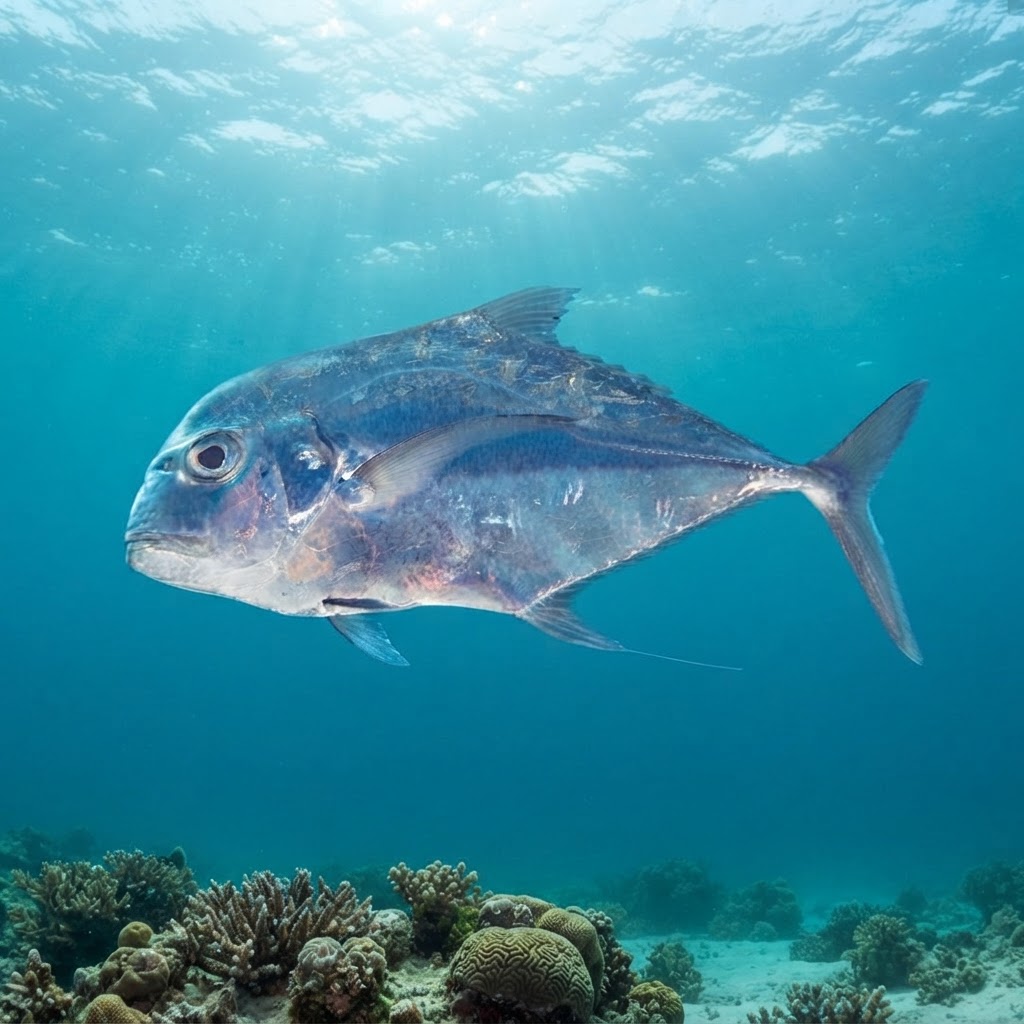
Alectis ciliaris
Deep-bodied and silver with long trailing fins, African Pompano turns up as an uncommon find off Santiago, Cape Verde, year-round in warm water.
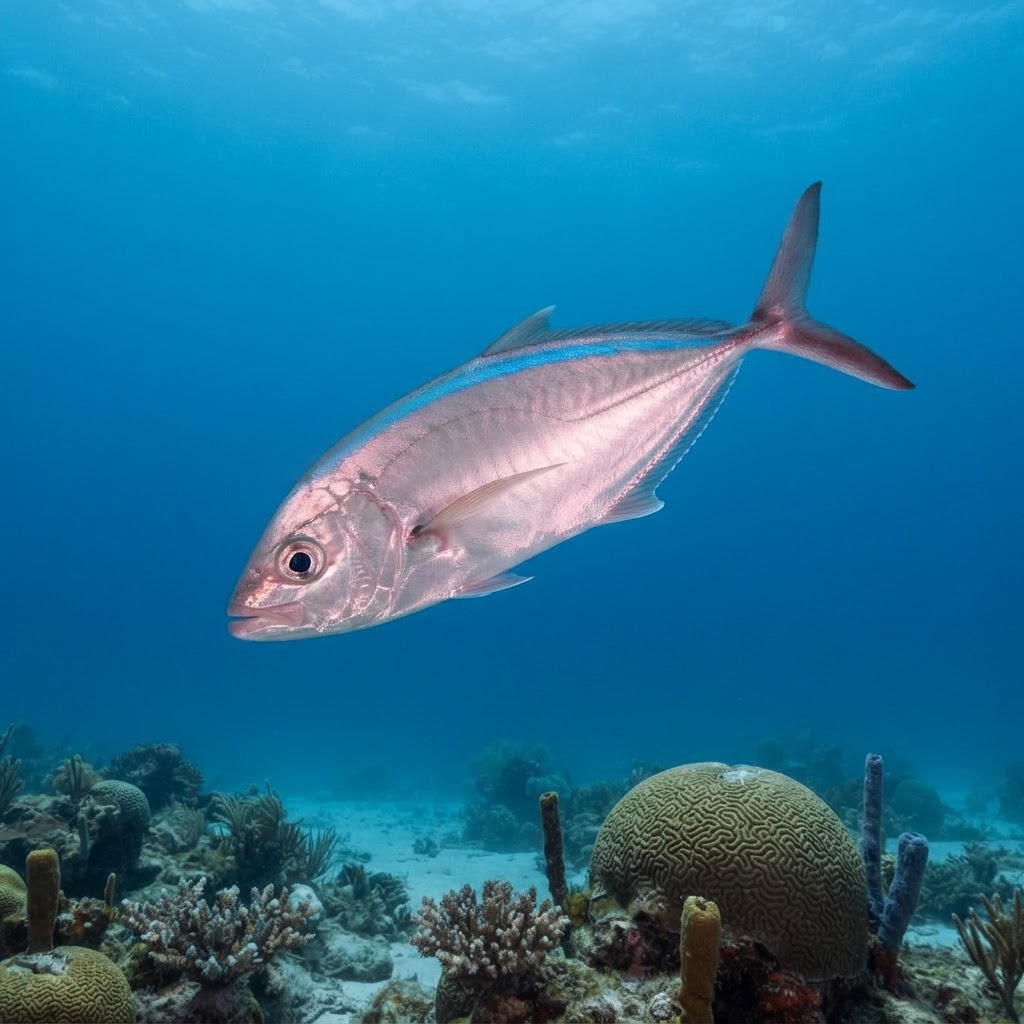
Adults show a strikingly deep, almost oval-shaped silver body that flattens further with age, topped by long trailing filaments streaming off the dorsal and anal fins. Look for a steep, blunt forehead profile and a small mouth set low on that steep face. At over a metre long in mature fish, the sheer body depth relative to length is the giveaway compared with slimmer jacks on the same reef.
Divers most often encounter African pompano cruising alone or in loose association with the reef rather than in tight schools, moving steadily along drop-offs and open sandy patches where it hunts. It tends to keep a comfortable distance from divers, more curious passer-by than approachable subject, and is logged as uncommon at most sites where it appears, so a sighting is worth savouring rather than expecting.
Juveniles look almost nothing like the adults, sporting exaggerated, ribbon-like extensions on the dorsal and anal fins that they gradually lose as they grow into the deep-bodied adult form.
Sightings don't show a clear seasonal pattern, and with a tolerated range of 16.4 to 27.8 C it can show up across the year on both temperate and tropical sites. Treat it as a year-round possibility rather than a species tied to a particular month.
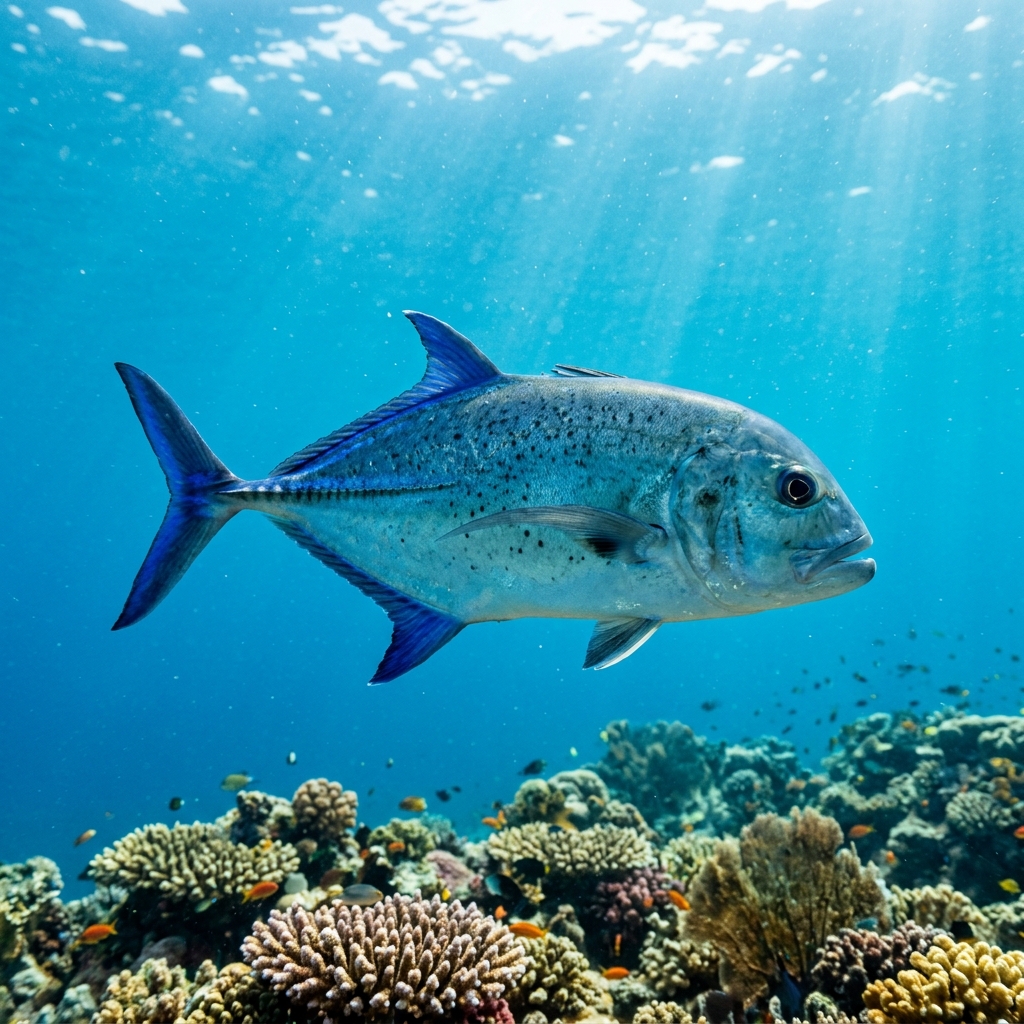
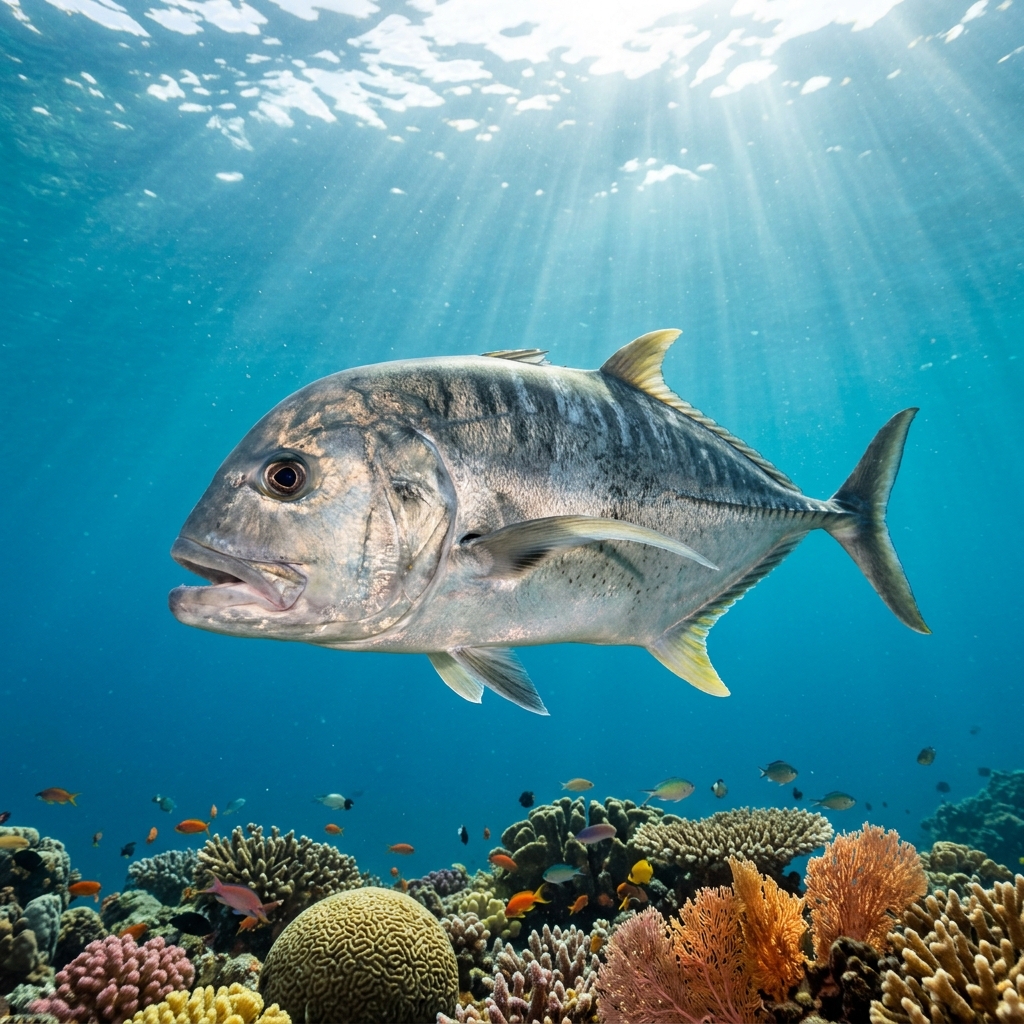
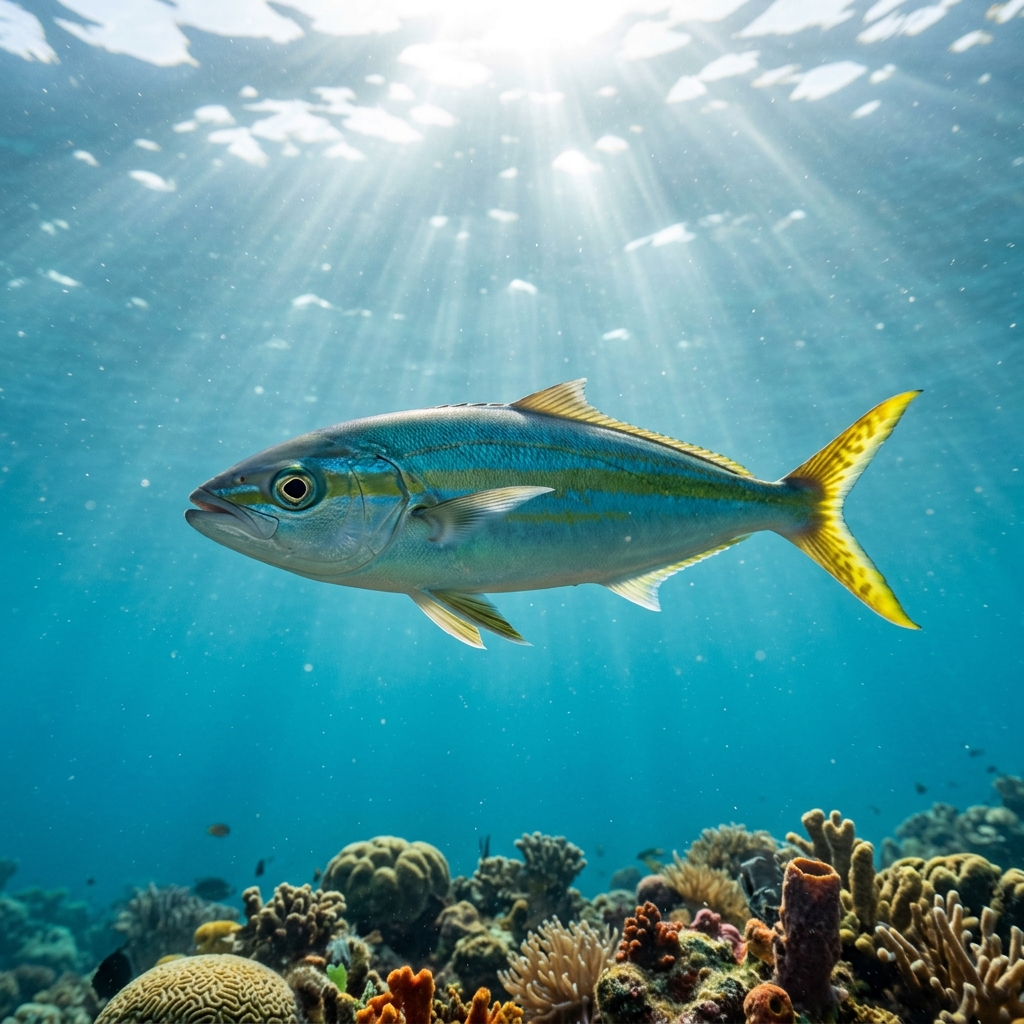
Reef neighbours a diver could mistake it for. Use the identification notes above to tell them apart.
Most reliably logged around Santiago in Cape Verde, which accounts for the bulk of confirmed sightings, with scattered records off the northeast United States, Fiji's Lomaiviti region, the Galápagos Islands in Ecuador, and Panama's Pacific coast. Outside Cape Verde it turns up as an occasional surprise rather than a species you can plan a trip around.
Mapping where African Pompano is logged…
Cape Verde, particularly around Santiago, is the most consistent place to encounter African pompano. Smaller numbers are also logged off the northeastern United States, Fiji, the Galápagos Islands, and Panama's Pacific coast.
There's no strong seasonal signal in sightings, and its temperature range of 16.4 to 27.8 C means it can appear in cooler and warmer water alike. It's best treated as a year-round, if uncommon, sighting.
Look for a deep, oval silver body, a steep blunt forehead, and long trailing filaments off the dorsal and anal fins, more pronounced in juveniles. Adults can exceed a metre and look noticeably deeper-bodied than most jacks sharing the reef.
They typically reach around 105 cm in length, with a body depth that makes them look even larger and heavier-bodied than similarly sized jacks.
Juveniles carry dramatically long, ribbon-like fin filaments that shrink away as the fish matures, so young and adult African pompano barely resemble each other underwater.
Site and sighting data is aggregated from diver logs, iNaturalist and GBIF. For taxonomy and conservation status:
Bigeye Trevally
2,591 sites