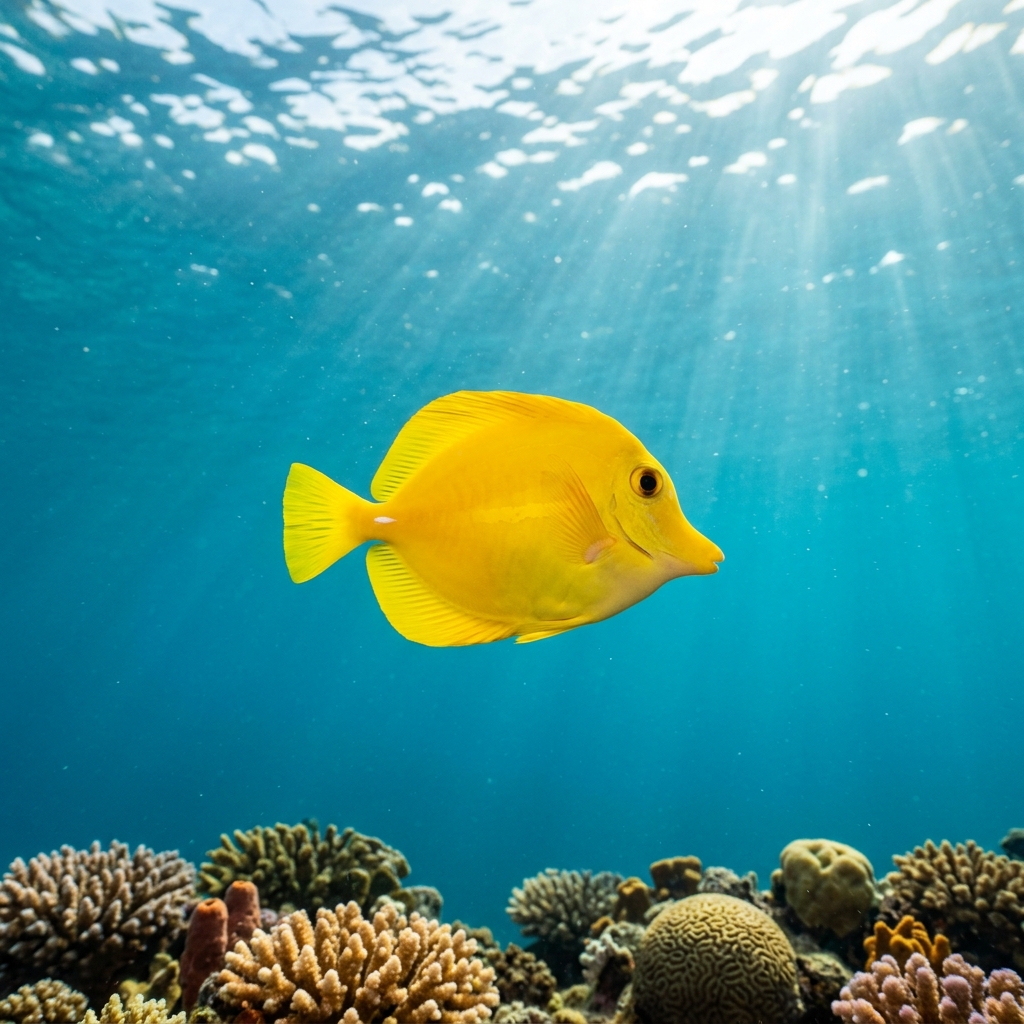
Zebrasoma flavescens
Bright yellow and unmistakable, yellow tang are most reliably seen across Hawaii's reefs. Here's where to find them and when to go.
Few reef fish are as immediately obvious underwater: the body is entirely vivid yellow, from snout to tail, with no contrasting markings on the flanks. The body is disc-shaped and laterally compressed, with a long, pointed snout used to graze algae from rock surfaces. At the base of the tail sits a white spine (the characteristic surgeonfish scalpel) that is easy to spot once you know to look for it. No other common Hawaiian reef fish combines that uniform yellow with this body outline.
Yellow tang spend most of their time grazing algae from hard reef surfaces, moving steadily across the reef in a distinctive side-to-side rocking motion as they scrape. They can be encountered alone or in loose aggregations, and are generally unconcerned by divers who approach slowly. Look for them on shallow, well-lit reef sections where algal growth is plentiful, typically in the top 10 to 20 metres.
Like all surgeonfish, yellow tang carry a razor-sharp retractable spine on each side of the tail base. It is a defence mechanism, not an attack, but handling the fish is a reliable way to get a clean cut.
Seasonality data from Northern Hemisphere sites shows sightings concentrated from May through March, suggesting broad year-round presence with no hard off-season. The species is observed in water temperatures between roughly 24 and 27 °C, consistent with the warm shallow reefs it inhabits throughout its range.
Hawaii is by far the stronghold, accounting for the vast majority of logged sightings, with reef sites spread across the islands. Outside Hawaii, Guam is the next most reliable destination, particularly around Apra Harbor and Tumon Bay, with smaller populations recorded across Saipan in the Northern Mariana Islands and Lanyu in Taiwan.
Mapping where Yellow Tang is logged…
Hawaii is the place to go, with strong populations logged across reef sites throughout the islands. Beyond Hawaii, Guam (especially Apra Harbor and Tumon Bay), Saipan in the Northern Mariana Islands, and Lanyu in Taiwan all have recorded sightings.
Sighting data from Northern Hemisphere sites spans May through March, pointing to a largely year-round presence. The species favours water temperatures of roughly 24 to 27 °C, which are stable year-round on Hawaii's shallow reefs, so there is no single peak month to chase.
Look for a disc-shaped, laterally compressed fish that is entirely bright yellow with no contrasting markings, and a small pointed snout. The white scalpel spine at the tail base is a useful secondary marker. In Hawaiian waters, nothing else combines that uniform yellow with that oval surgeonfish silhouette.
In the water they read as a medium-small reef fish, typically in the range of 15 to 20 cm in length. Their disc shape makes them look slightly larger than that length suggests.
They are not aggressive and pose no threat to divers who simply observe them. However, like all surgeonfish they carry a sharp spine at the tail base, so picking one up is a bad idea. Admire from a short distance and you will have no issues.
They are dedicated herbivores, grazing constantly on filamentous algae growing over hard reef surfaces. This grazing behaviour keeps algal overgrowth in check on coral reefs, giving them a meaningful role in reef health. Divers often watch them rocking back and forth as they scrape.
Site and sighting data is aggregated from diver logs, iNaturalist and GBIF. For taxonomy and conservation status:
Striped Surgeonfish
3,289 sites