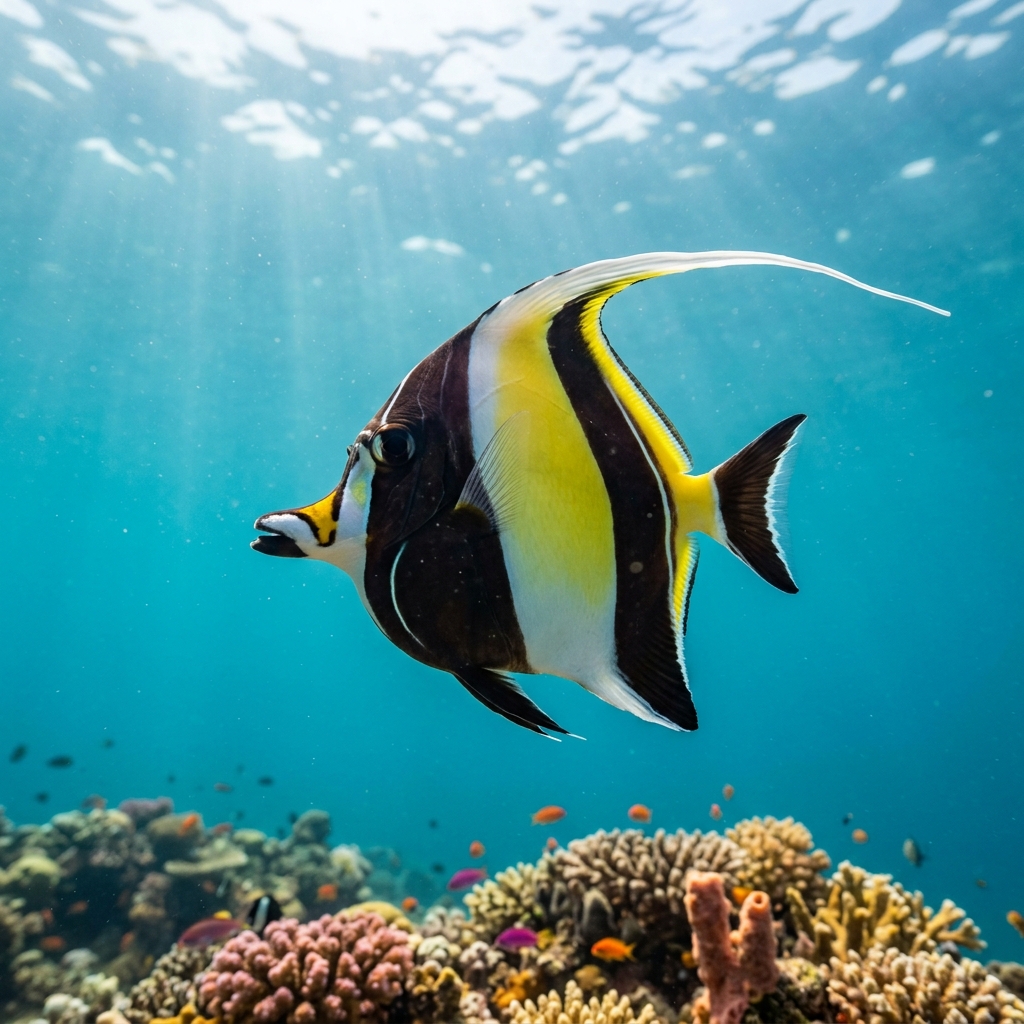
Zanclus cornutus
Spot Moorish Idol on reefs across the Maldives, Indonesia and Hawaii year-round. Learn the bold markings that make it unmistakable underwater.
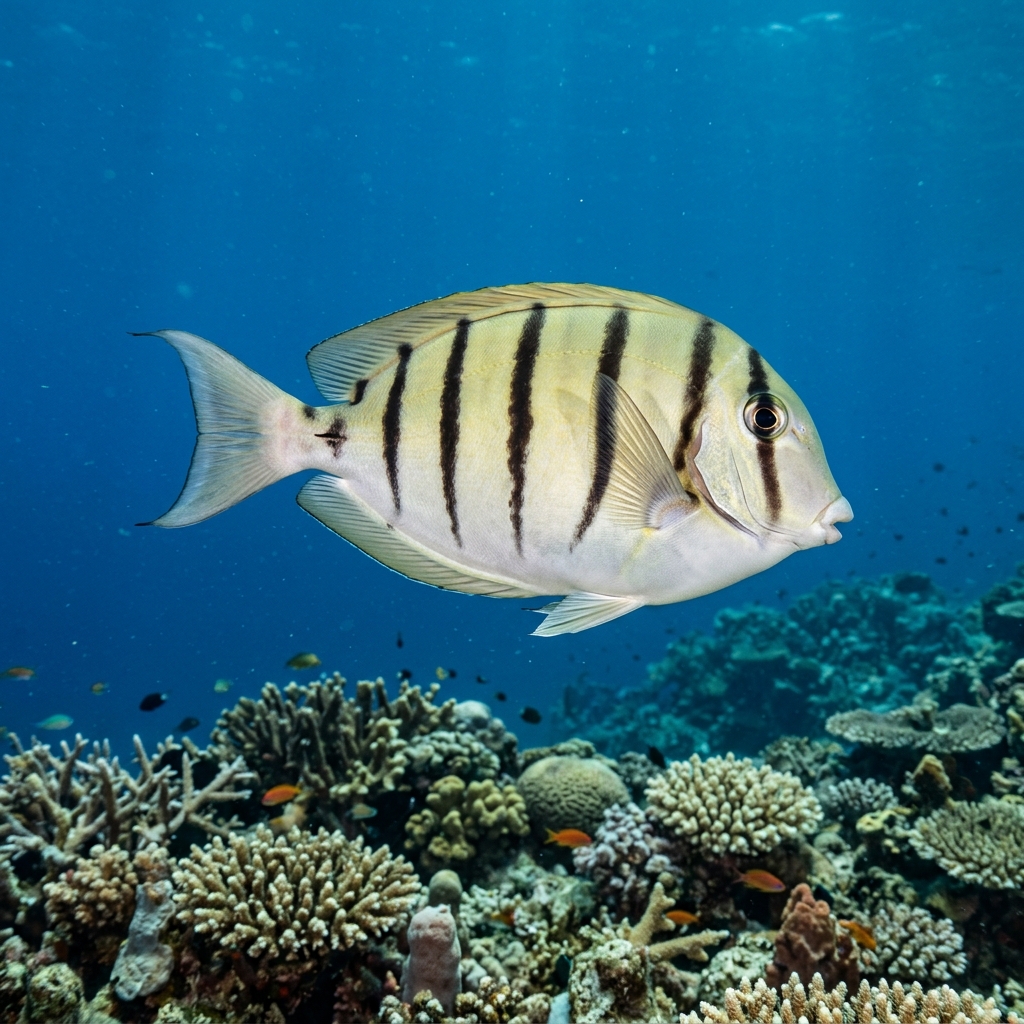
Few reef fish are easier to name on sight: look for a deep, disc-shaped body banded in three broad blocks of black, white and yellow, with a bright orange-yellow saddle across the snout and a dramatically elongated dorsal spine (the idolfish's white streamer) trailing behind like a flag. That trailing filament distinguishes it from every surgeonfish and tang at a glance. Adults typically appear in the 15 to 20 cm range in the water, though the filament can roughly double the apparent length. Juveniles carry the same banding but the snout saddle is less vivid and the dorsal filament shorter.
Most encounters involve a small group or a lone fish working methodically across hard coral and rocky reef, using its long tubular snout to probe crevices for sponges and invertebrates. It tends to ignore divers who approach slowly, allowing reasonably close observation, though it drifts away rather than holding still for long. Look for it in the shallower sections of the reef, particularly around coral heads with plenty of structural complexity.
Despite its close resemblance to butterflyfishes, Moorish Idol is the sole member of its entire family, Zanclidae, making it one of the most evolutionarily isolated fish on the reef. That distinctive shape has no close living relatives.
Present year-round in both hemispheres with no concentrated season, which matches its preference for warm tropical water in the 24 to 29 °C range found on Indo-Pacific reefs throughout the year.
Moorish Idol turns up across a vast swathe of the Indo-Pacific and into the central Pacific; the strongest logged populations are in the Maldives, Indonesia, and the Philippines, with the Male and Ari Atolls and Bali among the most reliable specific regions. Hawaii stands out as a notable Pacific outlier where sightings are consistently recorded, and Queensland, Thailand, and Malaysia all have strong representation too.
Mapping where Moorish Idol is logged…
Moorish Idol is logged across an enormous range of tropical sites. The Maldives, Indonesia, and the Philippines are the most reliably productive, with the Male and Ari Atolls, Bali, and the Visayas all offering frequent encounters. Hawaii, Queensland, Phuket, and Malaysia round out the best-represented regions in the data.
Year-round, in both the northern and southern hemispheres. There is no peak season in the data. As long as water temperatures are in the warm tropical range typical of Indo-Pacific reefs, Moorish Idol are resident and active.
The long, trailing white dorsal filament and the three bold vertical bands of black, white and yellow on a very deep, disc-shaped body make this one of the easiest reef fish to name on sight. The bright orange-yellow saddle across the snout is a useful secondary marker. No other common reef fish combines all of these features.
In the water, the body typically looks to be around 15 to 20 cm across, though the elongated dorsal filament can make the fish appear considerably larger. They are not particularly large fish, but the dramatic shape makes them feel prominent on the reef.
No, although it is often grouped with surgeonfishes in reef guides. It is the only member of its own family, Zanclidae, making it completely unique. It shares some ancestry with surgeonfish and rabbitfish but has no living close relatives, which is why it looks like nothing else on the reef.
Site and sighting data is aggregated from diver logs, iNaturalist and GBIF. For taxonomy and conservation status:
Atlantic Blue Tang
3,045 sites