Stegostoma tigrinum
Spot zebra sharks across the Philippines, Australia, and Thailand. Most sightings fall between Oct, May in the north, Nov, Apr in the south, in warm 24-29 °C reefs.
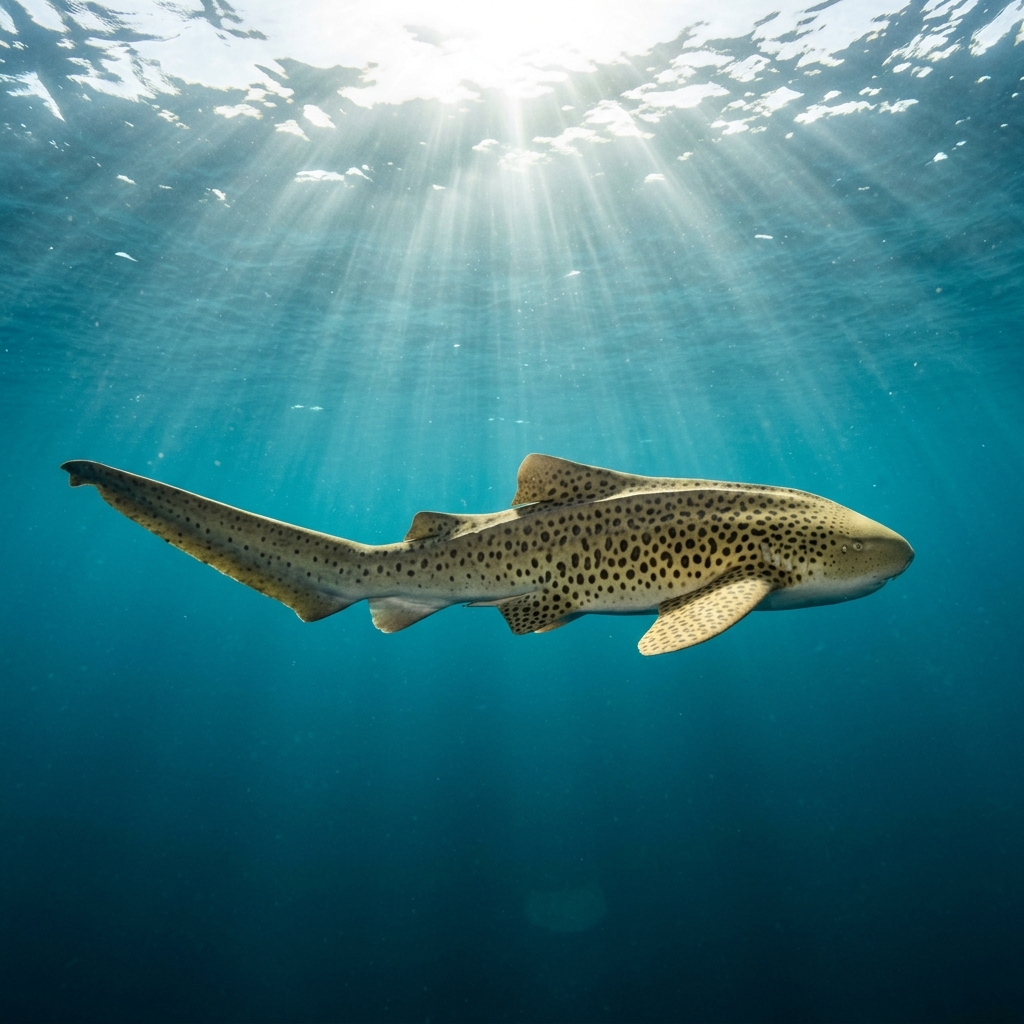
Adults are long and slender with a distinctively elongated tail that can equal almost half the total body length. The body is pale tan or yellowish-brown scattered with small dark spots, and prominent ridges run along the sides of the trunk. Juveniles look completely different: dark brown or black with vivid yellow stripes and spots, which is where the common name comes from before the pattern reverses with age.
Zebra sharks are most often found resting motionless on sandy patches or rubble at the base of the reef, sometimes tucked into coral overhangs. They are slow-moving and relaxed around divers, rarely bolting unless approached too closely or touched. Dawn and dusk dives tend to produce more active animals moving along the reef in search of prey, but daytime sightings of resting individuals are the norm.
Females can produce offspring through parthenogenesis (development from an unfertilised egg), meaning isolated females in aquaria have successfully given birth without any contact with a male. This is rare among sharks and only confirmed in a handful of species.
In Northern Hemisphere destinations such as Thailand, the Philippines, and the Red Sea, sightings concentrate from October through May. For Southern Hemisphere sites like Queensland, Australia, November to April is the peak window.
Most commonly logged across the Philippines, Australia, and Indonesia, with Queensland, Palawan and Apo Reef, and the Visayas among the standout regions. Thailand's Gulf of Thailand and Malaysia's Sipadan and East Sabah are also reliable areas, and meaningful populations extend into the Red Sea around Sudan and Saudi Arabia, as well as into Mozambique.
Mapping where Zebra Shark is logged…
The strongest populations are logged in the Philippines, Australia, and Indonesia. Queensland, Palawan and Apo Reef, the Visayas, Sipadan in Malaysia, and the northern Gulf of Thailand are particularly reliable. They also appear in the Red Sea around Sudan and Saudi Arabia, and along the East African coast in Mozambique.
For northern destinations like the Philippines, Thailand, and the Red Sea, October through May sees the most sightings. In southern locations such as Queensland, Australia, November to April is the peak period. Outside those windows sightings still occur but are less frequent.
No. Zebra sharks are considered harmless to divers. They are docile and usually rest calmly on the seabed even when approached. Standard shark etiquette still applies: keep a respectful distance and never touch or harass them.
Look for an unusually long, whip-like tail and a slender body covered in dark spots on a pale background. The ridge lines running down each side of the body are distinctive up close. Adults are often seen resting on sand, which makes a good long look easy to get.
Zebra sharks typically reach around 2.5 metres in total length, with much of that made up by the elongated tail. In the water they look slender and graceful rather than bulky, which can make them seem slightly shorter than they actually are.
Yes. They are classified as Endangered by the IUCN. Populations have declined significantly due to fishing bycatch, direct harvest, and reef degradation across their Indo-Pacific range. Logging verified sightings on citizen-science platforms helps researchers monitor how populations are faring.
The Zebra Shark is listed as endangered by the IUCN. Observe from a distance, avoid touching or feeding it, and report sightings to local marine research organisations.
Zebra sharks are listed as Endangered on the IUCN Red List, driven by fishing pressure and habitat loss across much of their range. As a diver, keep your distance, never touch or ride them, and log your sightings on citizen-science platforms to help track population health.
Site and sighting data is aggregated from diver logs, iNaturalist and GBIF. For taxonomy and conservation status:
Tiger Shark
1,616 sites