Squatina squatina
Flat, sand-coloured and easy to miss - find angelsharks buried off Sicily, the Canaries and the Cyclades in 14-23C water.
Safety warning
It won't chase divers, but its bite response is fast and its jaws carry rows of sharp teeth built for grabbing prey, so the real risk is a diver putting a hand down on one buried in sand without seeing it. Keep hands and fins off the bottom in sandy areas known for angelsharks and give any spotted individual space rather than trying to touch or move it.
If you're bitten
BiteGeneral first-aid guidance, not a substitute for professional medical care. In an emergency, call your local emergency number.
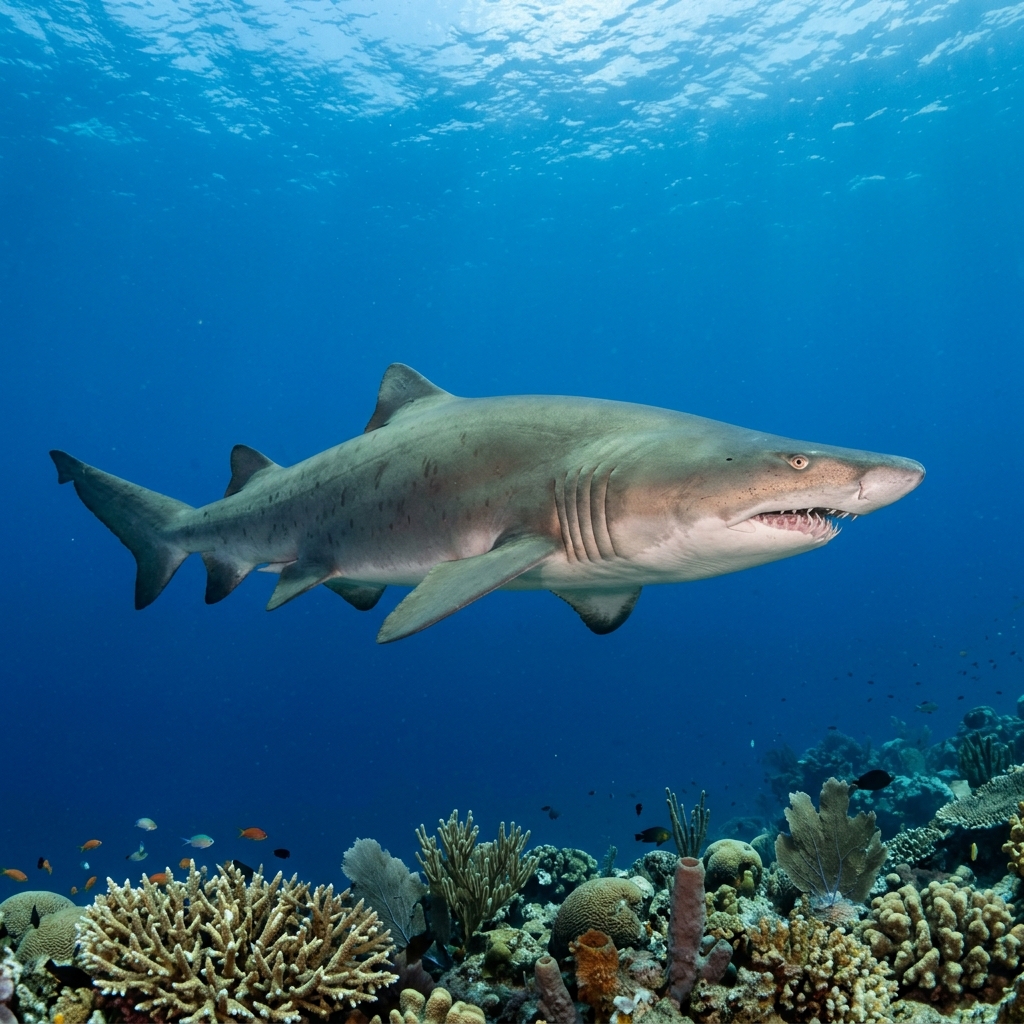
Flattened, ray-like body with broad pectoral fins that give it a wing shape, mottled grey-brown to sandy colouring that blends straight into the seabed, and a wide mouth at the front of a blunt head rather than underslung like a ray. Grows to around 128 cm, and divers almost always find it lying still, half or fully buried, with only the eyes and outline of the fins giving it away.
Expect to find it motionless on sand or fine sediment, often partly covered, ambushing prey that swims too close rather than actively hunting it down. It tends to hold still even as divers approach, relying on camouflage over flight, though it can bolt off the bottom in a sudden burst if it feels crowded. Most encounters happen on sandy patches near reef or seagrass edges rather than out on open rubble.
That ray-like body is deceptive: it's a true shark, distinguished from rays by gill slits on the side of the head rather than underneath, and by pectoral fins that are attached separately from the head rather than fused to it.
Sighting data doesn't show a clear seasonal pattern, so treat this as a year-round possibility wherever water sits in its comfortable 14 to 23C range. Mediterranean sites tend to fish out slightly warmer, calmer stretches, but there's no strong month-by-month signal to chase.
Most consistently logged in Greece, particularly the Saronic Gulf and Athens area and the Cyclades, with strong numbers also reported across Italy in Sicily and Sardinia. Turkey (notably Bodrum), Spain's Balearic Islands, Croatia's Northern Dalmatia and France's Bay of Biscay round out the main areas where divers report sightings.
Mapping where Angelshark is logged…
Greece is the strongest area, especially the Saronic Gulf, Athens region and Cyclades, with good numbers also reported in Sicily and Sardinia in Italy. Turkey's Bodrum coast, Spain's Balearic Islands, Croatia's Northern Dalmatia and France's Bay of Biscay are other reliable spots.
There's no strong seasonal pattern in the sighting data, so they're best treated as a year-round find within their 14 to 23C temperature range. Check local conditions rather than chasing a specific month.
They're not aggressive and rely on camouflage rather than confrontation, but a startled angelshark can bite quickly if stepped on or grabbed. Avoid putting hands or fins down on sandy bottoms where one might be buried.
Look for a flat, ray-shaped body around a metre long, sandy-grey mottled colouring, and broad pectoral fins spread flush with the seabed. Unlike a ray, its gill slits sit on the sides of the head, not underneath.
They typically reach around 128 cm in length, with a wide, flattened body that makes them look larger and heavier across the sand than that length suggests.
Despite the ray-like shape built for lying flat and ambushing prey, it's a real shark, told apart from true rays by side-set gill slits and pectoral fins that stay separate from the head.
Site and sighting data is aggregated from diver logs, iNaturalist and GBIF. For taxonomy and conservation status:
Tiger Shark
1,616 sites